


A Population-Based Matched-Sibling Analysis Estimating the Associations Between First Interpregnancy Interval and Birth Outcomes
- PMID: 30188970
- PMCID: PMC6321799
- DOI: 10.1093/aje/kwy188
A Population-Based Matched-Sibling Analysis Estimating the Associations Between First Interpregnancy Interval and Birth Outcomes
Abstract
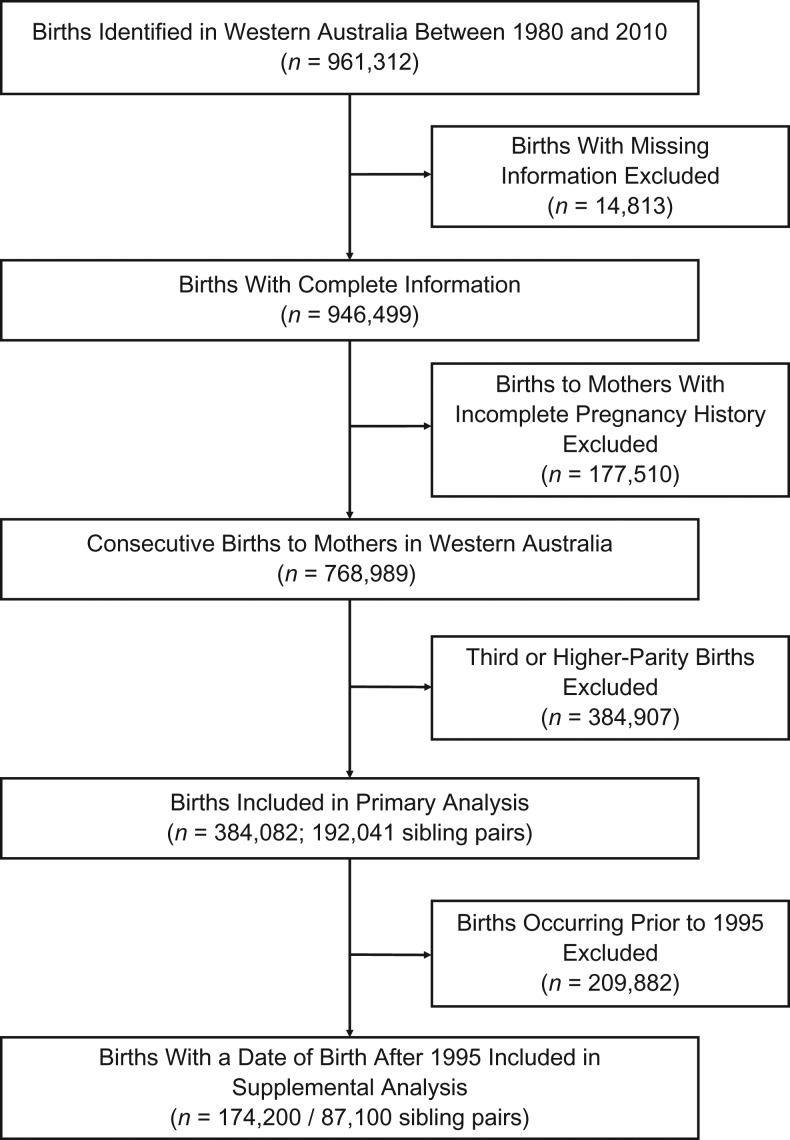
The association between a single interpregnancy interval (IPI) and birth outcomes has not yet been explored using matched methods. We modeled the odds of preterm birth, being small for gestational age, and having low birth weight in a second, live-born infant in a cohort of 192,041 sibling pairs born in Western Australia between 1980 and 2010. The association between IPI and birth outcomes was estimated from the interaction between birth order and IPI (with 18-23 months as the reference category), using conditional logistic regression. Matched analysis showed the odds of preterm birth were higher for siblings born following an IPI of <6 months (adjusted interaction odds ratio = 1.22, 95% confidence interval: 1.06, 1.38) compared with those born after an IPI of 18-23 months. There were no significant differences for IPIs of <6 months for other outcomes (small for gestational age or low birth weight). This is the first study to use matched analyses to investigate the association between a single IPI on birth outcomes. IPIs of <6 months were associated with increased odds of preterm birth in second-born infants, although the association is likely smaller than previously estimated by unmatched studies.
Figures
Comment in
-
Invited Commentary: Promise and Pitfalls of the Sibling Comparison Design in Studies of Optimal Birth Spacing.Am J Epidemiol. 2019 Jan 1;188(1):17-21. doi: 10.1093/aje/kwy195. Am J Epidemiol. 2019. PMID: 30188975
-
Regan et al. Reply to "Sibling Comparison Design in Birth-Spacing Studies".Am J Epidemiol. 2019 Jan 1;188(1):22-23. doi: 10.1093/aje/kwy187. Am J Epidemiol. 2019. PMID: 30188997 Free PMC article. No abstract available.
References
-
- Liu L, Oza S, Hogan D, et al. Global, regional, and national causes of child mortality in 2000–13, with projections to inform post-2015 priorities: an updated systematic analysis. Lancet. 2015;385(9966):430–440. - PubMed
-
- Merklinger-Gruchala A, Jasienska G, Kapiszewska M. Short interpregnancy interval and low birth weight: a role of parity. Am J Hum Biol. 2015;27(5):660–666. - PubMed
-
- Shachar BZ, Mayo JA, Lyell DJ, et al. Interpregnancy interval after live birth or pregnancy termination and estimated risk of preterm birth: a retrospective cohort study. BJOG. 2016;123(12):2009–2017. - PubMed
-
- Ekin A, Gezer C, Taner CE, et al. Impact of interpregnancy interval on the subsequent risk of adverse perinatal outcomes. J Obstet Gynaecol Res. 2015;41(11):1744–1751. - PubMed
Publication types
MeSH terms
Grants and funding
LinkOut - more resources
Full Text Sources
Other Literature Sources
