


Diagnostics for Pleiotropy in Mendelian Randomization Studies: Global and Individual Tests for Direct Effects
- PMID: 30188971
- PMCID: PMC6269243
- DOI: 10.1093/aje/kwy177
Diagnostics for Pleiotropy in Mendelian Randomization Studies: Global and Individual Tests for Direct Effects
Abstract
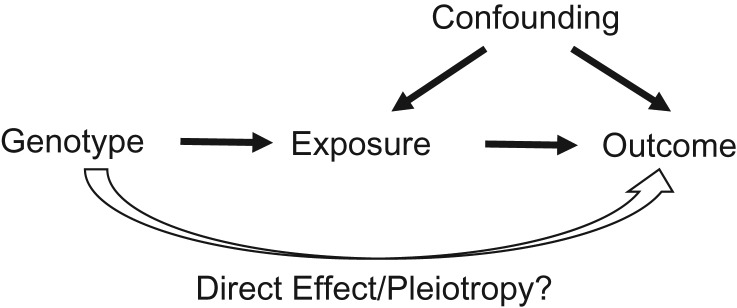
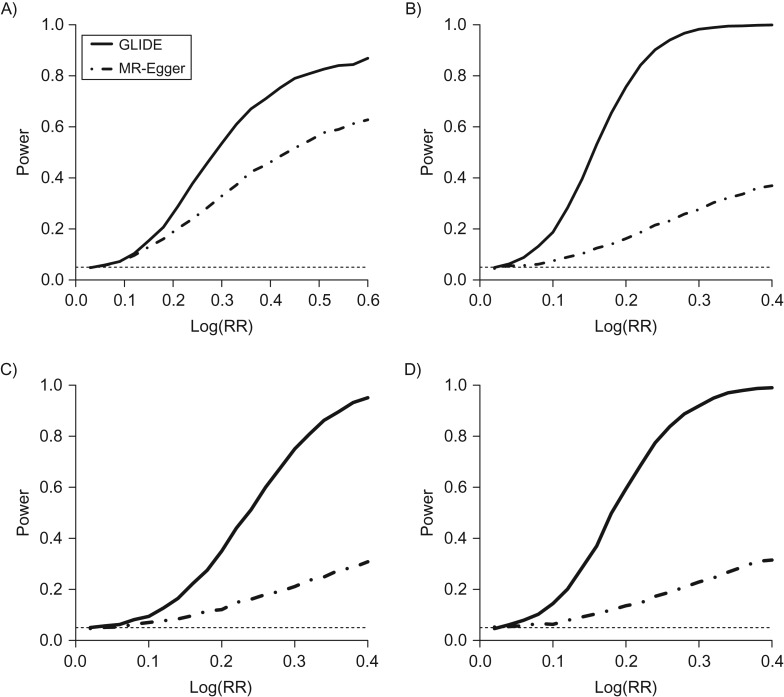
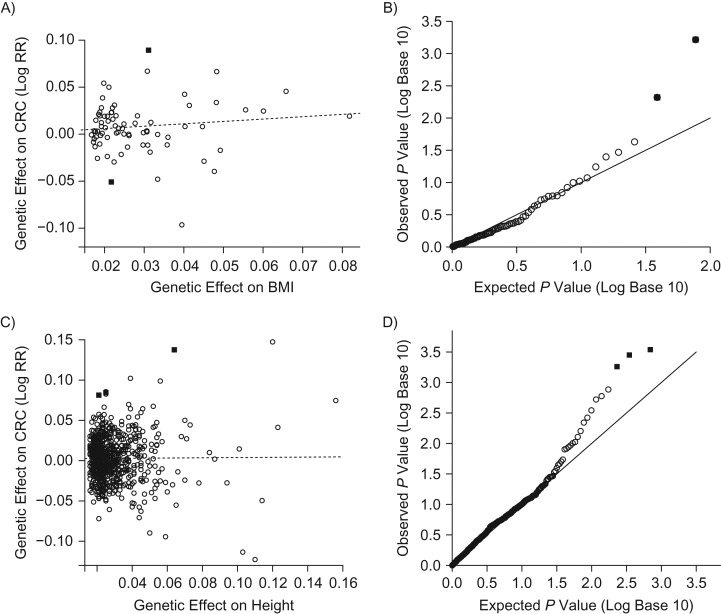
Diagnosing pleiotropy is critical for assessing the validity of Mendelian randomization (MR) analyses. The popular MR-Egger method evaluates whether there is evidence of bias-generating pleiotropy among a set of candidate genetic instrumental variables. In this article, we propose a statistical method-global and individual tests for direct effects (GLIDE)-for systematically evaluating pleiotropy among the set of genetic variants (e.g., single nucleotide polymorphisms (SNPs)) used for MR. As a global test, simulation experiments suggest that GLIDE is nearly uniformly more powerful than the MR-Egger method. As a sensitivity analysis, GLIDE is capable of detecting outliers in individual variant-level pleiotropy, in order to obtain a refined set of genetic instrumental variables. We used GLIDE to analyze both body mass index and height for associations with colorectal cancer risk in data from the Genetics and Epidemiology of Colorectal Cancer Consortium and the Colon Cancer Family Registry (multiple studies). Among the body mass index-associated SNPs and the height-associated SNPs, several individual variants showed evidence of pleiotropy. Removal of these potentially pleiotropic SNPs resulted in attenuation of respective estimates of the causal effects. In summary, the proposed GLIDE method is useful for sensitivity analyses and improves the validity of MR.
Figures
Comment in
-
Invited Commentary: Detecting Individual and Global Horizontal Pleiotropy in Mendelian Randomization-A Job for the Humble Heterogeneity Statistic?Am J Epidemiol. 2018 Dec 1;187(12):2681-2685. doi: 10.1093/aje/kwy185. Am J Epidemiol. 2018. PMID: 30188969 Free PMC article.
References
-
- Katan MB. Apolipoprotein E isoforms, serum cholesterol, and cancer. Lancet. 1986;1(8479):507–508. - PubMed
-
- Smith GD, Ebrahim S. ‘Mendelian randomization’: can genetic epidemiology contribute to understanding environmental determinants of disease? Int J Epidemiol. 2003;32(1):1–22. - PubMed
-
- Thomas DC, Conti DV. Commentary: the concept of ‘Mendelian randomization’. Int J Epidemiol. 2004;33(1):21–25. - PubMed
-
- Didelez V, Sheehan N. Mendelian randomisation as an instrumental variable approach to causal inference. Stat Methods Med Res. 2007;16(4):309–330. - PubMed
-
- Nitsch D, Molokhia M, Smeeth L, et al. Limits to causal inference based on Mendelian randomization: a comparison with randomized controlled trials. Am J Epidemiol. 2006;163(5):397–403. - PubMed
Publication types
MeSH terms
Grants and funding
- MC_UU_00011/2/MRC_/Medical Research Council/United Kingdom
- P01 CA053996/CA/NCI NIH HHS/United States
- U01 CA074794/CA/NCI NIH HHS/United States
- U01 CA167551/CA/NCI NIH HHS/United States
- R00 CA215314/CA/NCI NIH HHS/United States
- S10 OD020069/OD/NIH HHS/United States
- R01 CA222833/CA/NCI NIH HHS/United States
- U01 CA137088/CA/NCI NIH HHS/United States
- MC_UU_00011/1/MRC_/Medical Research Council/United Kingdom
- U24 CA074794/CA/NCI NIH HHS/United States
- R01 CA189532/CA/NCI NIH HHS/United States
- R01 HL114901/HL/NHLBI NIH HHS/United States
LinkOut - more resources
Full Text Sources
Other Literature Sources
Research Materials
