


Constituent analysis of iodine intake in Armenia
- PMID: 30189914
- PMCID: PMC10261023
- DOI: 10.1017/S1368980018002197
Constituent analysis of iodine intake in Armenia
Abstract
Objective: We sought to assess the universal salt iodization (USI) strategy in Armenia by characterizing dietary iodine intake from naturally occurring iodine, salt-derived iodine in processed foods and salt-derived iodine in household-prepared foods.
Design: Using a cross-sectional cluster survey model, we collected urine samples which were analysed for iodine and sodium concentrations (UIC and UNaC) and household salt samples which were analysed for iodine concentration (SI). SI and UNaC data were used as explanatory variables in multiple linear regression analyses with UIC as dependent variable, and the regression parameters were used to estimate the iodine intake sources attributable to native iodine and iodine from salt in processed foods and household salt.
Setting: Armenia is naturally iodine deficient; in 2004, the government mandated a USI strategy.
Subjects: We recruited school-age children (SAC), pregnant women (PW) and non-pregnant women of reproductive age (WRA).
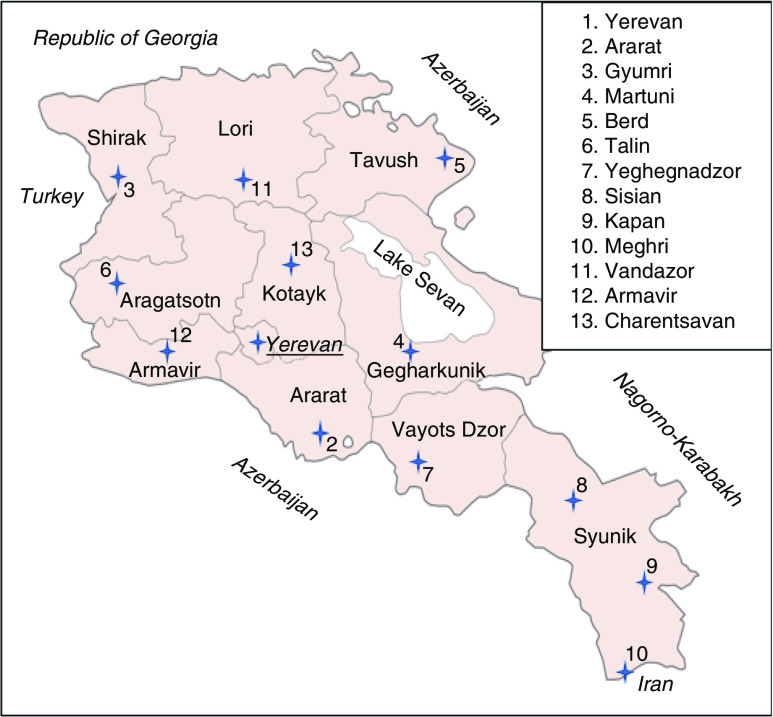
Results: From thirteen sites covering all provinces, sufficient urine and table salt samples were obtained from 312 SAC, 311 PW and 332 WRA. Findings revealed significant differences between groups: contribution of native iodine ranged from 81% in PW to 46% in SAC, while household salt-derived iodine contributed from 19% in SAC to 1% in PW.
Conclusions: Differences between groups may reflect differences in diet. In all groups, household and processed food salt constituted a significant part of total iodine intake, highlighting the success and importance of USI in ensuring iodine sufficiency. There appears to be leeway to reduce salt intake without adversely affecting the iodine status of the population in Armenia.
Keywords: Armenia; Iodine nutrition; Population iodine intake apportionment; Universal salt iodization.
Figures

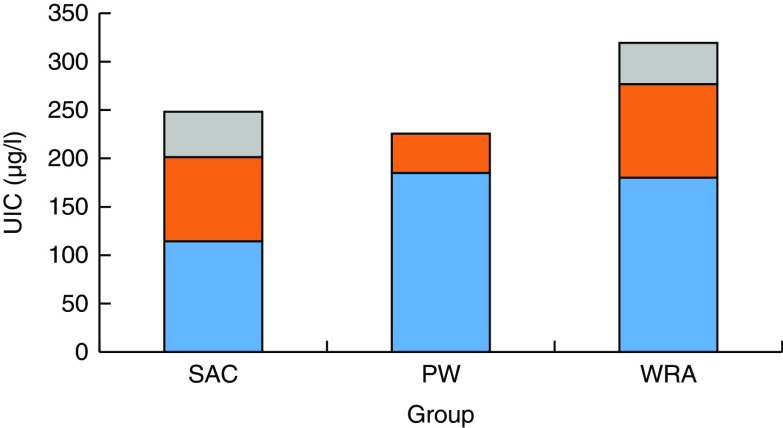
 , iodine from table salt;
  , iodine from salt used in processed foods;
  , native iodine) of urinary iodine concentration (UIC) according to population group (SAC, school-age children; PW, pregnant women; WRA, non-pregnant women of reproductive age) Armenia, September–November 2016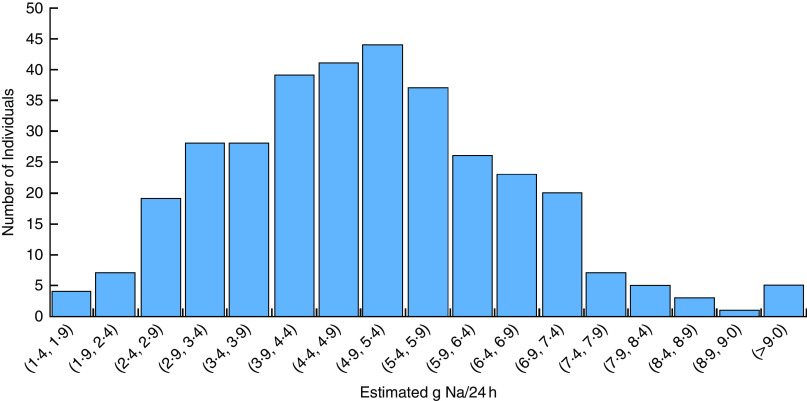
References
-
- Jameson J, Mandel S & Weetman A (2012) Disorders of the thyroid gland. In Harrison’s Principles of Internal Medicine, 18th ed., chapter 341 [D Kasper, A Fauci, S Hauser et al., editors]. New York: McGraw-Hill. http://accessmedicine.mhmedical.com/content.aspx?bookid=1130§ionid=7... (accessed March 2018).
-
- World Health Organization (2007) Assessment of Iodine Deficiency Disorders and Monitoring their Elimination: A Guide for Programme Managers, 3rd ed. Geneva: WHO.
-
- Ghazarian HG (1979) On peculiarities of thyroid gland in inhabitants of three different areas of the Armenian SSR. J Exp Clin Med XIX, 115–122.
-
- Karamian RK (1981) On the state of the thyroid glands in inhabitants of Zangezour regions of the Armenian SSR. J Exp Clin Med XXI, 74–77.
Publication types
MeSH terms
Substances
LinkOut - more resources
Full Text Sources
Other Literature Sources
Medical
