. 2018 Sep 6;8(1):13333.
doi: 10.1038/s41598-018-31215-w.

Comparative metabolism of xenobiotic chemicals by cytochrome P450s in the nematode Caenorhabditis elegans

Affiliations

Comparative metabolism of xenobiotic chemicals by cytochrome P450s in the nematode Caenorhabditis elegans

Philippa H Harlow et al. Sci Rep. .

Abstract

We investigated the metabolic capabilities of C. elegans using compounds whose metabolism has been well characterised in mammalian systems. We find that similar metabolites are produced in C. elegans as in mammals but that C. elegans is deficient in CYP1-like metabolism, as has been seen in other studies. We show that CYP-34A9, CYP-34A10 and CYP-36A1 are the principal enzymes responsible for the metabolism of tolbutamide in C. elegans. These are related to the mammalian enzymes that metabolise this compound but are not the closest homologs suggesting that sequence comparison alone will not predict functional conservation among cytochrome P450s. In mammals, metabolite production from amytryptiline and dextromethorphan is dependent on specific cytochrome P450s. However, in C. elegans we did not find evidence of similar specificity: the same metabolites were produced but in small amounts by numerous cytochrome P450s. We conclude that, while some aspects of cytochrome P450 mediated metabolism in C. elegans are similar to mammals, there are differences in the production of some metabolites and in the underlying genetics of metabolism.


Conflict of interest statement

P.H.H., S.J.P., A.S., and A.J.F., are employees of Syngenta. The work was funded by Syngenta.

Figures

Figure 1
Figure 1
RNAi knockdown of specific cytochrome P450 genes affects the hydroxylation of tolbutamide. Hydroxytolbutamide produced (ng/ml) in the supernatant in response to certain treatment conditions. Error bars show standard error. (n = 3). (A) Data in red show N2 (wild type control) compared to emb-8 (hc69), a temperature sensitive strain which was exposed to emb-8 RNAi and shifted to the restrictive temperature four days before testing. emb-8 encodes the C. elegans cytochrome P450 reductase; under these conditions the mutant strain does not have any detectable NADPH-cytochrome c reductase activity. The emb-8 animals showed reduced hydroxytolbutamide production (t-test: p = 0.02). Data in blue are a separate experiment showing RNAi knockdown of groups of P450 genes. In this experiment N2 grew faster than anticipated and starved before measurement so metabolism is likely underestimated, indeed N2 versus the cyp-34A9, cyp-34A10 and cyp-36A1 group shows no significant difference (Tukey’s multiple comparisons test: p = 0.9998). However, the reduction of metabolism in this RNAi group is substantial compared to other RNAi treatments (e.g. versus the cyp-25A1-2 group (Tukey’s multiple comparisons test: p = 0.0474) and so, given the starved N2 control, we chose to study this group in a further experiment – see panel B, this figure. (B) Simultaneous RNAi knockdown of cyp-34A9, cyp-34A10 and cyp-36A1as a group, RNAi of the same genes individually and N2. In this experiment the assay was modified to ensure no animals starved – see Methods. Compared to N2, all treatments showed significantly reduced metabolite production (Tukey’s multiple comparisons test: p < 0.0001 for all treatments compared to N2). The effects of RNAi of cyp-34A10 alone was also significantly different to cyp-34A9 or cyp-36A1 alone. (Tukey’s multiple comparisons test: cyp-34A9 vs cyp-34A10 p = 0.0008, cyp-34A10 vs cyp-36A1 p = 0.0095).
Figure 2
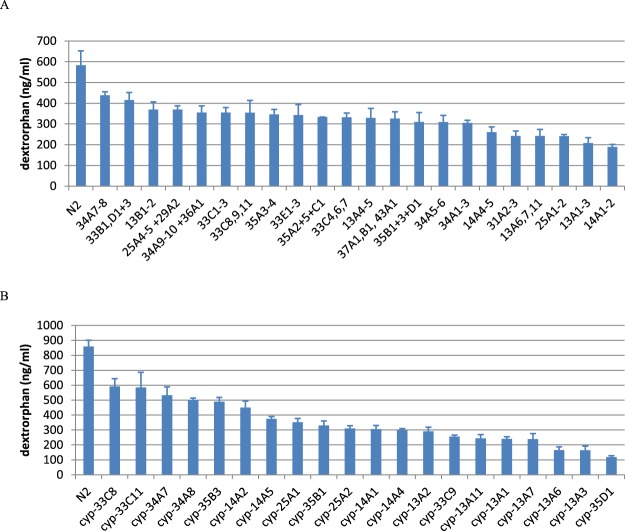
Figure 2
RNAi knockdown of cytochrome P450 genes affects the metabolism of dextromethorphan. Dextrorphan recovered (ng/ml) in the supernatant. Error bars show standard error (n = 3). (A) P450s knocked down in small groups. (B) P450s knocked down individually.
Figure 3
Figure 3
RNAi knockdown of cytochrome P450 genes affects the metabolism of amitriptyline. Nortriptyline produced (ng/ml) in the supernatant. Error bars show standard error (n = 3). (A) P450s knocked down in small groups. (B) P450s knocked down individually.

References

    1. Keller J, et al. CYP-13A12 of the nematode Caenorhabditis elegans is a PUFA-epoxygenase involved in behavioural response to reoxygenation. Biochem J. 2014;464:61–71. doi: 10.1042/BJ20140848. - DOI - PubMed
    1. Kosel M, et al. Eicosanoid formation by a cytochrome P450 isoform expressed in the pharynx of Caenorhabditis elegans. Biochem J. 2011;435:689–700. doi: 10.1042/BJ20101942. - DOI - PubMed
    1. Kulas J, Schmidt C, Rothe M, Schunck WH, Menzel R. Cytochrome P450-dependent metabolism of eicosapentaenoic acid in the nematode Caenorhabditis elegans. Arch Biochem Biophys. 2008;472:65–75. doi: 10.1016/j.abb.2008.02.002. - DOI - PubMed
    1. Lindblom TH, Dodd AK. Xenobiotic detoxification in the nematode Caenorhabditis elegans. J Exp Zool A Comp Exp Biol. 2006;305:720–730. doi: 10.1002/jez.a.324. - DOI - PMC - PubMed
    1. Guengerich FP. Cytochrome P450 and Chemical Toxicology. Chemical Research in Toxicology. 2007;21:70–83. doi: 10.1021/tx700079z. - DOI - PubMed

Publication types

MeSH terms

Substances

LinkOut - more resources