. 2018 Aug 23:9:1178.
doi: 10.3389/fphys.2018.01178. eCollection 2018.

Systematic Analysis of Mouse Genome Reveals Distinct Evolutionary and Functional Properties Among Circadian and Ultradian Genes

Affiliations

Systematic Analysis of Mouse Genome Reveals Distinct Evolutionary and Functional Properties Among Circadian and Ultradian Genes

Stefano Castellana et al. Front Physiol. .

Abstract

In living organisms, biological clocks regulate 24 h (circadian) molecular, physiological, and behavioral rhythms to maintain homeostasis and synchrony with predictable environmental changes, in particular with those induced by Earth's rotation on its axis. Harmonics of these circadian rhythms having periods of 8 and 12 h (ultradian) have been documented in several species. In mouse liver, harmonics of the 24-h period of gene transcription hallmarked genes oscillating with a frequency two or three times faster than circadian periodicity. Many of these harmonic transcripts enriched pathways regulating responses to environmental stress and coinciding preferentially with subjective dawn and dusk. At this time, the evolutionary history of genes with rhythmic expression is still poorly known and the role of length-of-day changes due to Earth's rotation speed decrease over the last four billion years is totally ignored. We hypothesized that ultradian and stress anticipatory genes would be more evolutionarily conserved than circadian genes and background non-oscillating genes. To investigate this issue, we performed broad computational analyses of genes/proteins oscillating at different frequency ranges across several species and showed that ultradian genes/proteins, especially those oscillating with a 12-h periodicity, are more likely to be of ancient origin and essential in mice. In summary, our results show that genes with ultradian transcriptional patterns are more likely to be phylogenetically conserved and associated with the primeval and inevitable dawn/dusk transitions.

Keywords: circadian; clock; evolution; gene; rhythmicity; ultradian.


Figures
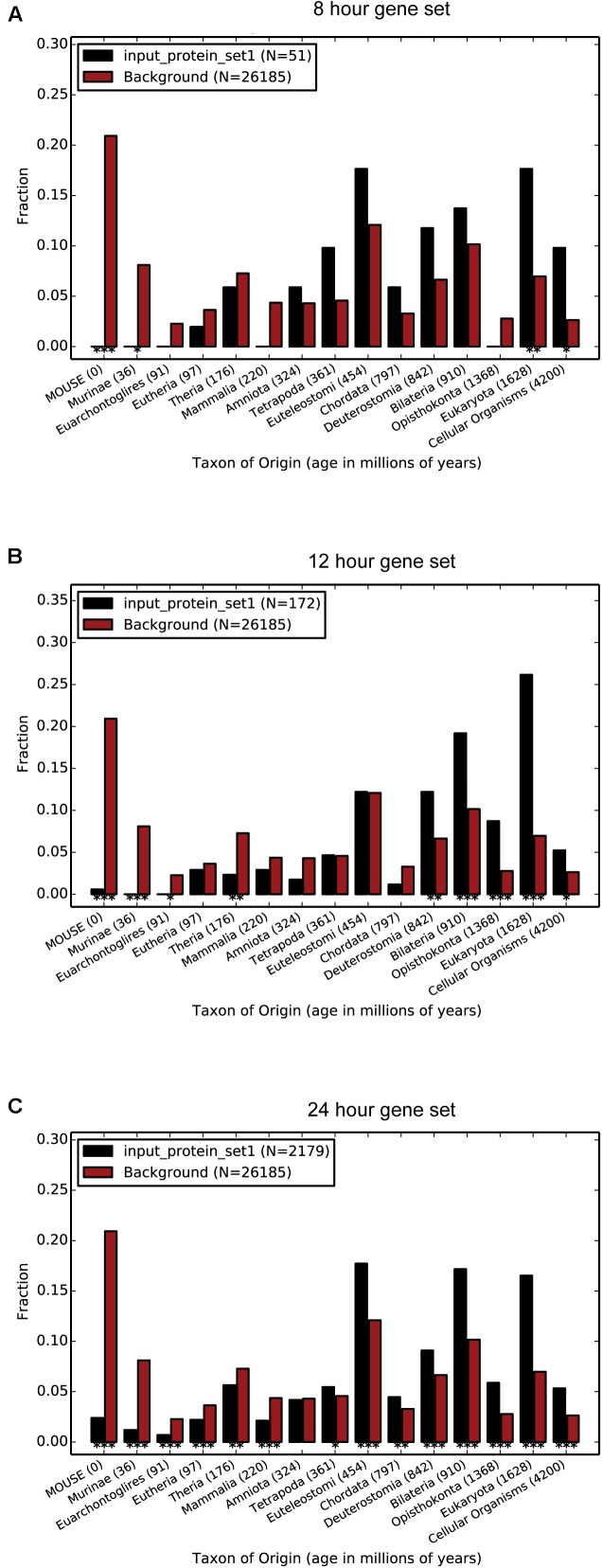
FIGURE 1
FIGURE 1
The evolutionary age of the oscillating gene subsets differs significantly. The 12 h oscillating gene subset shows the highest average age. The 8 h (A) oscillating gene subset has an average age of 1117 million years, the 12 h; (B) oscillating gene subset has an average age of 1143 million years and the 24 h; (C) oscillating gene subset has an average age of 973 million years. All the three subsets are significantly older than the genomic background, having an average age of 553 million years. Since the gene subsets are derived from experiments performed with modern mice, the age of the mouse has been set to 0 million years on the x-axis. The remaining ages refer to the emergence of the corresponding branches of the Tree of Life. Data for the computed evolutionary age of the oscillating gene subsets were gathered by the Protein Historian tool.
FIGURE 2
FIGURE 2
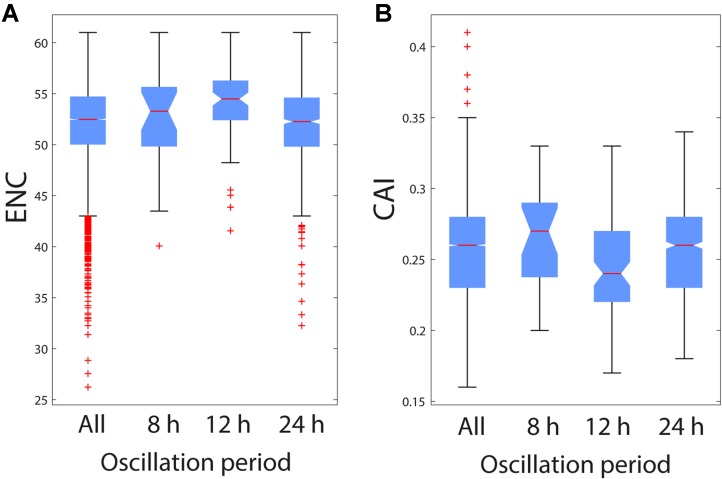
Effective Number of Codons (ENC) and Codon Adaptation Index (CAI) in the three oscillating gene subsets and the global mouse transcriptome. (A) Box plots of ENC values calculated for all selected mouse transcript sequences (All) and the three oscillating gene subsets (8, 12, and 24 h). Selection was carried out according to the GC content (see section “Materials and Methods” for details). (B) Box plots of CAI values calculated for all selected mouse transcript sequences and the three oscillating gene subsets for all selected mouse transcript sequences (All) and the three oscillating gene subsets (8, 12, and 24 h). Selection was carried out according to the GC content (see section “Materials and Methods” for details).
FIGURE 3
FIGURE 3
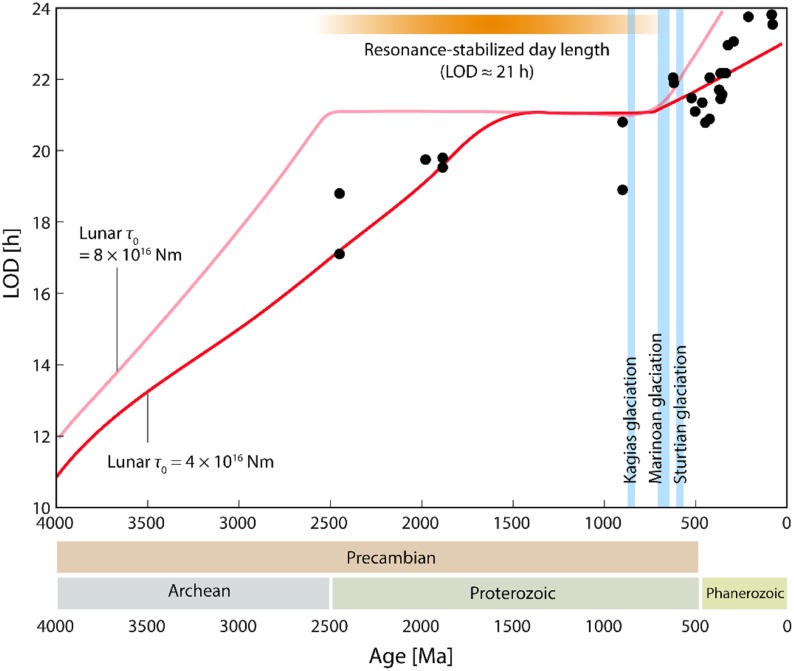
Changes of LOD over a period of 4000 million years (Ma). Black dots represent empirically determined LOD values based given by Williams. The two red functions represent different predictions of the long-term LOD changes by Bartlett and Stevenson based on varying choices of τ0, the lunar torque. Only the prediction based on the upper and lower range of τ0 values used for the simulation are shown for clarity.

References

    1. Amm I., Sommer T., Wolf D. H. (2014). Protein quality control and elimination of protein waste: the role of the ubiquitin-proteasome system. Biochim. Biophys. Acta 1843 182–196. 10.1016/j.bbamcr.2013.06.031 - DOI - PubMed
    1. Bailey T. L., Boden M., Buske F. A., Frith M., Grant C. E., Clementi L., et al. (2009). MEME SUITE: tools for motif discovery and searching. Nucleic Acids Res. 37 W202–W208. 10.1093/nar/gkp335 - DOI - PMC - PubMed
    1. Barter P. J., Nicholls S., Rye K. A., Anantharamaiah G. M., Navab M., Fogelman A. M. (2004). Antiinflammatory properties of HDL. Circ. Res. 95 764–772. 10.1161/01.RES.0000146094.59640.13 - DOI - PubMed
    1. Bartlett B. C., Stevenson D. J. (2016). Analysis of a Precambrian resonance-stabilized day length,Geophys. Res. Lett. 43 5716–5724. 10.1002/2016GL068912 - DOI
    1. Behura S. K., Severson D. W. (2013). Codon usage bias: causative factors, quantification methods and genome-wide patterns: with emphasis on insect genomes. Biol. Rev. Camb. Philos. Soc. 88 49–61. 10.1111/j.1469-185X.2012.00242.x - DOI - PubMed

LinkOut - more resources