. 2018 Oct 1;7(10):giy107.
doi: 10.1093/gigascience/giy107.

The metagenome of the female upper reproductive tract

Affiliations

The metagenome of the female upper reproductive tract

Fei Li et al. Gigascience. .

Abstract

Background: The human uterus is traditionally believed to be sterile, while the vaginal microbiota plays an important role in fending off pathogens. Emerging evidence demonstrates the presence of bacteria beyond the vagina. However, a microbiome-wide metagenomic analysis characterizing the diverse microbial communities has been lacking.

Results: We performed shotgun-sequencing of 52 samples from the cervical canal and the peritoneal fluid of Chinese women of reproductive age using the Illumina platform. Direct annotation of sequencing reads identified the taxonomy of bacteria, archaea, fungi and viruses, confirming and extending the results from our previous study. We replicated our previous findings in another 24 samples from the vagina, the cervical canal, the uterus and the peritoneal fluid using the BGISEQ-500 platform revealing that microorganisms in the samples from the same individuals were largely shared in the entire reproductive tract. Human sequences made up more than 99% of the 20GB raw data. After filtering, vaginal microorganisms were well covered in the generated reproductive tract gene catalogue, while the more diverse upper reproductive tract microbiota would require greater depth of sequencing and more samples to meet the full coverage scale.

Conclusions: We provide novel detailed data on the microbial composition of a largely unchartered body site, the female reproductive tract. Our results indicated the presence of an intra-individual continuum of microorganisms that gradually changed from the vagina to the peritoneal fluid. This study also provides a framework for understanding the implications of the composition and functional potential of the distinct microbial ecosystems of the female reproductive tract in relation to health and disease.


Figures
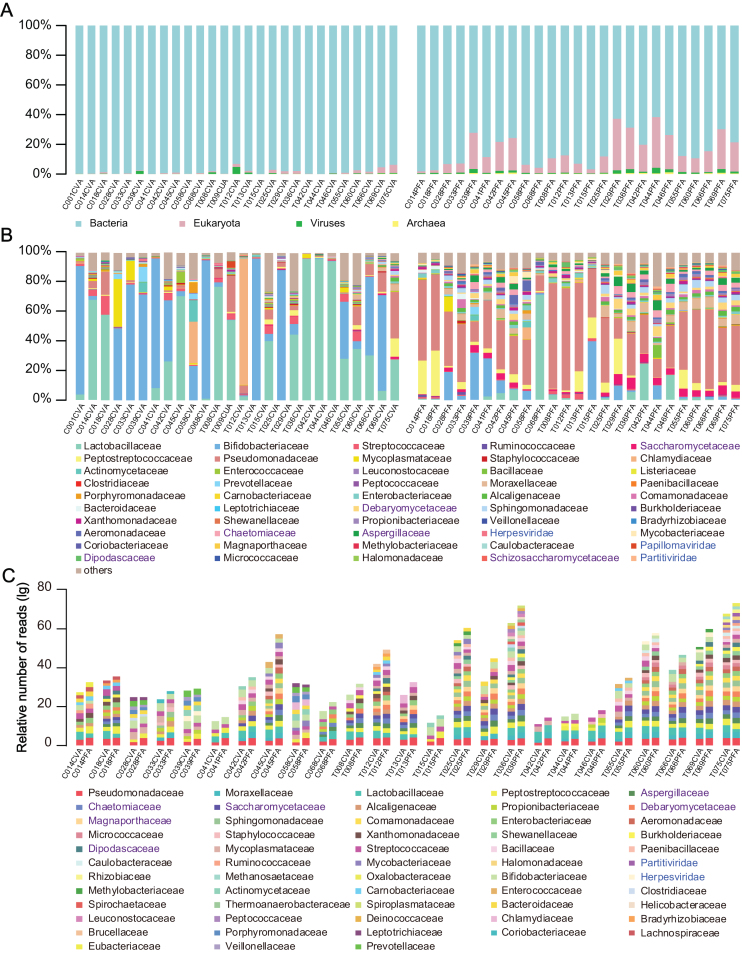
Figure 1:
Figure 1:
The overall microbiome composition of the cervical canal and the peritoneal fluid of reproductive-age women. Cumulative bar charts of the main taxa at domain (A) and family (B) levels in CV and PF samples. (C) Compositional overlap at the family level of CV and PF samples from the same individuals. Relative number of reads was calculated as formula image, where formula image is the number of reads within formula image taxa in formula image sample, formula image is the total number of reads within formula image sample, and m is the median number of reads within all 50 samples. When formula image taxa is shared by CV and PF samples from the same individuals and at the same time, both formula image values are higher than 0.1%formula image, the formula image taxa is included in the cumulative bar charts. Taxa names (B, C ) in black, purple, and blue denote bacteria, eukaryotes, and viruses, respectively.
Figure 2:
Figure 2:
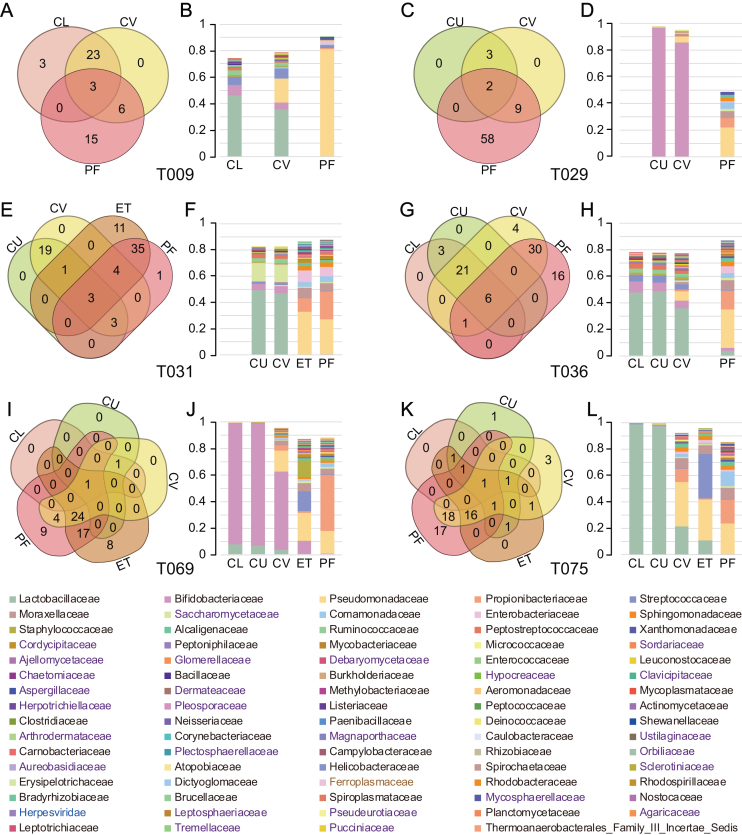
Composition of the vagino-uterine microbiota. (A, C, E, G, I, K) Venn diagrams depicting shared taxa at the family level in samples collected at different sites in the same individual. (B, D, F, H, K, L) Cumulative bar charts of the taxa with relative abundance higher than 0.1% and present in at least two sites of the same individual. Taxa names (B, C) in black, purple, blue, and gray denote bacteria, eukaryotes, viruses, and archaea, respectively.
Figure 3:
Figure 3:
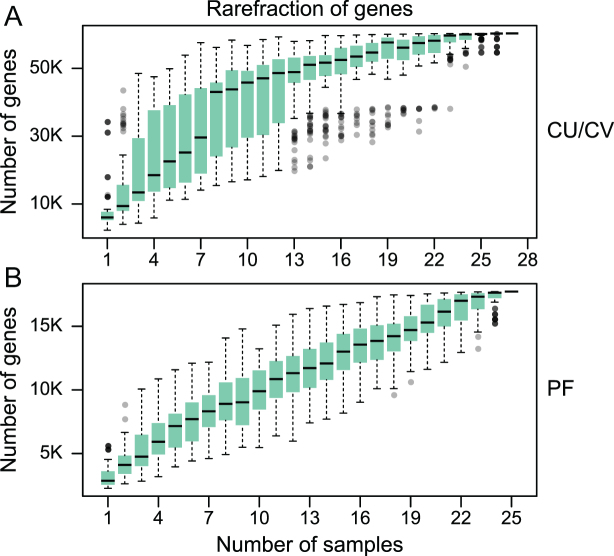
Rarefaction of microbial gene content in CV (A) and PF (B) samples. The number of genes in each group was calculated after 100 random samplings with replacement. Boxes denote the interquartile range (IQR) between the first and third quartiles (25th and 75th percentiles, respectively), and the line inside denotes the median. Whiskers denote the lowest and highest values within 1.5 times IQR from the first and third quartiles, respectively. Circles denote outliers beyond the whiskers.
Figure 4:
Figure 4:
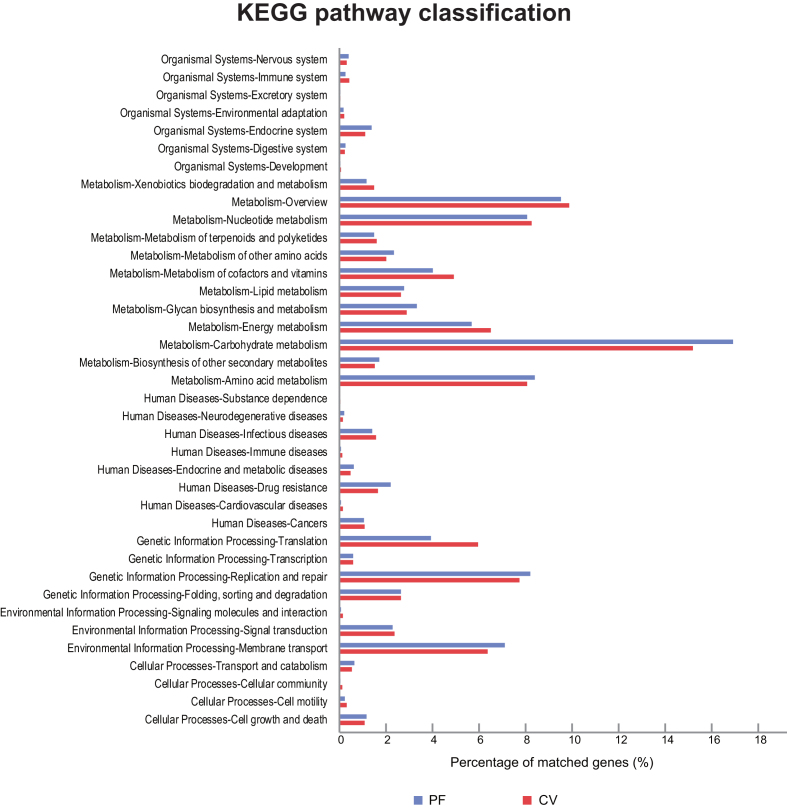
KEGG pathway classification of the vagino-uterine microbiome. Comparison of CV (red) and PF (blue) data based on KEGG annotation, which emphasizes functional similarity of the CV and PF microbiota.

References

    1. Funkhouser LJ, Bordenstein SR. Mom knows best: the universality of maternal microbial transmission. PLoS Biol. 2013;11:e1001631. - PMC - PubMed
    1. Aagaard K, Ma J, Antony KM, et al. . The placenta harbors a unique microbiome. Sci Transl Med. 2014;6:237ra65. - PMC - PubMed
    1. Antony KM, Ma J, Mitchell KB et al. . The preterm placental microbiome varies in association with excess maternal gestational weight gain. Am J Obs Gynecol. 2014;212:653.e1–653.e16. - PMC - PubMed
    1. Chen C, Song X, Wei W, et al. . The microbiota continuum along the female reproductive tract and its relation to uterine-related diseases. Nat Commun. 2017;8(1):875. - PMC - PubMed
    1. Ravel J, Gajer P, Abdo Z, et al. . Vaginal microbiome of reproductive-age women. Proc Natl Acad Sci. 2010;108:4680–7. - PMC - PubMed

Publication types

LinkOut - more resources