Review
. 2018:140:201-247.
doi: 10.1016/bs.irn.2018.07.007. Epub 2018 Aug 14.

Oxytocin and Rodent Models of Addiction

Affiliations
Review

Oxytocin and Rodent Models of Addiction

Kah-Chung Leong et al. Int Rev Neurobiol. 2018.

Abstract

Interest for the use of oxytocin as a treatment for addiction began over 40years ago. Better known for its roles in parturition, lactation and pair bonding, oxytocin also has anxiolytic properties, reduces immune and inflammatory responses, and has a role in learning and memory. In this chapter, oxytocin effects on addiction processes are described by highlighting research findings that have used oxytocin within current preclinical animal models of addiction, relapse, or craving. First, we provide a brief background of the endogenous oxytocin system followed by descriptions of the behavioral models used to study addiction, including models of drug taking and seeking. Then we review recent preclinical studies that have used oxytocin as a therapeutic intervention throughout multiple stages of the addiction cycle from a behavioral and neurobiological perspective. These models encompass the entire range of the addiction cycle including acquisition and maintenance of drug taking, withdrawal and craving during periods of drug abstinence, and ultimately relapse. We then posit several theories about how oxytocin interacts with both drug and social reward, as well as presenting a mechanistic account of how specific oxytocin receptor localization may contribute to oxytocin's efficacy as an addiction therapeutic.

Keywords: Addiction; Alcohol; Opioids; Oxytocin; Relapse; Self-administration; Social reward; Stimulants.


Figures

Fig. 1
Fig. 1
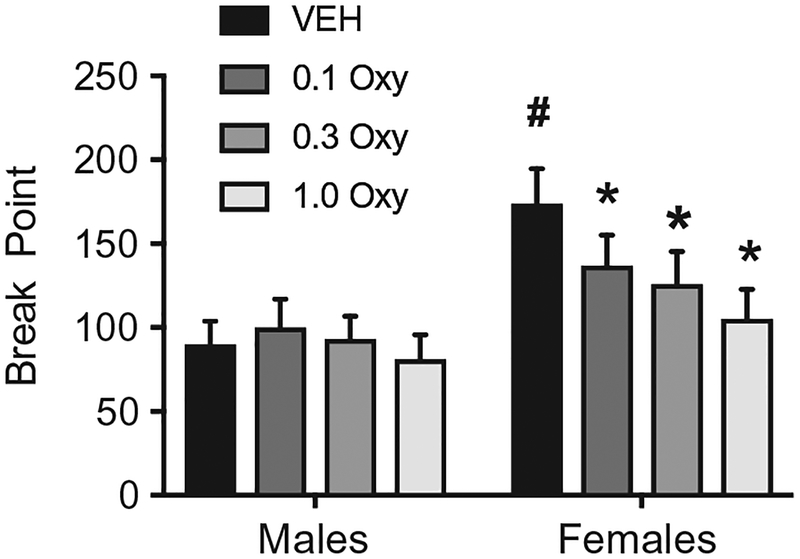
Oxytocin decreased the breakpoint for cocaine self-administration in female rats. # Females significantly greater than males. *Significantly reduced relative to vehicle-treated animals of the same sex vehicle.
Fig. 2
Fig. 2
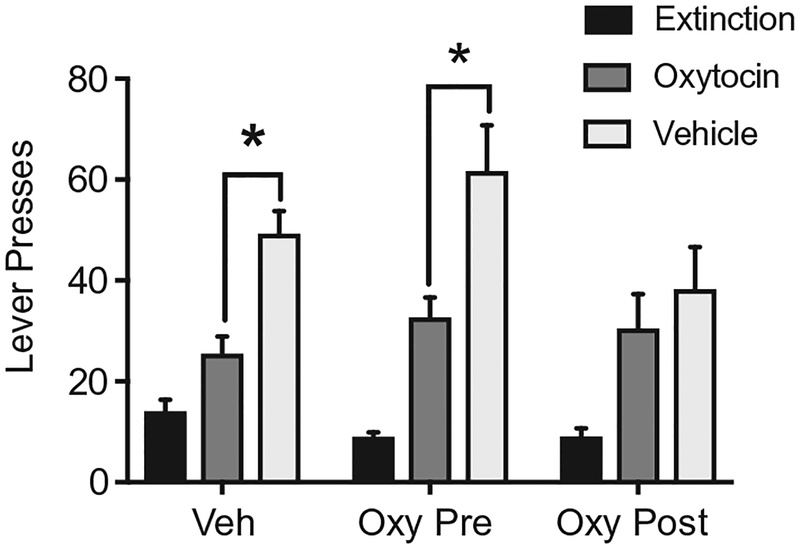
Daily oxytocin administered following extinction sessions deceased cue-induced reinstatement of cocaine seeking. Vehicle-treated animals received daily saline injections, Oxy Pre animals received oxytocin (1 mg/kg) before the extinction session and Oxy Post animals had oxytocin after the session. On test days rats were injected with vehicle or oxytocin. *Significant difference between oxytocin and vehicle treatments.
Fig. 3
Fig. 3
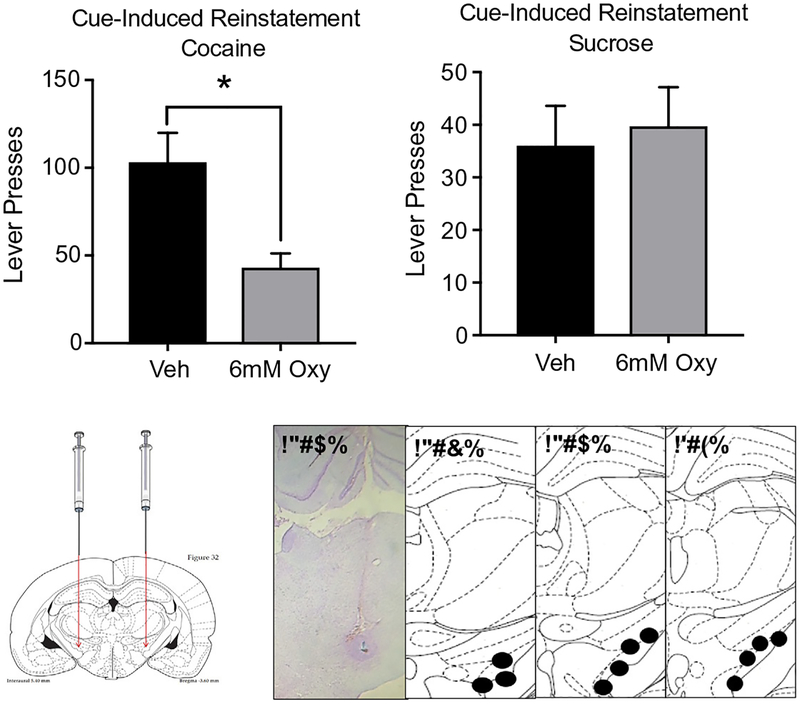
Oxytocin infused into the STN deceased cued-induced reinstatement of cocaine but not sucrose seeking. Vehicle or oxytocin was infused into the STN before reinstatement testing. Images depict the terminal point of the injectors used to infuse compounds, with numbers next to brain sections detailing the distance in mm to Bregma. *Significantly decreased compared to vehicle.
Fig. 4
Fig. 4
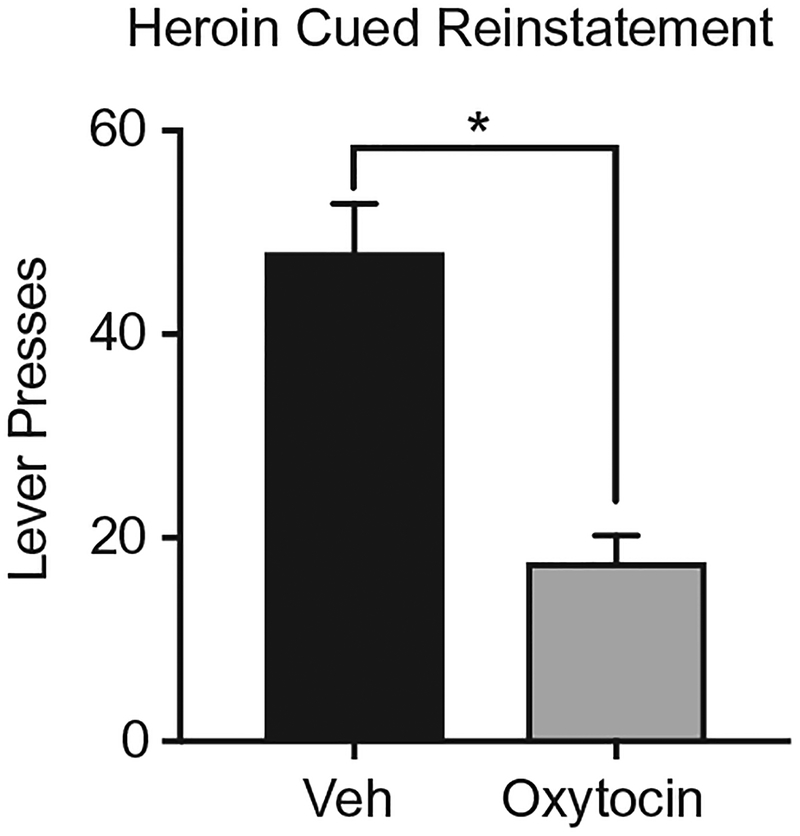
Oxytocin decreased cued reinstatement of heroin seeking. *Significant difference between vehicle and oxytocin treatments.

References

    1. Amico JA, Mantella RC, Vollmer RR, & Li X (2004). Anxiety and stress responses in female oxytocin deficient mice. Journal of Neuroendocrinology, 16(4), 319–324. 10.1111/j.0953-8194.2004.01161.x. - DOI - PubMed
    1. Bahi A (2015). The oxytocin receptor impairs ethanol reward in mice. Physiology & Behavior,139, 321–327. 10.1016/j.physbeh.2014.11.046. - DOI - PubMed
    1. Bahi A, Al Mansouri S, & Al Maamari E (2016). Nucleus accumbens lentiviral-mediated gain of function of the oxytocin receptor regulates anxiety- and ethanol-related behaviors in adult mice. Physiology & Behavior, 164(Pt. A), 249–258. 10.1016/j.physbeh.2016.06.009. - DOI - PubMed
    1. Baracz SJ, & Cornish JL (2016). The neurocircuitry involved in oxytocin modulation of methamphetamine addiction. Frontiers in Neuroendocrinology, 43, 1–18. 10.1016/j.yfrne.2016.08.001. - DOI - PubMed
    1. Baracz SJ, Everett NA, & Cornish JL (2015). The involvement of oxytocin in the subthalamic nucleus on relapse to methamphetamine-seeking behaviour. PLoS One, 10(8), e0136132 10.1371/journal.pone.0136132. - DOI - PMC - PubMed

MeSH terms