


Alcohol consumption behaviors and neurocognitive dysfunction and emotional distress in adult survivors of childhood cancer: a report from the Childhood Cancer Survivor Study
- PMID: 30194889
- PMCID: PMC6421854
- DOI: 10.1111/add.14439
Alcohol consumption behaviors and neurocognitive dysfunction and emotional distress in adult survivors of childhood cancer: a report from the Childhood Cancer Survivor Study
Abstract
Aims: To estimate the level of alcohol consumption behaviors in adult survivors of childhood cancer and to test associations between alcohol consumption behaviors and symptoms of neurocognitive impairment and emotional distress.
Design: Retrospective cohort study with longitudinal follow-up of self-reported health outcomes.
Setting: Childhood Cancer Survivor Study (CCSS), a 26-center study of ≥ 5-year survivors of childhood cancer diagnosed ≤ 21 years of age between 1970 and 1986 in the United States and Canada.
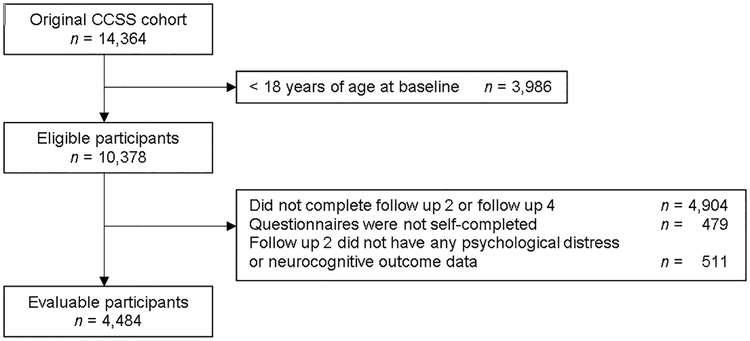
Participants: A total of 4484 adult survivors of childhood cancer [mean (standard deviation) age at evaluation = 34.8 (6.1) years; time from diagnosis = 24.8 (4.4) years] and 1651 sibling controls who completed surveys reporting on alcohol use, neurocognitive impairment and emotional distress.
Measurements: Survivor report of alcohol use included age at drinking initiation and quantity and frequency of alcohol consumption. Neurocognition was assessed using the CCSS Neurocognitive Questionnaire. Emotional distress symptoms were measured using the Brief Symptoms Inventory-18 and the Posttraumatic Stress Diagnostic Scale.
Findings: After adjustment for childhood cancer treatment exposures, including cranial radiation therapy, drinking initiation prior to 18 years of age was associated with 30% increased risk of subsequent memory problems [risk ratio (RR) = 1.3; 95% confidence interval (CI) = 1.1-1.5]. Younger age at drinking initiation was associated with future risk of depression (RR = 1.3; 95% CI = 1.1-1.5), anxiety (RR = 1.6; 95% CI = 1.3-2.1), and somatization (RR = 1.2; 95% CI = 1.1-1.4). Persistent heavy/risky drinking was associated with 80% increased risk of persistent psychological distress (RR = 1.8, 95% CI = 1.4-2.3).
Conclusions: Drinking initiation during adolescence is associated with modest increased risk for memory impairment and emotional distress in adult survivors of childhood cancer.
Keywords: Alcohol; childhood cancer; emotional distress; late effects; neurocognition; survivorship.
© 2018 Society for the Study of Addiction.
Conflict of interest statement
Disclosures: The authors have no conflicts of interest to disclose.
Figures
Comment in
-
High alcohol consumption in adult survivors of childhood cancer increases risk of emotional distress.Evid Based Nurs. 2019 Jul;22(3):84. doi: 10.1136/ebnurs-2018-103038. Epub 2019 May 30. Evid Based Nurs. 2019. PMID: 31147346 No abstract available.
References
-
- Krull KR, Brinkman TM, Li C, Armstrong GT, Ness KK, Srivastava DK, et al. Neurocognitive outcomes decades after treatment for childhood acute lymphoblastic leukemia: a report from the St Jude lifetime cohort study. Journal of clinical oncology: official journal of the American Society of Clinical Oncology. 2013;31(35):4407–15. - PMC - PubMed
Publication types
MeSH terms
Grants and funding
LinkOut - more resources
Full Text Sources
Other Literature Sources
Medical
