


Assessment of mammographic breast density after sleeve gastrectomy
- PMID: 30195656
- PMCID: PMC6289637
- DOI: 10.1016/j.soard.2018.07.024
Assessment of mammographic breast density after sleeve gastrectomy
Abstract
Background: Mammographic breast density (BD) is an independent risk factor for breast cancer. The effects of bariatric surgery on BD are unknown.
Objectives: To investigate BD changes after sleeve gastrectomy (SG).
Setting: University hospital, United States.
Methods: Fifty women with mammograms before and after SG performed from 2009 to 2015 were identified after excluding patients with a history of breast cancer, hormone replacement, and/or breast surgery. Patient age, menopausal status, co-morbidities, hemoglobin A1C, and body mass index were collected. Craniocaudal mammographic views before and after SG were interpreted by a blinded radiologist and analyzed by software to obtain breast imaging reporting and data system density categories, breast area, BD, and absolute dense breast area (ADA). Analyses were performed using χ2, McNemar's test, t test, and linear regressions.
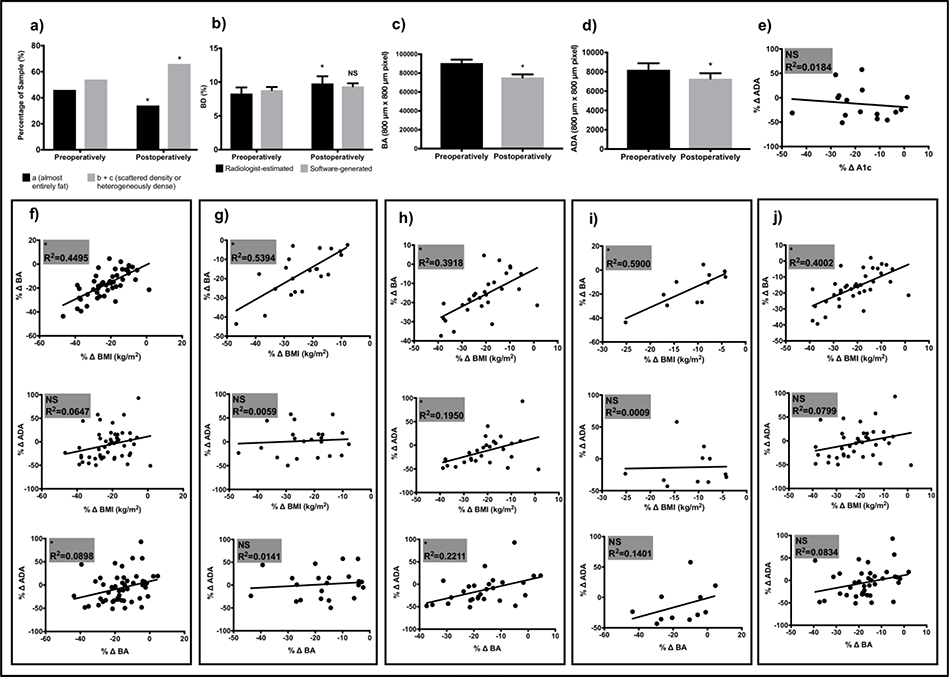
Results: Radiologist interpretation revealed a significant increase in breast imaging reporting and data system B+C category (68% versus 54%; P = .0095) and BD (9.8 ± 7.4% versus 8.3 ± 6.4%; P = .0006) after SG. Software analyses showed a postoperative decrease in breast area (75,398.9 ± 22,941.2 versus 90,655.9 ± 25,621.0 pixels; P < .0001) and ADA (7287.1 ± 3951.3 versus 8204.6 ± 4769.9 pixels; P = .0314) with no significant change in BD. Reduction in ADA was accentuated in postmenopausal patients. Declining breast area was directly correlated with body mass index reduction (R2 = .4495; P < 0.0001). Changes in breast rather than whole body adiposity better explained ADA reduction. Neither diabetes status nor changes in hemoglobin A1C correlated with changes in ADA.
Conclusions: ADA decreases after SG, particularly in postmenopausal patients. Software-generated ADA may be more accurate than radiologist-estimated BD or breast imaging reporting and data system for capturing changes in dense breast tissue after SG.
Keywords: Bariatric surgery; Breast cancer; Breast cancer risk; Breast density; Dense breast tissue; Diabetes; Glucose metabolism; Mammographic breast density; Mammography; Menopausal status; Metabolic surgery; Postmenopausal; Premenopausal; Sleeve gastrectomy; Weight loss surgery.
Copyright © 2018 American Society for Bariatric Surgery. Published by Elsevier Inc. All rights reserved.
Figures
References
-
- Ogden CL, Carroll MD, Fryar CD, Flegal KM. Prevalence of Obesity Among Adults and Youth: United States, 2011–2014. NCHS Data Brief. 2015;(219):1–8. - PubMed
Publication types
MeSH terms
Grants and funding
LinkOut - more resources
Full Text Sources
Other Literature Sources
Medical
Research Materials
