. 2018 Dec:188:213-224.
doi: 10.1016/j.actatropica.2018.09.003. Epub 2018 Sep 6.

A scoping review of Chikungunya virus infection: epidemiology, clinical characteristics, viral co-circulation complications, and control

Affiliations

A scoping review of Chikungunya virus infection: epidemiology, clinical characteristics, viral co-circulation complications, and control

José V J Silva Jr et al. Acta Trop. 2018 Dec.

Abstract

Chikungunya fever is a mosquito-borne viral illness characterized by a sudden onset of fever associated with joint pains. It was first described in the 1950s during a Chikungunya virus (CHIKV) outbreak in southern Tanzania and has since (re-) emerged and spread to several other geographical areas, reaching large populations and causing massive epidemics. In recent years, CHIKV has gained considerable attention due to its quick spread to the Caribbean and then in the Americas, with many cases reported between 2014 and 2017. CHIKV has further garnered attention due to the clinical diagnostic difficulties when Zika (ZIKV) and dengue (DENV) viruses are simultaneously present. In this review, topical CHIKV-related issues, such as epidemiology and transmission, are examined. The different manifestations of infection (acute, chronic and atypical) are described and a particular focus is placed upon the diagnostic handling in the case of ZIKV and DENV co-circulating. Natural and synthetic compounds under evaluation for treatment of chikungunya disease, including drugs already licensed for other purposes, are also discussed. Finally, previous and current vaccine strategies, as well as the control of the CHIKV transmission through an integrated vector management, are reviewed in some detail.

Keywords: Arboviruses; Chikungunya fever; Dengue; Zika.


Figures

None
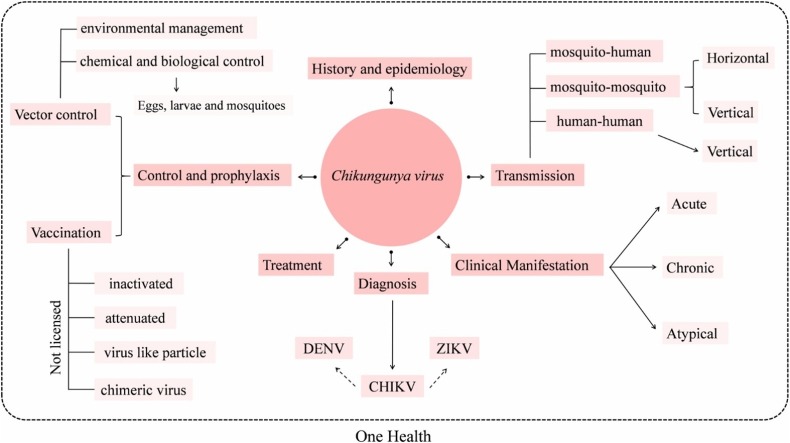
Graphical abstract
Fig. 1
Fig. 1
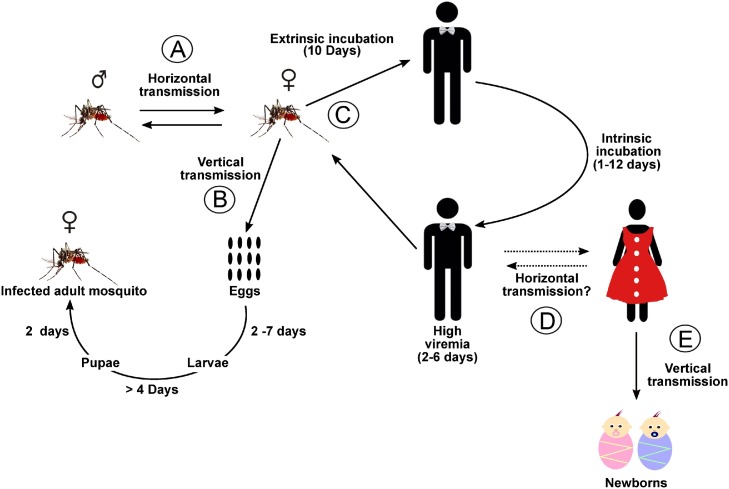
CHIKV transmission diagram. (A) Horizontal transmission between CHIKV vectors; (B) Vertical transmission within vectors; (C) Transmission to a susceptible human; (D) Horizontal transmission in humans; (E) Vertical transmission in humans. Dashed lines represent transmission pathways that have not yet been described.
Fig. 2
Fig. 2
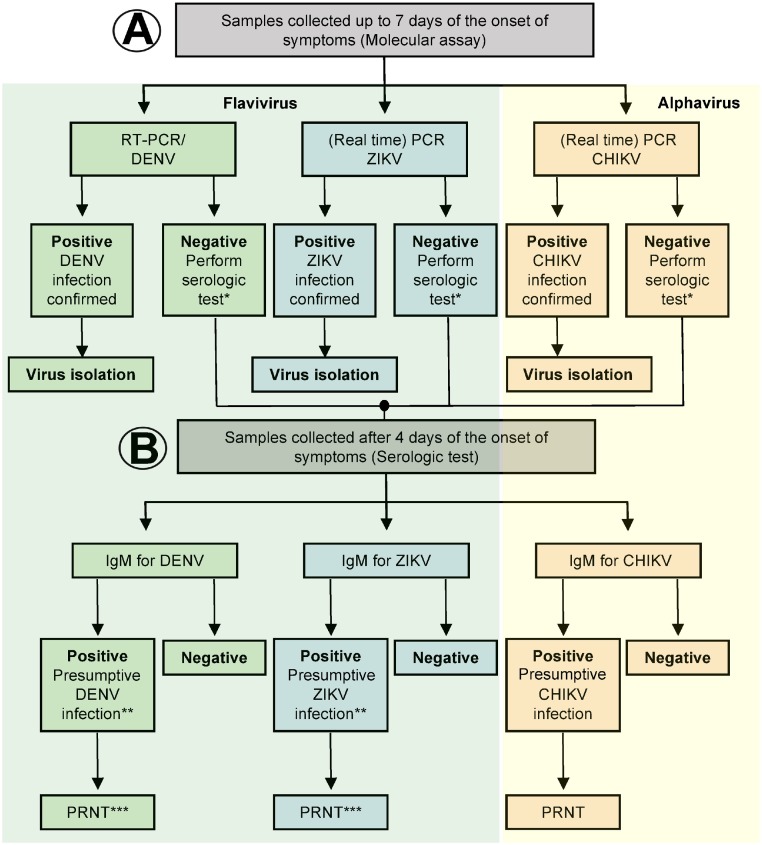
Algorithm for arbovirus diagnosis in suspect cases of chikungunya, dengue and Zika diseases. (A) Samples should be tested by RT-PCR due to the cross-reaction observed in flavivirus samples. (B) Once the molecular test is negative, serological test must be performed. *perform serological tests for samples collected ≥ 4 days after the onset of clinical signs and symptoms; **PRNT is required due to the cross-reaction between DENV and ZIKV; ***Test also for other flavivirus (e.g. West Nile and Saint Louis encephalitis viruses). Reference: CDC (2016) and PAHO (2017).
Fig. 3
Fig. 3
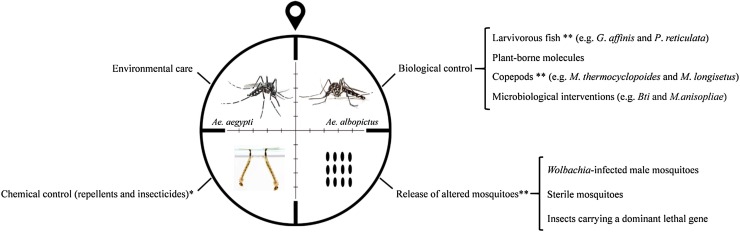
Management for an integrated Aedes vector control. *The use of insecticides and repellents should be carried out taking into account the mosquitoes’ resistance profiles; ** It is important to consider and evaluate the influence of these interventions on ecosystem balance.

References

    1. Agarwal A., Dash P.K., Singh A.K., Sharma S., Gopalan N., Rao P.V., et al. Evidence of experimental vertical transmission of emerging novel ECSA genotype of Chikungunya virus in Aedes aegypti. PLoS Negl. Trop. Dis. 2014;8(7):e2990. - PMC - PubMed
    1. Akahata W., Yang Z.Y., Andersen H., Sun S., Holdaway H.A., Kong W.P., et al. A virus-like particle vaccine for epidemic Chikungunya virus protects nonhuman primates against infection. Nat. Med. 2010;16(3):334–338. - PMC - PubMed
    1. Alphey L., Benedict M., Bellini R., Clark G.G., Dame D.A., Service M.W., et al. Sterile-insect methods for control of mosquito-borne diseases: an analysis. Vector Borne Zoonotic Dis. 2010;10(3):295–311. - PMC - PubMed
    1. Alphey L., McKemey A., Nimmo D., Neira Oviedo M., Lacroix R., Matzen K., et al. Genetic control of Aedes mosquitoes. Pathog. Glob. Health. 2013;107(4):170–179. - PMC - PubMed
    1. Althouse B.M., Guerbois M., Cummings D.A.T., Diop O.M., Faye O., Faye A., et al. Role of monkeys in the sylvatic cycle of chikungunya virus in Senegal. Nat. Commun. 2018;9(1):1046. - PMC - PubMed

Publication types