Review
. 2018 Nov:61:111-128.
doi: 10.1016/j.jnutbio.2018.07.010. Epub 2018 Aug 16.

Gut microbes as future therapeutics in treating inflammatory and infectious diseases: Lessons from recent findings

Affiliations
Review

Gut microbes as future therapeutics in treating inflammatory and infectious diseases: Lessons from recent findings

Suprabhat Mukherjee et al. J Nutr Biochem. 2018 Nov.

Abstract

The human gut microbiota has been the interest of extensive research in recent years and our knowledge on using the potential capacity of these microbes are growing rapidly. Microorganisms colonized throughout the gastrointestinal tract of human are coevolved through symbiotic relationship and can influence physiology, metabolism, nutrition and immune functions of an individual. The gut microbes are directly involved in conferring protection against pathogen colonization by inducing direct killing, competing with nutrients and enhancing the response of the gut-associated immune repertoire. Damage in the microbiome (dysbiosis) is linked with several life-threatening outcomes viz. inflammatory bowel disease, cancer, obesity, allergy, and auto-immune disorders. Therefore, the manipulation of human gut microbiota came out as a potential choice for therapeutic intervention of the several human diseases. Herein, we review significant studies emphasizing the influence of the gut microbiota on the regulation of host responses in combating infectious and inflammatory diseases alongside describing the promises of gut microbes as future therapeutics.

Keywords: Gut microbiota; Homeostasis; Infectious diseases; Inflammatory disorders; Probiotics.


Figures

Fig. 1
Fig. 1
Human gut microbes and their physiological functions. Gut microbes and their metabolites regulate physiology, development and immune functioning of the human gut epithelium. [1] Gut microbiota confers protection against pathogens through four different mechanisms viz. [i.] direct inhibition of growth and colonization of the pathogens by competing with the nutrients and available space; [ii.] modulation of the immune responses that act against the pathogens but not against the beneficial gut microbes of the human host; [iii.] formation and maintenance of the mucosal barrier that restricts the entry of the invading pathogens; [iv.] utilization of nutrients available in the gut to control the growth of pathogenic organisms and repair of the damaged tissue [2] Gut microbiota regulates the brain function through the gut-brain axis governing modification of nervous system and [3] cognitive function; [4] Gut microbiota influences the metabolic and the biochemical functions of the liver through establishment of the liver-microbiome axis; [5] Gut microbiota can regulate the cardiac function and physiology; [6] Gut microbes potentially regulate the immune surveillance of the lungs through the gut-lung axis; [7] Gut microbes play essential roles in the maintenance of renal physiology and immunity; [8] Gut microbiota maintains healthy prostate and prevents development of cancer; [9] Gut microbiota regulates the tone of lipid metabolism and insulin homeostasis.
Fig. 2
Fig. 2
Gut microbes induced modulation/perturbation of the inflammatory homeostasis in human. Gut microbes can directly sensitize the gut epithelium associated antigen presenting cells for inducing proinflammatory response directly by enhancing the proinflammatory cytokine production and/or polarizing the naive T cell towards Th1 and Th17 phenotypes. The metabolites (largely the short chain fatty acids (SCFAs)) released from the gut microbes bind to the intestinal free fatty acid receptors (like GPR43) and induces the expression of FoxP3 to signal polarization of regulatory T cell (Treg) response. This Treg response plays a crucial role in inhibiting the inflammatory responses resulted from the pathogenic infections or the inflammatory disorders/autoimmunity and also maintain the immune homeostasis in the gut. SCFA like butyrate acts as a ligand for the immunoregulatory receptors (like GPR109a) on the macrophages and drives the polarization of M2 macrophages (anti-inflammatory phenotype of macrophage) that secrete anti-inflammatory cytokines (IL-10, TGF-β). These anti-inflammatory cytokines suppress the effects of proinflammatory cytokines (IL-12, IL-17, IFN-γ) released from the antigen presenting cells (macrophages and dendritic cells) and sensitized T cells (Th1 and Th17) induced from dysbiosis and/or microbiota-pathogen interactions. SCFA also induces IL-18 expression through inflammasome activation in the intestinal epithelial cells (IECs). IL-18 released from the IECs further triggers activation of the innate lymphoid cells to secrete IL-22 that guides synthesis of antimicrobial peptides and mucin to maintain intestinal homeostasis.
Fig. 3
Fig. 3
Mechanism of the function of gut microbes against inflammatory, metabolic and allergic diseases. Gut microbes confer protection against the physiological abnormalities principally via two different approaches. The gut microbes itself and the metabolites released from the microbes can function separately or together to restore the homeostasis. Short-chain fatty acids (SCFAs) released by the gut bacteria potentially interact with the receptors on the dendritic cells (DCs) resulting in the secretion of anti-inflammatory cytokines that ameliorate or suppress proinflammatory milieu associated with the pathological outcomes of dysbiosis, inflammatory bowel disease, and cancer. SCFA alone and the cytokines released from SCFA-educated DCs inhibit inflammasome activation. Moreover, SCFA sensitized DCs promote the induction and expansion of the anti-inflammatory immune cell types the regulatory T cells (Treg) that regulate the detrimental effects of the proinflammatory cytokines. SCFAs can directly inhibit DC activation and concomitant upregulation of the Th2 responses that subdue the pulmonary inflammation. The Tregs alongside other anti-inflammatory cytokines are also indispensable for preventing the hypersensitivity. Gut microbes potentially prevent the trans-epithelial entry and the translocation of pathogenic microorganisms to prevent a human from systemic inflammation or sepsis. The gut microbes also maintain the normal metabolic activity of the adipocyte by upregulating the browning of white adipose tissue and inhibiting the lipogenesis. In addition, gut microbes block the entry of LPS from pathobionts and inhibit TLR4 activation. This inhibition of TLR4 ceases systemic inflammatory responses and plays a pivotal role to maintain the normal insulin activity required for the metabolic homeostasis in the human host.
Fig. 4
Fig. 4
Mechanism of gut microbiota induced protection against the microbial infections. The gut microbes exert a protective action on the microbial infections by direct inhibition, competition with nutrient and inducing antimicrobial immunity. The antimicrobial immune response comprises excess mucus secretion from goblet cells, synthesis of antimicrobial peptides and induction of pro-inflammatory response. The gut microbes trigger the Paneath cells to secrete antimicrobial peptides that control the growth of pathogenic microorganisms. Moreover, the gut microbes also result in the copious production of mucosal IgA to act against the pathobionts especially by blocking their adherence to the intestinal epithelium. Polysaccharide A (PSA) from gut bacteria sensitizes the DCs via TLR2 activation and subsequently stimulates the induction of Tregs. Anti-inflammatory cytokines secreted from the PSA-educated DCs also inhibit the immunopathological effects of the proinflammatory cytokines secreted in response to the various infectious agents. On other side, gut microbes efficiently induce and shape the host immunity against the invading pathogens by directly activating the proinflammatory T cell responses (TH1 and TH17) through the activation of antigen presenting cells (macrophages and DCs). The gut microbes, especially the commensals, restrict the entry of gut pathogens through the formation of mucosal barrier and prevent the bacterial translocation in the circulation.
Fig. 5
Fig. 5
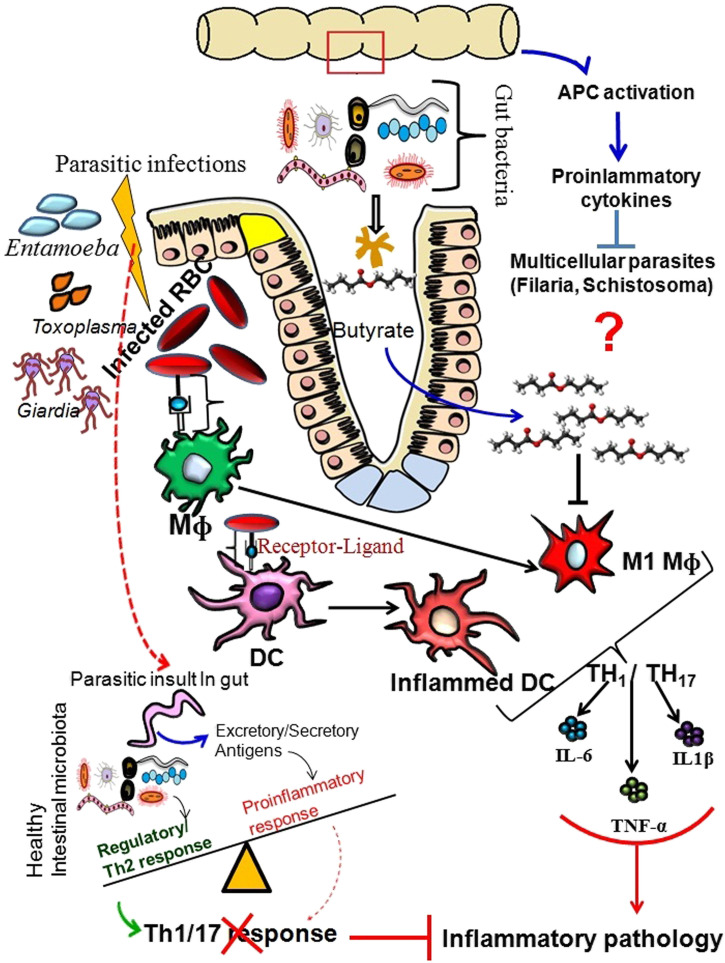
Mechanism of the gut microbe induced protection against the parasitic infections. The gut microbes release short-chain fatty acids (such as butyrate) that block polarization of the M1 macrophages and activation of the DCs to suppress the overt immunopathology associated with the different parasitic infections (Malaria, Giardia, Entamoeba, and Toxoplasma). Multicellular parasites in the gut, especially the gut helminths, also drive Th2 response to strengthen the anti-inflammatory responses and reduction of tissue damage. A healthy gut microbiota directs the major antigen presenting cells (APCs) to secrete anti-inflammatory cytokines that suppress immunopathogenesis associated with the different parasitic infections (Malaria, Toxoplasma, Giardia, Entamoeba, and helminths). The exact role of the gut microbiome in the control of multicellular parasitic infection is yet not clear. However, APC activation leading to the secretion of proinflammatory cytokines is considered one of the key mechanisms to inhibit the pathogenesis of multicellular parasites.

References

    1. Jandhyala S.M., Talukdar R., Subramanyam C., Vuyyuru H., Sasikala M., Nageshwar Reddy D. Role of the normal gut microbiota. World J Gastroenterol. 2015;21:8787–8803. - PMC - PubMed
    1. Grice E.A., Segre J.A. The human microbiome:Our second genome. Annu Rev Genomics Hum Genet. 2012;13:151–170. - PMC - PubMed
    1. Ley R.E., Peterson D.A., Gordon J.I. Ecological and evolutionary forces shaping microbial diversity in the human intestine. Cell. 2006;124:837–848. - PubMed
    1. Sun J., Chang B. Exploring gut microbes in human health and disease: pushing the envelope. Genes Dis. 2014;1:132–139. - PMC - PubMed
    1. Ogilvie L.A., Jones B.V. The human gut virome: A multifaceted majority. Front Microbiol. 2015;6:918. - PMC - PubMed

Publication types

MeSH terms

LinkOut - more resources