. 2018 Aug 24:9:1953.
doi: 10.3389/fmicb.2018.01953. eCollection 2018.

Probiotic Lactobacillus plantarum Promotes Intestinal Barrier Function by Strengthening the Epithelium and Modulating Gut Microbiota

Affiliations

Probiotic Lactobacillus plantarum Promotes Intestinal Barrier Function by Strengthening the Epithelium and Modulating Gut Microbiota

Jing Wang et al. Front Microbiol. .

Abstract

Weaning disturbs the intestinal barrier function and increases the risk of infection in piglets. Probiotics exert beneficial health effects, mainly by reinforcing the intestinal epithelium and modulating the gut microbiota. However, the mechanisms of action, and especially, the specific regulatory effects of modulated microbiota by probiotics on the intestinal epithelium have not yet been elucidated. The present study aimed to decipher the protective effects of the probiotic Lactobacillus plantarum strain ZLP001 on the intestinal epithelium and microbiota as well as the effects of modulated microbiota on epithelial function. Paracellular permeability was measured with fluorescein isothiocyanate-dextran (FD-4). Gene and protein expression levels of tight junction (TJ) proteins, proinflammatory cytokines, and host defense peptides were determined by RT-qPCR, ELISA, and western blot analysis. Short-chain fatty acid (SCFA) concentrations were measured by ion chromatography. Fecal microbiota composition was assessed by high-throughput sequencing. The results showed that pretreatment with 108 colony forming units (CFU) mL-1 of L. plantarum ZLP001 significantly counteracted the increase in gut permeability to FD-4 induced by 106 CFU mL-1 enterotoxigenic Escherichia coli (ETEC). In addition, L. plantarum ZLP001 pretreatment alleviated the reduction in TJ proteins (claudin-1, occludin, and ZO-1) and downregulated proinflammatory cytokines IL-6 and IL-8, and TNFα expression and secretion caused by ETEC. L. plantarum ZLP001 also significantly increased the expression of the host defense peptides pBD2 and PG1-5 and pBD2 secretion relative to the control. Furthermore, L. plantarum ZLP001 treatment affected piglet fecal microbiota. The abundance of butyrate-producing bacteria Anaerotruncus and Faecalibacterium was significantly increased in L. plantarum ZLP001-treated piglets, and showed a positive correlation with fecal butyric and acetic acid concentrations. In addition, the cell density of Clostridium sensu stricto 1, which may cause epithelial inflammation, was decreased after L. plantarum ZLP001 administration, while the beneficial Lactobacillus was significantly increased. Our findings suggest that L. plantarum ZLP001 fortifies the intestinal barrier by strengthening epithelial defense functions and modulating gut microbiota.

Keywords: Lactobacillus plantarum; host defense; immune response; microbiota; permeability; tight junction.


Figures
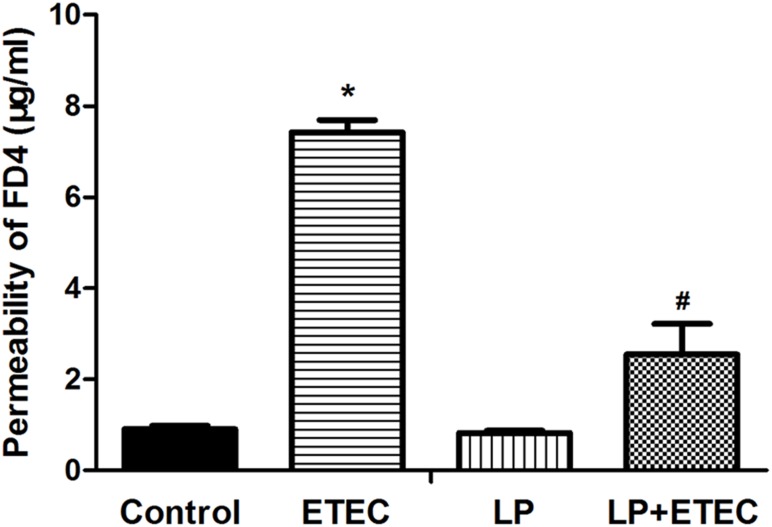
FIGURE 1
FIGURE 1
FD-4 diffusion in L. plantarum ZLP001-treated IPEC-J2 cells. Cells were left untreated or pretreated with L. plantarum ZLP001 (LP, 108 CFU mL−1) for 6 h on the apical sides of the cell monolayers and then challenged or not with 106 CFU mL−1 ETEC for 3 h. FD-4 concentrations in the basal compartments were measured. Values are shown as the means ± SE of three independent experiments. P < 0.05 vs. non-treated controls; #P < 0.05 vs. ETEC alone.
FIGURE 2
FIGURE 2
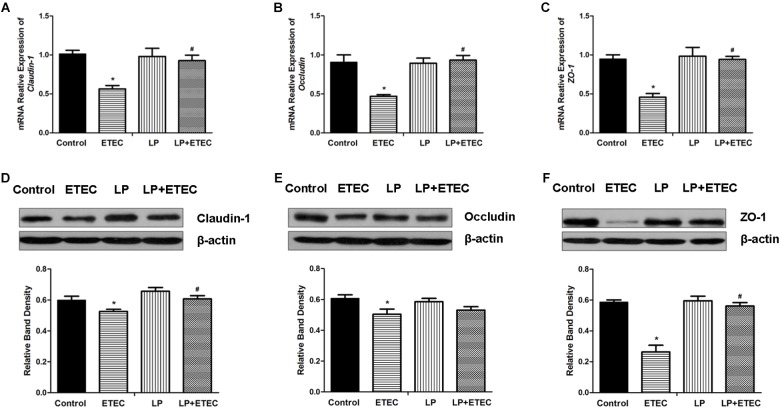
Relative mRNA transcript and protein levels of TJ proteins in IPEC-J2 cells left untreated or pretreated with L. plantarum ZLP001 (LP, 108 CFU mL−1) for 6 h, and then challenged or not with 106 CFU mL−1 ETEC for 3 h. mRNA levels of claudin-1 (A), occludin (B), and ZO-1 (C) were standardized to that of GAPDH. Expression levels relative to non-treated controls were calculated by the 2−ΔΔCT method. TJ protein levels were assessed by immunoblotting. Data are western blotting results and gradation analysis of claudin-1 (D), occludin (E), ZO-1 (F). Values are shown as the means ± SE of three independent experiments. P < 0.05 vs. non-treated controls; #P < 0.05 vs. ETEC alone.
FIGURE 3
FIGURE 3
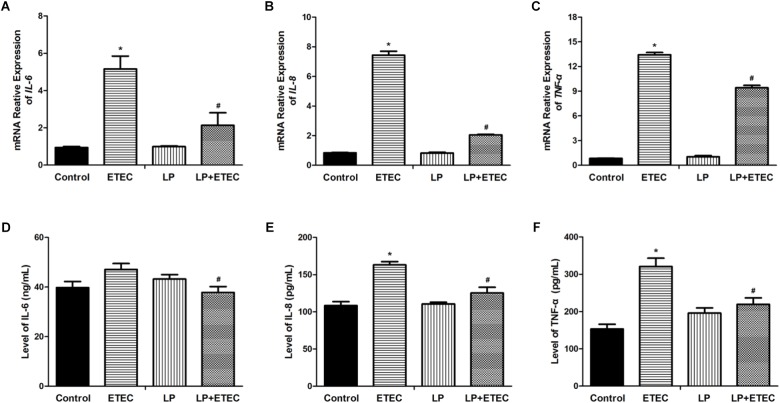
Relative mRNA transcript levels and concentrations of proinflammatory cytokines in the culture supernatant of IPEC-J2 cells left untreated or pretreated with L. plantarum ZLP001 (LP, 108 CFU mL−1) for 6 h then either unchallenged or challenged with 106 CFU mL−1 ETEC for 3 h. mRNA levels of IL-6 (A), IL-8 (B), and TNF-α (C) were standardized to that of GAPDH. Expression levels relative to non-treated controls were calculated by the 2−ΔΔCT method. Protein expression of IL-6 (D), IL-8 (E), and TNF-α (F) was assessed by ELISA. Values are shown as the means ± SE of three independent experiments. P < 0.05 vs. non-treated controls; #P < 0.05 vs. ETEC alone.
FIGURE 4
FIGURE 4
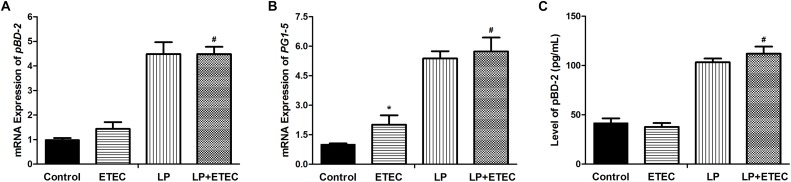
Relative mRNA transcript levels of pBD2 (A) and PG1-5 (B) and concentrations of pBD2 (C) in the culture supernatant of IPEC-J2 cells left untreated or pretreated with L. plantarum ZLP001 (LP, 108 CFU mL−1) for 6 h and then challenged or not with 106 CFU mL−1 ETEC for 3 h. mRNA expression levels were standardized to that of GAPDH. Expression levels relative to non-treated controls were calculated by the 2−ΔΔCT method. The pBD2 concentration was assessed by ELISA. Values are shown as the means ± SE of three independent experiments. P < 0.05 vs. non-treated controls; #P < 0.05 vs. ETEC alone.
FIGURE 5
FIGURE 5
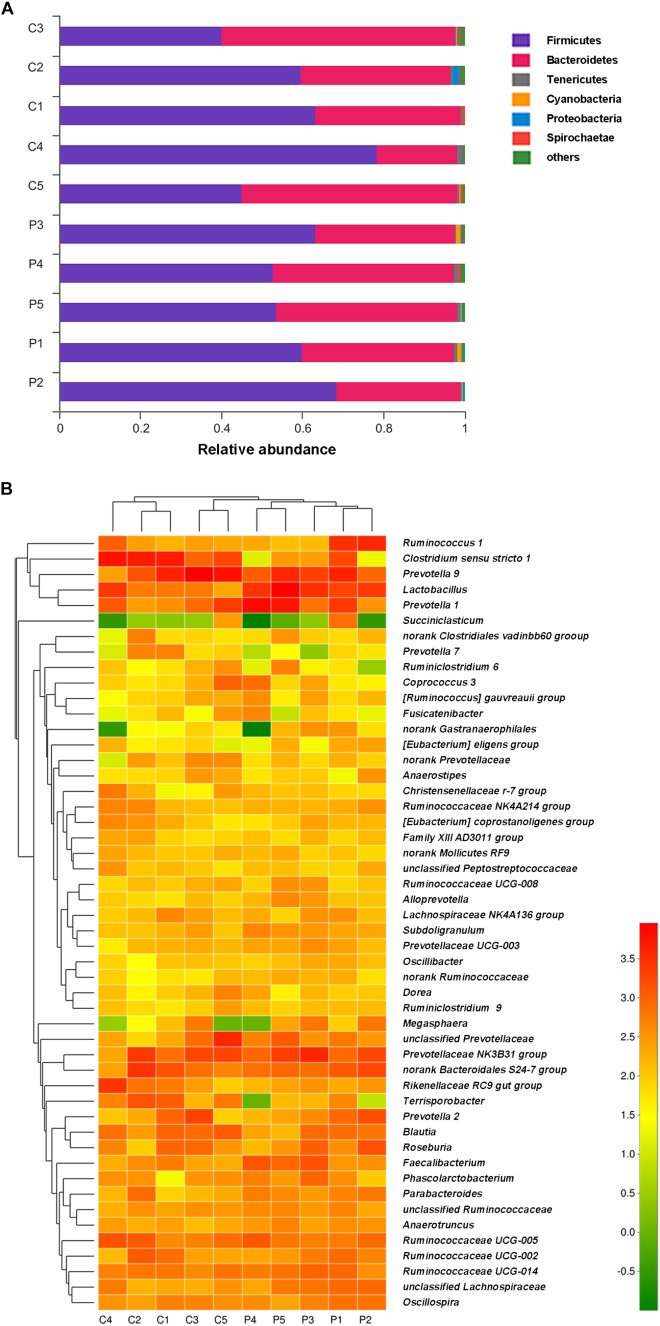
Phylum-level microbiota profile of L. plantarum ZLP001-treated piglets as compared to that of placebo-treated control piglets (A). Stacked column chart showing the relative phylum-level bacterial abundance per fecal sample. Genus-level microbiota profile of L. plantarum ZLP001-treated piglets as compared to that of placebo-treated control piglets (B). The heatmap shows genera whose relative abundance was >0.1%. Relative abundance is indicated by a color gradient from green to red, with green representing low abundance and red representing high abundance. C and P represent the control and the probiotic-treated group, respectively. Numbers represent individual animals.
FIGURE 6
FIGURE 6
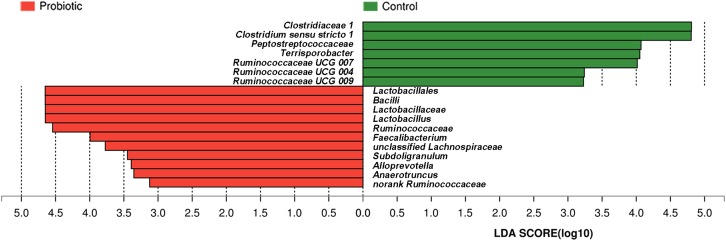
Differences between bacterial taxa in L. plantarum ZLP001-treated piglets and placebo-treated control piglets. The histogram shows differentially abundant bacteria in the treatment and control groups ranked by linear discriminant analysis (LDA) scores. Red bars (negative LDA scores) represent bacteria that are more abundant in probiotic-treated fecal samples than in controls. Green bars (positive LDA scores) represent bacteria that are more abundant in placebo-treated fecal samples than in probiotic-treated fecal samples.
FIGURE 7
FIGURE 7
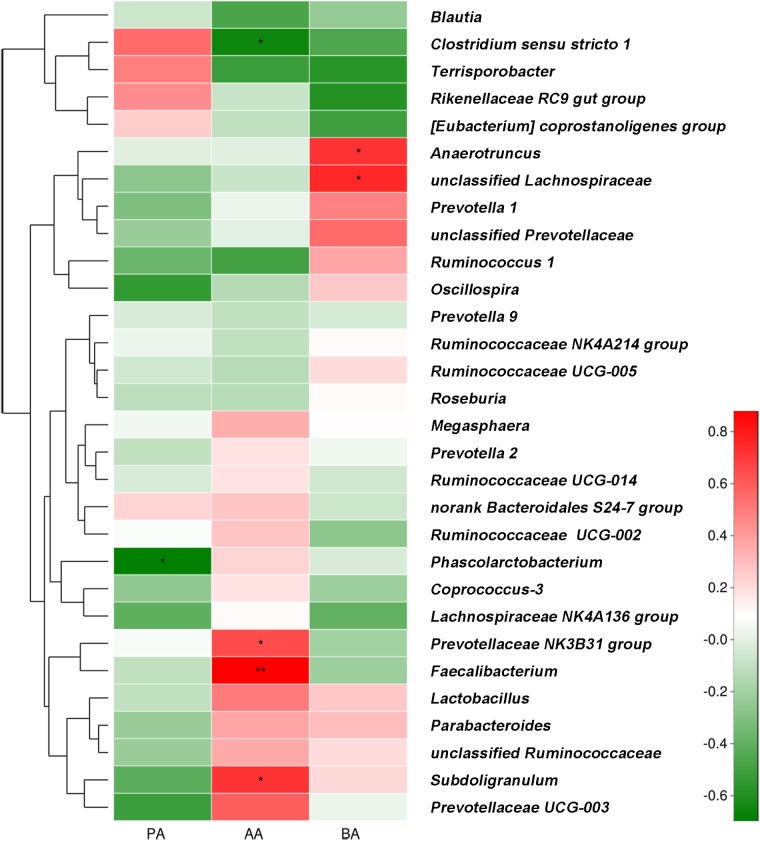
Correlations between relative generic abundance and SCFA concentrations in feces obtained from post-weaning piglets. Only the relative abundances of the top 30 bacterial genera are shown. Correlation is indicated by a color gradient from green to red based on Spearman’s correlation coefficients. Asterisks in red cells represent significant positive correlations (P < 0.05; ∗∗P < 0.01). Asterisks in green cells represent significant negative correlations (P < 0.05). AA, acetic acid; PA, propionic acid; BA, butyric acid.
FIGURE 8
FIGURE 8
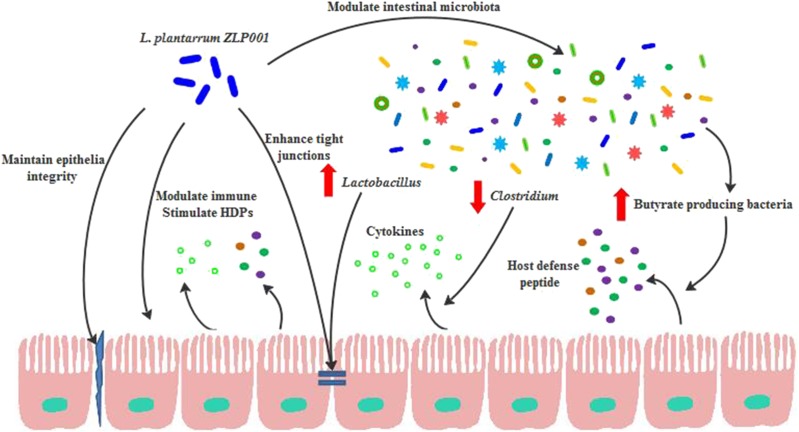
Suggested mechanism by which L. plantarum ZLP001 protects intestinal barrier function from weaning stress. L. plantarum ZLP001 functions not only through maintaining epithelial integrity, improving TJs, regulating the immune response, and stimulating HDPs, but also via modulating the intestinal indigenous microbiota. Modulated microbiota and alterations in certain bacterial taxa in turn enhance epithelial function.

References

    1. Anderson R. C., Cookson A., McNabb W., Park Z., McCann M., Kelly W., et al. (2010). Lactobacillus plantarum MB452 enhances the function of the intestinal barrier by increasing the expression levels of genes involved in tight junction formation. BMC Microbiol. 10:316. 10.1186/1471-2180-10-316 - DOI - PMC - PubMed
    1. Bevins C. L., Martin-Porter E., Ganz T. (1999). Defensins and innate host defence of the gastrointestinal tract. Gut 45 911–915. 10.1136/gut.45.6.911 - DOI - PMC - PubMed
    1. Blackwood B. P., Yuan C. Y., Wood D. R., Nicolas J. D., Grothaus J. S., Hunter C. J. (2017). Probiotic Lactobacillus species strengthen intestinal barrier function and tight junction integrity in experimental necrotizing enterocolitis. J. Probiotics Health 5:159. 10.4172/2329-8901.1000159 - DOI - PMC - PubMed
    1. Boirivant M., Strober W. (2007). The mechanism of action of probiotics. Curr. Opin. Gastroenterol. 23 679–692. 10.1097/MOG.0b013e3282f0cffc - DOI - PubMed
    1. Campbell J. M., Crenshaw J. D., Polo J. (2013). The biological stress of early weaned piglets. J. Anim. Sci. Biotechnol. 4:19. 10.1186/2049-1891-4-19 - DOI - PMC - PubMed