


Risk Factors for Adverse Fetal Outcome in Hemodialysis Pregnant Women
- PMID: 30197974
- PMCID: PMC6127404
- DOI: 10.1016/j.ekir.2018.04.013
Risk Factors for Adverse Fetal Outcome in Hemodialysis Pregnant Women
Abstract
Introduction: Pregnancy in women on dialysis is associated with a higher risk of adverse events, and the best care for this population remains to be established.
Methods: In this series, we aimed to identify factors associated with the risk of adverse fetal outcomes among 93 pregnancies in women on hemodialysis. Dialysis dose was initially assigned according to the presence of residual diuresis, body weight, and years on dialysis. Subsequent adjustments on dialysis dose were performed according to several parameters.
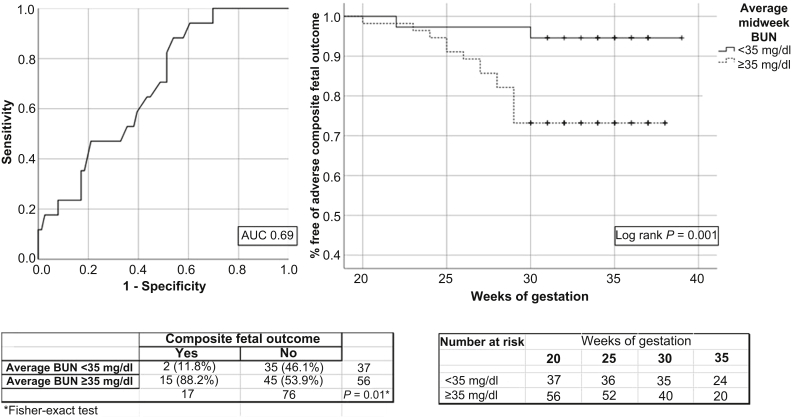
Results: The overall successful delivery rate was 89.2%, with a dialysis regimen of 2.6 ± 0.7 h/d, 15.4 ± 4.0 h/wk, and mean weekly standard urea Kt/V of 3.3 ± 0.6. In the logistic models, preeclampsia, lupus, primigravida, and average midweek blood urea nitrogen (BUN) level were positively related to the risk of a composite outcome of perinatal death or extreme prematurity, whereas polyhydramnios was inversely related to it. In multivariable linear regression, preeclampsia, polyhydramnios, primigravida, average midweek BUN, and residual diuresis remained significantly and independently related to fetal weight, which is a surrogate marker of fetal outcome. An average midweek BUN of 35 mg/dl was the best value for discriminating the composite outcome, and BUN ≥35 mg/dl was associated with a significant difference in a Kaplan-Meier curve (P = 0.01).
Conclusion: Our results showed that a good fetal outcome could be reached and that preeclampsia, lupus, primigravida, residual diuresis, polyhydramnios, and hemodialysis dose were important variables associated with this outcome. In addition, we suggested that a midweek BUN <35 mg/dl might be used as a target for adjusting dialysis dose until hard data were generated.
Keywords: chronic kidney disease; fetal outcomes; hemodialysis; hemodialysis adequacy; preeclampsia; pregnancy.
Figures
References
-
- Bagon J.A., Vernaeve H., De Muylder X. Pregnancy and dialysis. Am J Kidney Dis. 1998;31:756–765. - PubMed
-
- Souqiyyeh M.Z., Huraib S.O., Saleh A.G. Pregnancy in chronic hemodialysis patients in the Kingdom of Saudi Arabia. Am J Kidney Dis. 1992;19:235–238. - PubMed
-
- Holley J.L., Reddy S.S. Pregnancy in dialysis patients: a review of outcomes, complications, and management. Semin Dial. 2003;16:384–388. - PubMed
-
- Hu S. Pregnancy in dialysis patients: where do we go from here? Semin Dial. 2003;16:376–378. - PubMed
-
- Shahir A.K., Briggs N., Katsoulis J. An observational outcomes study from 1966-2008, examining pregnancy and neonatal outcomes from dialyzed women using data from the ANZDATA Registry. Nephrology. 2013;18:276–284. - PubMed
LinkOut - more resources
Full Text Sources
Other Literature Sources
