. 2018 Apr 22;3(5):1193-1201.
doi: 10.1016/j.ekir.2018.04.009. eCollection 2018 Sep.

Apolipoprotein CII Amyloidosis Associated With p.Lys41Thr Mutation

Affiliations

Apolipoprotein CII Amyloidosis Associated With p.Lys41Thr Mutation

Sanjeev Sethi et al. Kidney Int Rep. .

Abstract

Introduction: Apolipoprotein CII amyloidosis (AApoCII) is a rare form of amyloidosis. Here, we report a novel mutation associated with AApoCII amyloidosis in 5 patients and describe their clinical, renal biopsy, and mass spectrometry findings.

Methods: Five patients with renal AApoCII p.Lys41Thr amyloidosis were identified from our amyloid mass spectrometry cohort. Clinical features, kidney biopsy, and mass spectrometry findings were analyzed in this rare type of amyloidosis.

Results: The patients were older adults (mean age of 71.6 years at diagnosis), presented with nephrotic-range proteinuria, and often had declining renal function. All renal biopsy specimens showed massive mesangial nodules composed of weakly eosinophilic, periodic acid-Schiff negative, Congo red-positive amyloid deposits. There were no interstitial, vascular, or medullary deposits. In all cases, immunofluorescence studies were negative for Igs and electron microscopy showed amyloid fibrils. Proteomic analysis of Congo red-positive amyloid deposits detected large amounts of apolipoprotein CII (APOC2) protein. We also detected APOC2 p.Lys41Thr mutant protein in amyloid deposits of all patients. DNA sequencing in 1 patient confirmed the presence of the mutation. Both mutant and wild-type forms of APOC2 were detected in amyloid deposits of all patients. Molecular dynamic simulations showed the variant mediating a collapse of the native structure of APOC2, thereby destabilizing the protein.

Conclusion: We propose that AApoCII p.Lys41Thr amyloidosis is a new form of amyloidosis seen in elderly individuals, histologically exhibiting massive glomerular involvement, leading to nephrotic-range proteinuria and progressive chronic kidney disease.

Keywords: amyloidosis; apolipoprotein CII; kidney; mutation; p.Lys41Thr; proteomics.


Figures
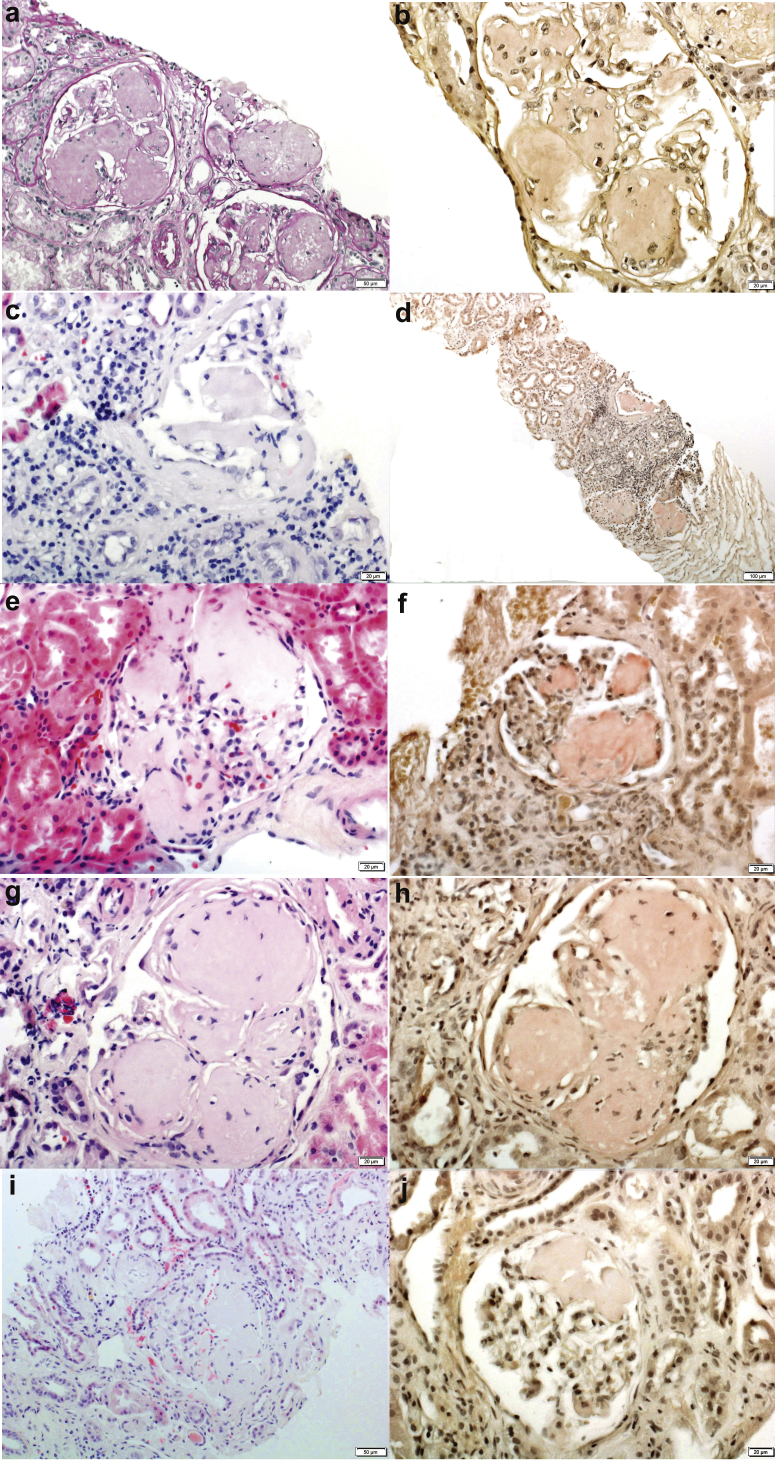
Figure 1
Figure 1
Kidney biopsy findings. Light microscopy shows large acellular mesangial nodules that are periodic acid−Schiff stain negative and Congo red–positive. In some glomeruli, the large mesangial nodules may involve the glomerulus only segmentally. In addition, in some biopsy specimens, the Congo red stain is only weakly positive. The column on the right pertains to the Congo red stain. The column on the left pertains to hematoxylin and eosin except (a), which is a periodic acid−Schiff stain. Each row represents 1 patient: (a,b) patient 1; (c,d) patient 2; (e,f) patient 3; (g,h) patient 4; and (i,j) patient 5. Original magnification for all ×40, except for (a) and (i) (×20) and d (×10).
Figure 2
Figure 2
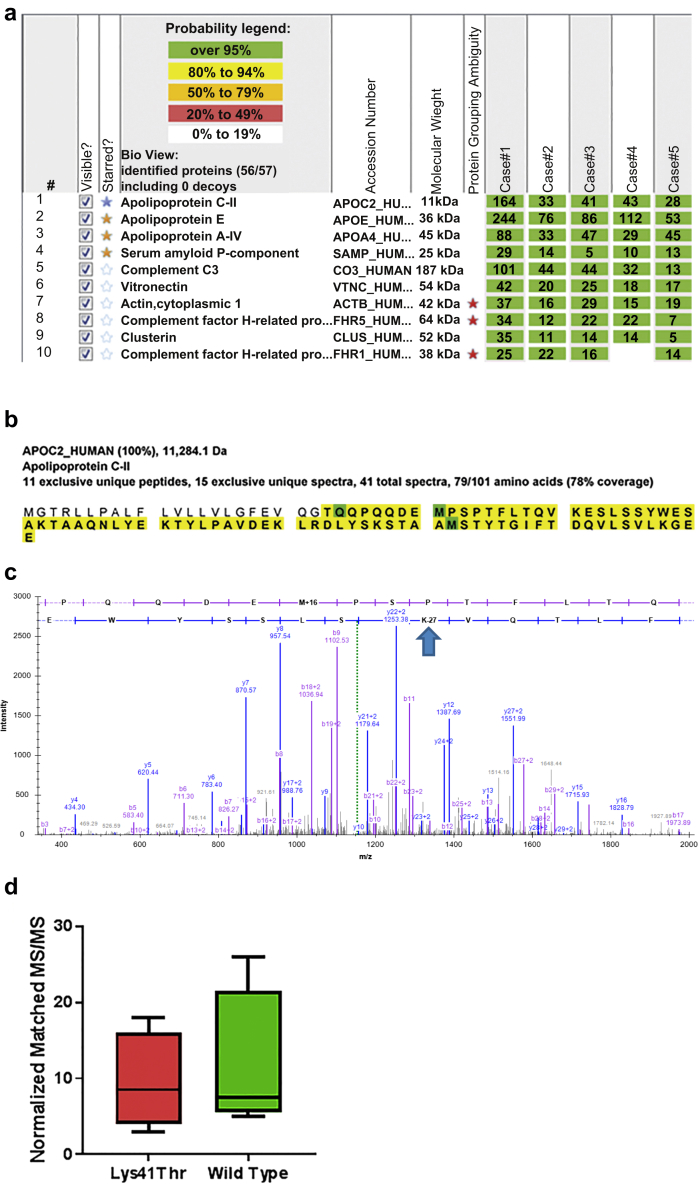
Proteomic identification of APOC2 Lys41Thr in glomerular amyloid deposits. Congo red−positive glomeruli were microdissected and analyzed using liquid chromatography with mass spectrometry (LC-MS/MS), as described in the Methods. (a) Protein identification report consisting of representative dissections from all 5 cases is shown. Numbers in green boxes represent number of MS/MS matches to the respective protein. Universal amyloid tissue marker proteins (apolipoprotein E [APOE], APOA4, and serum amyloid protein [SAP]) are shown in gold stars. Type-specific marker (APOC2) is shown in the blue star. (b) Sequence coverage map of wild-type APOC2, from the patient 1 specimen, showing that the entire protein is deposited. Amino acids highlighted in bold letters over yellow background were detected in the deposit. The first 22 amino acids correspond to the signal peptide. (c) MS/MS spectrum corresponding to the APOC2 p.Lys41Thr mutant peptide is shown. Blue arrow shows the location of the mutation in the detected peptide. (d) Peptides corresponding to both mutant and wild-type forms of APOC2 were detected in the deposit. Distribution of normalized MS/MS matches to the corresponding APOC2 forms are shown.
Figure 3
Figure 3
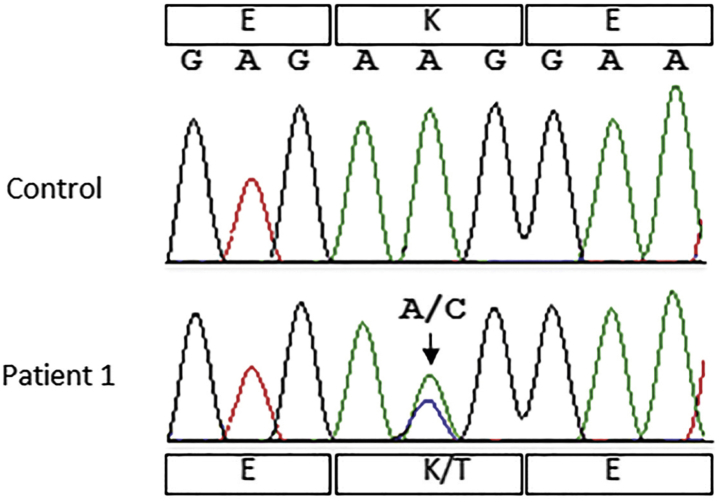
Sanger sequencing to detect ApoCII variant. Sanger sequencing of blood DNA in patient 1 shows heterozygous APOC2 variant c.122A>C (p.Lys41Thr). The control sequence is shown for comparison.
Figure 4
Figure 4
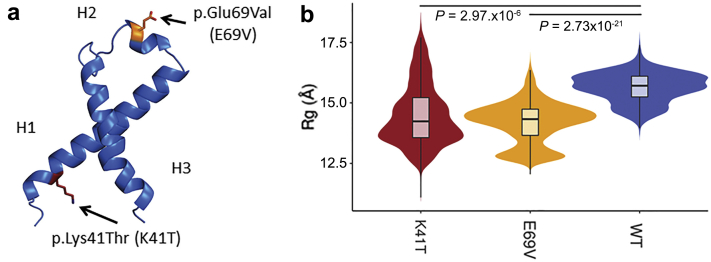
Molecular dynamics (MD) simulation of APOC2 p.Lys41Thr. (a) Variant p.Lys41Thr was located in the third helix (H1) in the APOC2 native structure, whereas the previously known amyloidogenic variant p.Gly69Val was located in the second α-helix (H2). (b) Molecular dynamics simulations were performed for both variants, and radius of gyration (Rg) was monitored during simulations (Rg is a measure of the protein’s compactness). Furthermore, stable proteins have a narrower Rg in MD simulations when compared to unstable proteins. Distribution of Rg observed for wild-type (WT), K41T, and E69V variants. Like E69V, the new K41T was associated with a collapse of the protein, as indicated by significantly lower Rg measures. K41T folding, like that of E69V, is also more unstable than in WT, as indicated by a wider Rg distribution.

References

    1. Dember L.M. Amyloidosis-associated kidney disease. J Am Soc Nephrol. 2006;17:3458–3471. - PubMed
    1. Merlini G., Bellotti V. Molecular mechanisms of amyloidosis. N Engl J Med. 2003;349:583–596. - PubMed
    1. Said S.M., Sethi S., Valeri A.M. Renal amyloidosis: origin and clinicopathologic correlations of 474 recent cases. Clin J Am Soc Nephrol. 2013;8:1515–1523. - PMC - PubMed
    1. Picken M.M. New insights into systemic amyloidosis: the importance of diagnosis of specific type. Curr Opin Nephrol Hypertens. 2007;16:196–203. - PubMed
    1. Vigushin D.M., Gough J., Allan D. Familial nephropathic systemic amyloidosis caused by apolipoprotein Al variant Arg26. Q J Med. 1994;87:149–154. - PubMed

LinkOut - more resources