


Plate fixation through an anterior approach for coronoid process fractures: A retrospective case series and a literature review
- PMID: 30200084
- PMCID: PMC6133425
- DOI: 10.1097/MD.0000000000012041
Plate fixation through an anterior approach for coronoid process fractures: A retrospective case series and a literature review
Abstract
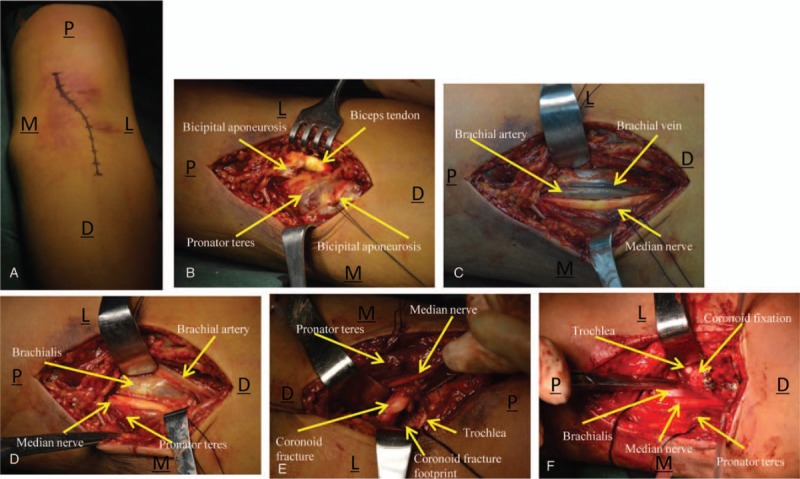
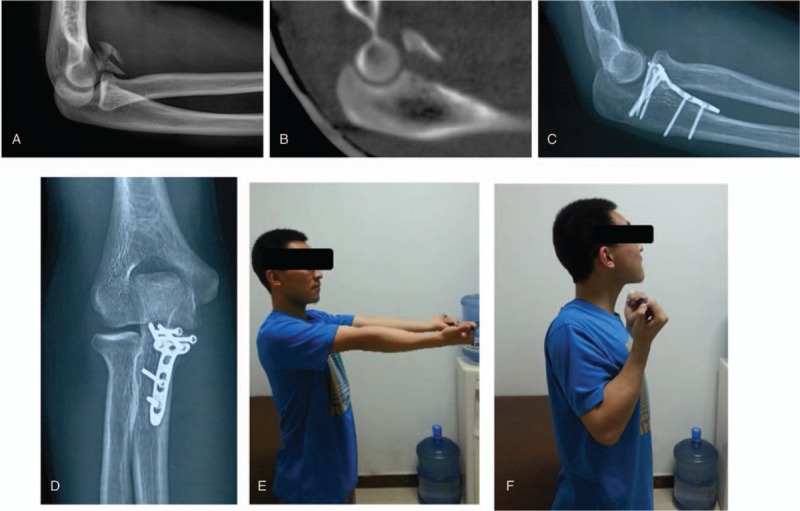
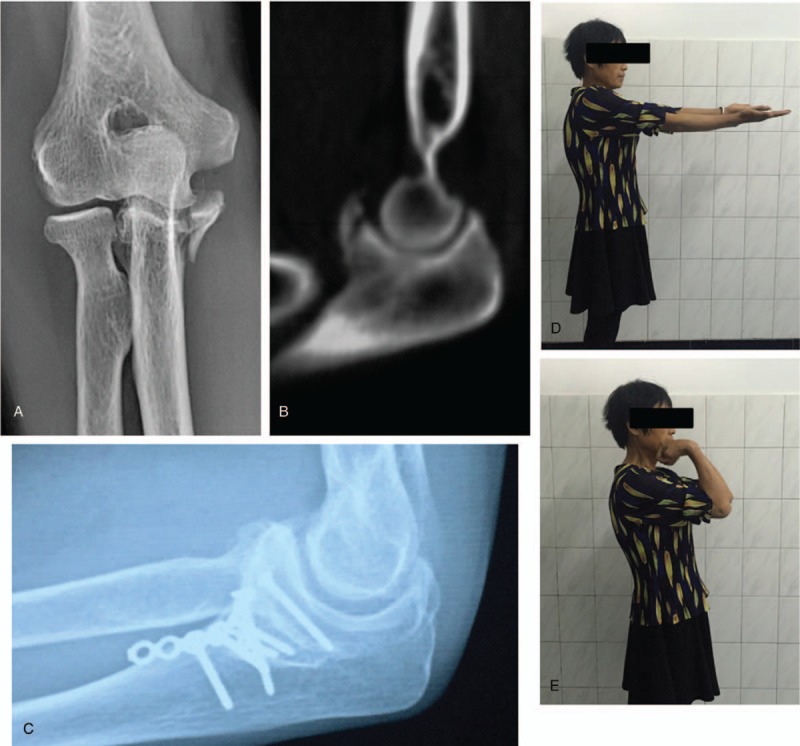
Coronoid process fractures of the ulna are difficult to treat, and are associated with stiffness, recurrent instability, and pain. Hence, treatment of coronoid process fractures are challenging for surgeons. The purpose of this study was to report the clinical outcomes of an anterior surgical approach associated with plate fixation for Regan and Morrey type II or type III fractures of the coronoid process.We evaluated 16 consecutive patients who underwent surgical treatment for fracture of the coronoid process of the ulna from March 2012 to July 2016. Ten patients had a type II fracture, and 6 patients had a type III fracture. All patients underwent surgical treatment for coronoid process fracture through an anterior approach. While preserving the neurovascular structure, all fractures were treated with buttress plate fixation, maintaining the gap between brachial artery and median nerve. Each patient was treated with concentric reduction of both the ulnotrochlear and the radiocapitellar articulations, without any evidence of elbow instability, except 1 case, who showed some medial instability.At the final follow-up, solid osseous union was confirmed for all coronoid fractures. The average time to radiologic union was 16.3 weeks. The mean flexion-extension arc was 124.25 ± 12.12 degree, with a mean flexion contracture of 8.25 ± 4.36 degree, and further flexion of 132.5 ± 9.31 degree. The mean forearm rotation arc was 167.81 ± 10.49 degree. Fifteen patients achieved a functional arc of motion. The mean Mayo elbow performance score was 92.1 points, with 12 excellent cases and 4 good cases.Coronoid process fractures of the ulna can be treated successfully with plate fixation through an anterior surgical approach, which allows for accurate reduction and rigid internal fixation and early functional exercise, resulting in a reasonable outcome.
Conflict of interest statement
The authors report no conflicts of interest.
Figures
References
-
- Adams JE, Hoskin TL, Morrey BF, et al. Management and outcome of 103 acute fractures of the coronoid process of the ulna. J Bone Joint Surg Br 2009;91:632–5. - PubMed
-
- Hotchkiss RN. Rockwood CA, Green DP, Bucholz RW, Heckman JD. Fractures and dislocations of the elbow. Rockwood and Green's Fractures in Adults, vol. 1 4th ed.Philadelphia: Lippincott-Raven; 1996. 929–1024.
-
- Regan W, Morrey B. Fractures of the coronoid process of the ulna. J Bone Joint Surg Am 1989;71:1348–54. - PubMed
-
- O’Driscoll SW, Jupiter JB, Cohen MS, et al. Difficult elbow fractures: pearls and pitfalls. Instr Course Lect 2003;52:113–34. - PubMed
-
- Yang X, Chang W, Chen W, et al. A novel anterior approach for the fixation of ulnar coronoid process fractures. Orthop Traumatol Surg Res 2017;103:899–904. - PubMed
Publication types
MeSH terms
LinkOut - more resources
Full Text Sources
Other Literature Sources
Medical
Miscellaneous
