


Relationship between dyslipidemia and diabetic retinopathy: A systematic review and meta-analysis
- PMID: 30200172
- PMCID: PMC6133445
- DOI: 10.1097/MD.0000000000012283
Relationship between dyslipidemia and diabetic retinopathy: A systematic review and meta-analysis
Abstract
Background: The association between serum lipids and diabetic retinopathy (DR) was controversial. Therefore, we performed a meta-analysis to evaluate the relationship between triglycerides (TG), serum total cholesterol (TC), high-density lipoprotein cholesterol (HDL-C) and low-density lipoprotein cholesterol (LDL-C), and DR.
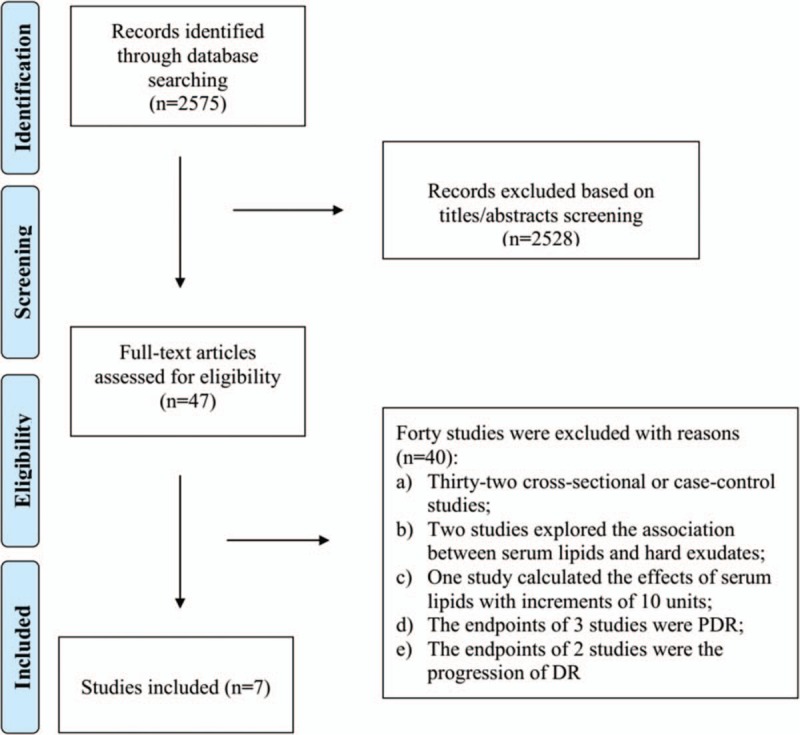
Methods: A systematic review and meta-analysis of observational studies was carried out to explore the association between serum lipids and DR. Studies related were initially indentified by searching PubMed, Cochrane Library, and Elsevier databases through June, 2017. Then a manual retrieval was also performed. RevMan 5.3 software was used to calculate the pooled mean differences (MDs) and related 95% confidence intervals (CIs). To test the stability of the final results, a sensitivity analysis was also performed.
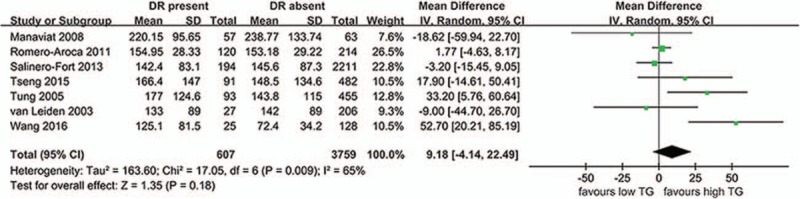
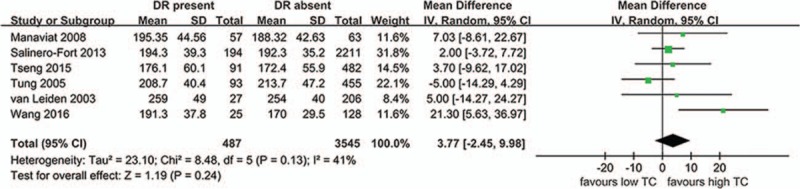
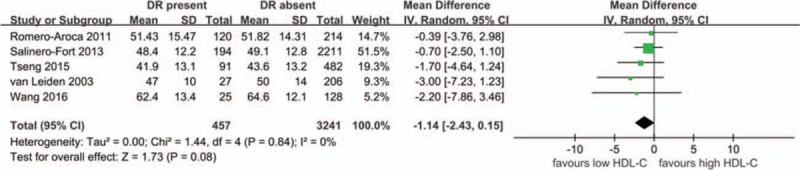
Results: A total of 7 studies were included in this meta-analysis. When compared with the controls, the DR cases did not show significantly higher TG levels (MD 9.18 mg/dL, 95%CI -4.14 to 22.49, P = .18), higher TC levels (MD 3.77 mg/dL, 95%CI: -2.45 to 9.98, P = .24), as well as lower HDL-C levels (MD -1.14 mg/dL, 95%CI: -2.43 to 0.15, P = .08). But slightly higher LDL-C levels were observed (MD 3.74 mg/dL, 95%CI: 0.13-7.35, P = .04). In addition, whether serum lipids involved in the progression of DR were relatively unexplored, but fenofibrate was confirmed to benefit the DR cases.
Conclusions: Based on recent published data, we did not find obvious differences in TG, TC, and HDL-C levels between patients with DR and without DR. However, slightly higher LDL-C levels were observed in the DR cases.
Conflict of interest statement
No conflicts of interest exist.
Figures

References
-
- Yamada M, Hiratsuka Y, Roberts CB, et al. Prevalence of visual impairment in the adult Japanese population by cause and severity and future projections. Ophthalmic Epidemiol 2010;17:50–7. - PubMed
-
- Cheung N, Wang JJ, Klein R, et al. Diabetic retinopathy and the risk of coronary heart disease: the Atherosclerosis Risk in Communities Study. Diabetes Care 2007;30:1742–6. - PubMed
-
- Cheung N, Rogers S, Couper DJ, et al. Is diabetic retinopathy an independent risk factor for ischemic stroke? Stroke 2007;38:398–401. - PubMed
-
- Lachin JM, Genuth S, Nathan DM, et al. Effect of glycemic exposure on the risk of microvascular complications in the diabetes control and complications trial--revisited. Diabetes 2008;57:995–1001. - PubMed
Publication types
MeSH terms
LinkOut - more resources
Full Text Sources
Other Literature Sources
Medical
Research Materials
Miscellaneous
