


A Population-Based Conceptual Framework for Evaluating the Role of Healthcare Services in Place of Death
- PMID: 30200247
- PMCID: PMC6164352
- DOI: 10.3390/healthcare6030107
A Population-Based Conceptual Framework for Evaluating the Role of Healthcare Services in Place of Death
Abstract
Background: There is a significant geographical disparity in place of death. Socio-demographic and disease-related variables only explain less than a quarter of the variation. Healthcare service factors may account for some (or much) of the remaining variation but their effects have never been systematically evaluated, partly due to the lack of a conceptual framework. This study aims to propose a population-based framework to guide the evaluation of the role of the healthcare service factors in place of death.
Methods: Review and synthesis of health service models that include the impact of a service component on either place of death/end of life care outcomes or service access/utilization.
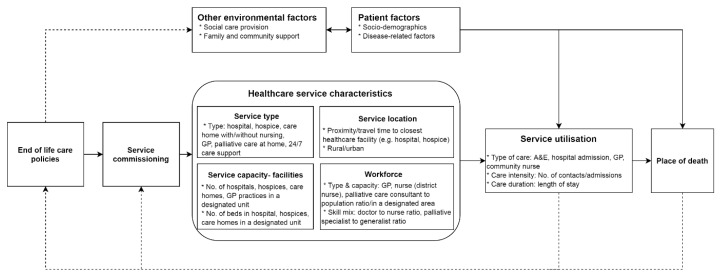
Results: The framework conceptualizes the impact of healthcare services on the place of death as starting from the end of life care policies that in turn influence service commissioning and shape healthcare service characteristics, including service type, service capacity-facilities, service location, and workforce, through which service utilization and ultimately place of death are affected. Patient socio-demographics, disease-related variables, family and community support and social care also influence place of death, but they are not the focus of this framework and therefore are grouped as needs and other environmental factors. Information on service utilization, together with the place of death, creates loop feedback to inform policy and service commission.
Conclusions: The framework provides guidance for analysis aiming to understand the role of healthcare services in place of death. It aids the interpretation of results in the light of existing knowledge and potentially identifies service factors that can be addressed to improve end of life care.
Keywords: conceptual framework; determinants; end of life care outcome; end of life care policies and commissioning; healthcare services; place of death.
Conflict of interest statement
The authors declare that they have no competing interests.
Figures
References
-
- Gao W., Ho Y.K., Verne J., Gordon E., Higginson I.J. Geographical and temporal understanding in place of death in England (1984–2010): Analysis of trends and associated factors to improve end-of-life care (GUIDE_Care)—Primary research. Health Serv. Deliv. Res. 2014;2:1–104. doi: 10.3310/hsdr02420. - DOI - PubMed
-
- Department of Health . End of Life Care Strategy. Department of Health; London, UK: 2008. p. 171.
-
- Department of Health . The Government Response to the Review of Choice in End of Life Care. Department of Health; London, UK: 2016. Our Commitment to you for end of life care.
Grants and funding
LinkOut - more resources
Full Text Sources
Other Literature Sources
