


Digital storytelling in health professions education: a systematic review
- PMID: 30200945
- PMCID: PMC6131857
- DOI: 10.1186/s12909-018-1320-1
Digital storytelling in health professions education: a systematic review
Abstract
Background: Digital stories are short videos that combine stand-alone and first-person narratives with multimedia. This systematic review examined the contexts and purposes for using digital storytelling in health professions education (HPE) as well as its impact on health professionals' learning and behaviours.
Methods: We focused on the results of HPE studies gleaned from a larger systematic review that explored digital storytelling in healthcare and HPE. In December 2016, we searched MEDLINE, EMBASE, PsycINFO, CINAHL, and ERIC. We included all English-language studies on digital storytelling that reported at least one outcome from Levels 2 (learning) or 3 (behaviour) of The New World Kirkpatrick Model. Two reviewers independently screened articles for inclusion and extracted data.
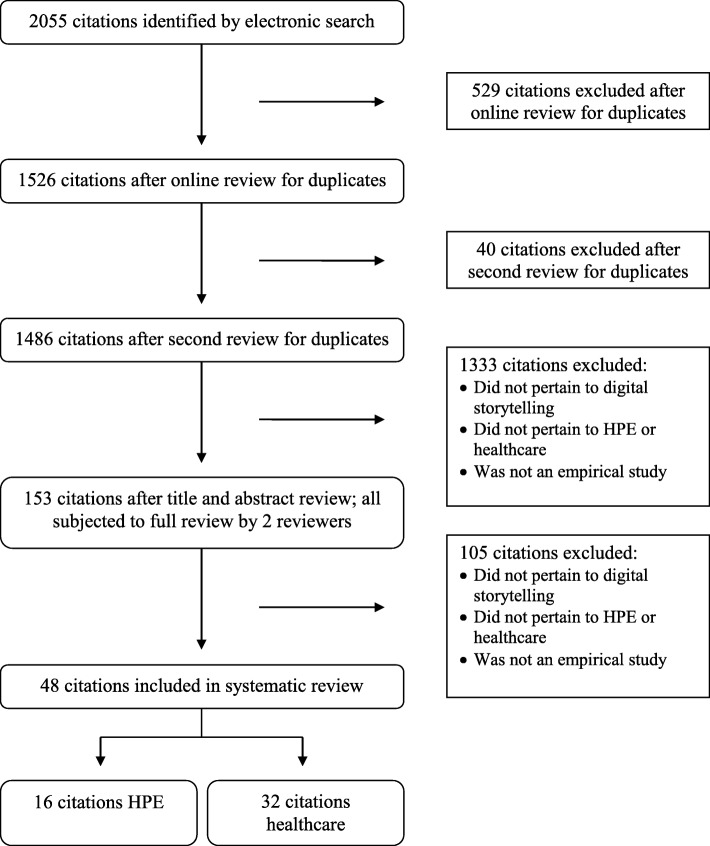
Results: The comprehensive search (i.e., digital storytelling in healthcare and HPE) resulted in 1486 unique titles/abstracts. Of these, 153 were eligible for full review and 42 pertained to HPE. Sixteen HPE articles were suitable for data extraction; 14 focused on health professionals' learning and two investigated health professionals' learning as well as their behaviour changes. Half represented the undergraduate nursing context. The purposes for using digital storytelling were eclectic. The co-creation of patients' digital stories with health professionals as well as the creation and use of health professionals' own digital stories enhanced learning. Patients' digital stories alone had minimal impact on health professionals' learning.
Conclusions: This review highlights the need for high-quality research on the impact of digital storytelling in HPE, especially on health professionals' behaviours.
Prospero registration number: CRD42016050271 .
Keywords: Digital storytelling; Health professions education; Systematic review.
Conflict of interest statement
Authors’ information
Dr. Katherine A. Moreau is an Assistant Professor in the Faculty of Education at the University of Ottawa and a Senior Researcher at the Centre for Research on Educational and Community Services, Ottawa, Ontario.
Dr. Kaylee Eady is a Postdoctoral Fellow in the Faculty of Education at the University of Ottawa, Ottawa, Ontario.
Lindsey Sikora is a Librarian at University of Ottawa who focuses on the use of appropriate methods for conducting systematic and scoping reviews within health sciences.
Dr. Tanya Horsley is the Associate Director of the Research Unit at Royal College of Physicians and Surgeons of Canada and an Adjunct Professor, Faculty of Medicine, University of Ottawa.
Ethics approval and consent to participate
Not applicable.
Consent for publication
Not applicable.
Competing interests
The authors declare that they have no competing interests.
Publisher’s Note
Springer Nature remains neutral with regard to jurisdictional claims in published maps and institutional affiliations.
Figures
References
-
- Rossiter M, Garcia PA. Digital storytelling: a new player on the narrative field. New Dir Adult Cont Educ. 2010;(126):37–48. https://onlinelibrary.wiley.com/doi/abs/10.1002/ace.370. - DOI
-
- Matthews N, Sunderland N. Digital storytelling in health and social policy: listening to marginalised voice. New York: Routledge; 2017.
-
- Lambert J. Cookbook for digital storytelling. New York: Digital Diner Press; 2010.
-
- Miller C. Digital storytelling: a creator's guide to interactive entertainment. Boston: Elsevier; 2004.
Publication types
MeSH terms
LinkOut - more resources
Full Text Sources
Other Literature Sources
