


Reproducibility of Transcranial Doppler ultrasound in the middle cerebral artery
- PMID: 30200977
- PMCID: PMC6131943
- DOI: 10.1186/s12947-018-0133-z
Reproducibility of Transcranial Doppler ultrasound in the middle cerebral artery
Abstract
Background: Transcranial Doppler ultrasound remains the only imaging modality that is capable of real-time measurements of blood flow velocity and microembolic signals in the cerebral circulation. We here assessed the repeatability and reproducibility of transcranial Doppler ultrasound in healthy volunteers and patients with symptomatic carotid artery stenosis.
Methods: Between March and August 2017, we recruited 20 healthy volunteers and 20 patients with symptomatic carotid artery stenosis. In a quiet temperature-controlled room, two 1-h transcranial Doppler measurements of blood flow velocities and microembolic signals were performed sequentially on the same day (within-day repeatability) and a third 7-14 days later (between-day reproducibility). Levels of agreement were assessed by interclass correlation co-efficient.
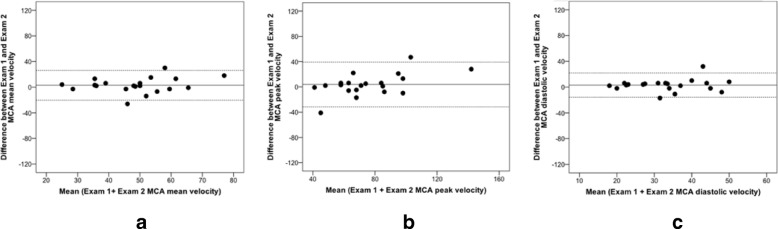
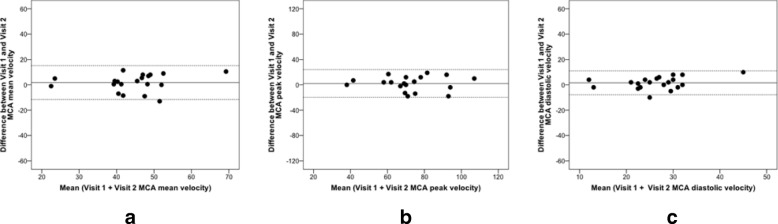
Results: In healthy volunteers (31±9 years, 11 male), within-day repeatability of Doppler measurements were 0.880 (95% CI 0.726-0.950) for peak velocity, 0.867 (95% CI 0.700-0.945) for mean velocity, and 0.887 (95% CI 0.741-0.953) for end-diastolic velocity. Between-day reproducibility was similar but lower: 0.777 (95% CI 0.526-0.905), 0.795 (95% CI 0.558-0.913), and 0.674 (95% CI 0.349-0.856) respectively. In patients (72±11 years, 11 male), within-day repeatability of Doppler measurements were higher: 0.926 (95% CI 0.826-0.970) for peak velocity, 0.922 (95% CI 0.817-0.968) for mean velocity, and 0.868 (95% CI 0.701-0.945) for end-diastolic velocity. Similarly, between-day reproducibility revealed lower values: 0.800 (95% CI 0.567-0.915), 0.786 (95% CI 0.542-0.909), and 0.778 (95% CI 0.527-0.905) respectively. In both cohorts, the intra-observer Bland Altman analysis demonstrated acceptable mean measurement differences and limits of agreement between series of middle cerebral artery velocity measurements with very few outliers. In patients, the carotid stenoses were 30-40% (n = 9), 40-50% (n = 6), 50-70% (n = 3) and > 70% (n = 2). No spontaneous embolisation was detected in either of the groups.
Conclusions: Transcranial Doppler generates reproducible data regarding the middle cerebral artery velocities. However, larger studies are needed to validate its clinical applicability.
Trial registration: ClinicalTrial.gov (ID NCT 03050567), retrospectively registered on 15/05/2017.
Trial registration: ClinicalTrials.gov NCT03050567.
Keywords: Carotid artery stenosis; Ischaemic stroke; Microembolic signals; Transcranial Doppler.
Conflict of interest statement
Authors’ information
JK: Clinical Research Fellow presently supported by the British Heart Foundation Clinical Research Fellowship (FS/17/50/33061). RH: Medical student at University of Edinburgh. KS: Vascular technologist specialised in the transcranial Doppler imaging at Queen Elizabeth University Hospital in Glasgow. MW: Professor of Clinical Pharmacology, Head of the Undergraduate Medical School University of Glasgow and Director of Scottish Stroke Research Network. WW: MRC Clinician Scientist & Honorary Consultant Neurologist at Royal Infirmary of Edinburgh. JW: Head of Edinburgh Imaging, Director of Brain Research Imaging Centre, Honorary Consultant Neuroradiologist at Royal Infirmary of Edinburgh. DEN: British Heart Foundation John Wheatley Chair of Cardiology, Consultant Cardiologist at Royal Infirmary of Edinburgh.
Ethics approval and consent to participate
Ethical approval was granted by the South East Scotland Research Ethics Committee 01 (approval number 16/SS/0217), and written consent was obtained from all participants.
Consent for publication
Not applicable.
Competing interests
The authors declare that they have no competing interests to declare.
Publisher’s Note
Springer Nature remains neutral with regard to jurisdictional claims in published maps and institutional affiliations.
Figures


References
-
- Writing G, Naylor AR, Ricco JB, de Borst GJ, Debus S, de Haro J, Halliday A, Hamilton G, Kakisis J, Kakkos S, Lepidi S, Markus HS, McCabe DJ, Roy J, Sillesen H, van den Berg JC, Vermassen F, Esvs Guidelines C, Kolh P, Chakfe N, Hinchliffe RJ, Koncar I, Lindholt JS, Vega de Ceniga M, Verzini F, Esvs Guideline R, Archie J, Bellmunt S, Chaudhuri A, Koelemay M, et al. Editor's Choice - Management of Atherosclerotic Carotid and Vertebral Artery Disease: 2017 clinical practice guidelines of the European Society for Vascular Surgery (ESVS) Eur J Vasc Endovasc Surg. 2018;55:3–81. doi: 10.1016/j.ejvs.2017.06.021. - DOI - PubMed
Publication types
MeSH terms
Associated data
Grants and funding
LinkOut - more resources
Full Text Sources
Other Literature Sources
Medical
