


Helicobacter pylori seropositivity and its association with incident all-cause and Alzheimer's disease dementia in large national surveys
- PMID: 30201100
- PMCID: PMC6196325
- DOI: 10.1016/j.jalz.2018.04.009
Helicobacter pylori seropositivity and its association with incident all-cause and Alzheimer's disease dementia in large national surveys
Abstract
Introduction: Infectious agents were recently implicated in Alzheimer's disease (AD) and etiology of other dementias, notably Helicobacter pylori.
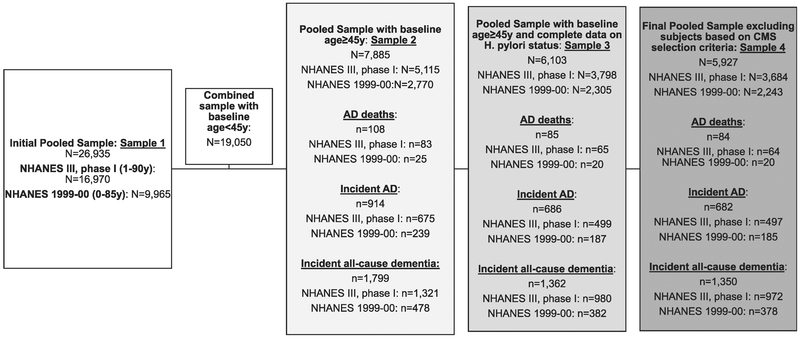
Methods: We tested associations of H. pylori seropositivity with incident all-cause and AD dementia and with AD-related mortality among US adults in a retrospective cohort study. Data from the National Health and Nutrition Surveys III, phase 1 (1988-1991) and 1999-2000 linked with Medicare and National Death Index registries, were used (baseline age ≥45 y, follow-up to 2013, Npooled = 5927).
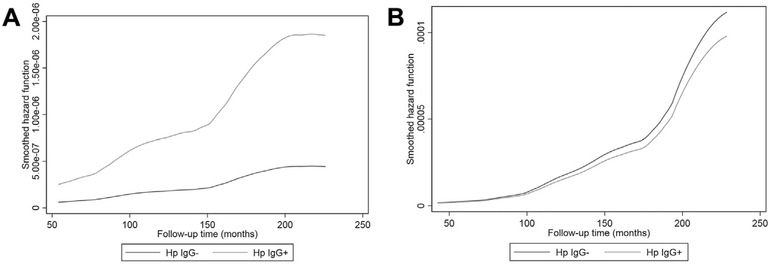
Results: A positive association between H. pylori seropositivity and AD mortality was found in men (hazard ratioadj, pooled = 4.33, 95% confidence interval: 1.51-12.41, P = .006), which was replicated for incident AD and all-cause dementia, with hazard ratioadj, pooled = 1.45 (95% confidence interval: 1.03-2.04, P = .035) and hazard ratioadj, III = 1.44 (95% confidence interval: 1.05-1.98, P = .022), respectively. These associations were also positive among higher socioeconomic status groups.
Discussion: In sum, H. pylori seropositivity's direct association with AD mortality, all-cause dementia, and AD dementia was restricted to men and to higher socioeconomic status groups.
Keywords: Aging; Alzheimer's disease; Dementia; Helicobacter pylori; Mortality.
Published by Elsevier Inc.
Conflict of interest statement
The authors have declared that no conflict of interest exists.
Figures
Comment in
-
Impact of Helicobacter pylori and/or Helicobacter pylori-related metabolic syndrome on incidence of all-cause and Alzheimer's dementia.Alzheimers Dement. 2019 May;15(5):723-725. doi: 10.1016/j.jalz.2019.01.008. Epub 2019 Mar 11. Alzheimers Dement. 2019. PMID: 30872115 No abstract available.
References
-
- Sosa-Ortiz AL, Acosta-Castillo I, Prince MJ. Epidemiology of dementias and Alzheimer’s disease. Arch Med Res 2012;43:600–8. - PubMed
-
- Prince M, Bryce R, Albanese E, Wimo A, Ribeiro W, Ferri CP. The global prevalence of dementia: a systematic review and metaanalysis. Alzheimers Dement 2013;9:63–75.e2. - PubMed
-
- Lindeboom J, Weinstein H. Neuropsychology of cognitive ageing, minimal cognitive impairment, Alzheimer’s disease, and vascular cognitive impairment. Eur J Pharmacol 2004;490:83–6. - PubMed
-
- Hardy J, Selkoe DJ. The amyloid hypothesis of Alzheimer’s disease: progress and problems on the road to therapeutics. Science 2002; 297:353–6. - PubMed
Publication types
MeSH terms
Substances
Grants and funding
LinkOut - more resources
Full Text Sources
Other Literature Sources
Medical
