Emergency Department Use and Enrollment in a Medical Home Providing After-Hours Care
- PMID: 30201638
- PMCID: PMC6130993
- DOI: 10.1370/afm.2291
Emergency Department Use and Enrollment in a Medical Home Providing After-Hours Care
Abstract
Purpose: Compared with other high-income countries, Canada and the United States have among the highest rates of emergency department use and the lowest rates of primary care physicians reporting arrangements for after-hours care. We assessed whether enrollment in a medical home mandated to provide after-hours care in Ontario, Canada, was associated with reduced emergency department use.
Methods: We conducted a retrospective cohort study using linked administrative data. We included all adult Ontarians enrolled in a medical home between April 1, 2005, and March 31, 2012, who had a minimum of 3 years of outcome data before and after enrollment (N = 2,945,087). We performed a linear segmented analysis with patient-level data to understand the association between initial enrollment in a medical home and emergency department visits, the proportion of all primary care visits occurring on the weekend, and the primary care visit rate. Age, income quintile, comorbidity, and morbidity were included in the modeling as time-varying covariates and sex as a stable variable.
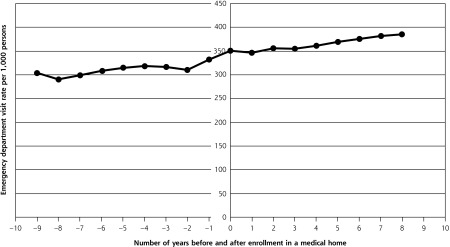
Results: The emergency department visit rate increased by 0.8% (95% CI, 0.7% to 0.9%) per year before medical home enrollment and by 1.5% (95% CI, 1.4% to 1.5%) per year after the transition. Enrollment in a medical home was associated with an increase in the proportion of visits that occurred on weekends, but a decrease in the overall primary care visit rate.
Conclusions: Enrollment of adult Ontarians in a primary care medical home offering after-hours care was not associated with a reduction in emergency department use. It will therefore be important to prospectively evaluate policy reforms aimed at improving access to primary care outside of conventional hours.
Keywords: access to health care; after-hours care; continuity of patient care; emergency care; health care reform; health care utilization; medical home; primary care.
© 2018 Annals of Family Medicine, Inc.
Figures
References
-
- Robin O, Schoen C. Chartpack: The Commonwealth Fund 2013 International Health Policy Survey in Eleven Countries. Washington, DC: Commonwealth Fund; 2013.
-
- O’Malley AS. After-hours access to primary care practices linked with lower emergency department use and less unmet medical need. Health Aff (Millwood). 2013; 32(1): 175–183. - PubMed
-
- van den Berg MJ, van Loenen T, Westert GP. Accessible and continuous primary care may help reduce rates of emergency department use. An international survey in 34 countries. Fam Pract. 2016; 33(1): 42–50. - PubMed
Publication types
MeSH terms
Grants and funding
LinkOut - more resources
Full Text Sources
Other Literature Sources
Miscellaneous