


The culture of social comparison
- PMID: 30201717
- PMCID: PMC6166806
- DOI: 10.1073/pnas.1721555115
The culture of social comparison
Erratum in
-
Correction for Baldwin and Mussweiler, The culture of social comparison.Proc Natl Acad Sci U S A. 2018 Oct 23;115(43):E10285. doi: 10.1073/pnas.1816586115. Epub 2018 Oct 15. Proc Natl Acad Sci U S A. 2018. PMID: 30322912 Free PMC article. No abstract available.
Abstract
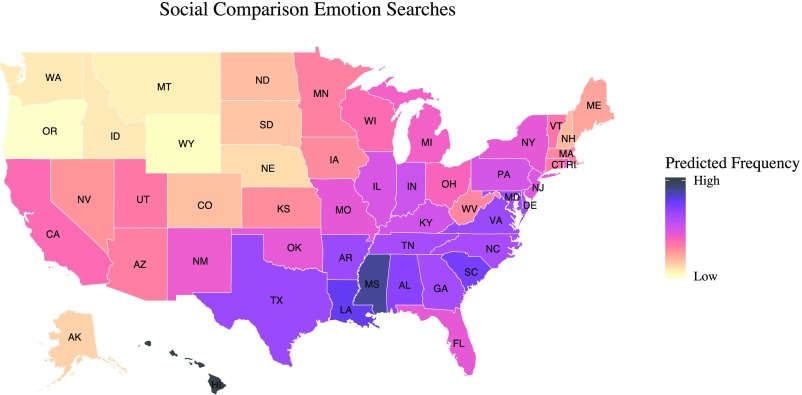
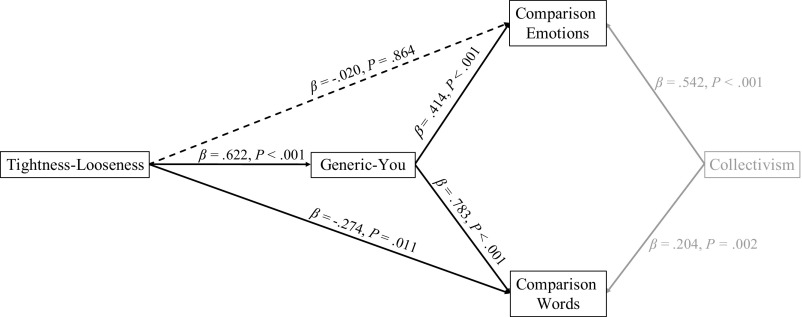
Social comparison is one of the most ubiquitous features of human social life. This fundamental human tendency to look to others for information about how to think, feel, and behave has provided us with the ability to thrive in a highly complex and interconnected modern social world. Despite its prominent role, however, a detailed understanding of the cultural foundations of social comparison is lacking. The current research aims to fill this gap by showing that two prominent cultural dimensions, tightness-looseness and individualism-collectivism, uniquely explain variation in social-comparison proclivity across individuals, situations, and cultures. We first demonstrate the yet-undocumented link between cultural tightness and comparison proclivity across individuals, and further show that perceptions of ambient tightness and interdependence are uniquely associated with stronger social-comparison tendencies. Next, we show that these associations arise across social settings and can be attributed to properties of the settings themselves, not solely to individual differences. Finally, we show that both tight and collectivistic US states show a propensity to engage in Google searches related to specific social-comparison emotions, but that the tightness-comparison link arises from a unique psychological mechanism. Altogether, these findings show that social comparison-a fundamental aspect of human cognition-is linked to cultural practices based both in prevalence and strength of social norms as well as the tendency to construe the self in relation to others.
Keywords: big data; culture; individualism–collectivism; social comparison; tightness–looseness.
Copyright © 2018 the Author(s). Published by PNAS.
Conflict of interest statement
The authors declare no conflict of interest.
Figures
References
-
- Fehr E, Fischbacher U. The nature of human altruism. Nature. 2003;425:785–791. - PubMed
-
- Fehr E, Rockenbach B. Human altruism: Economic, neural, and evolutionary perspectives. Curr Opin Neurobiol. 2004;14:784–790. - PubMed
-
- Rand DG, Greene JD, Nowak MA. Spontaneous giving and calculated greed. Nature. 2012;489:427–430. - PubMed
-
- Mussweiler T. Comparison processes in social judgment: Mechanisms and consequences. Psychol Rev. 2003;110:472–489. - PubMed
-
- Suls J, Martin R, Wheeler L. Social comparison: Why, with whom, and with what effect? Curr Dir Psychol Sci. 2002;11:159–163.
Publication types
MeSH terms
LinkOut - more resources
Full Text Sources
Other Literature Sources
Miscellaneous
