


Spatial Architecture and Arrangement of Tumor-Infiltrating Lymphocytes for Predicting Likelihood of Recurrence in Early-Stage Non-Small Cell Lung Cancer
- PMID: 30201760
- PMCID: PMC6397708
- DOI: 10.1158/1078-0432.CCR-18-2013
Spatial Architecture and Arrangement of Tumor-Infiltrating Lymphocytes for Predicting Likelihood of Recurrence in Early-Stage Non-Small Cell Lung Cancer
Abstract
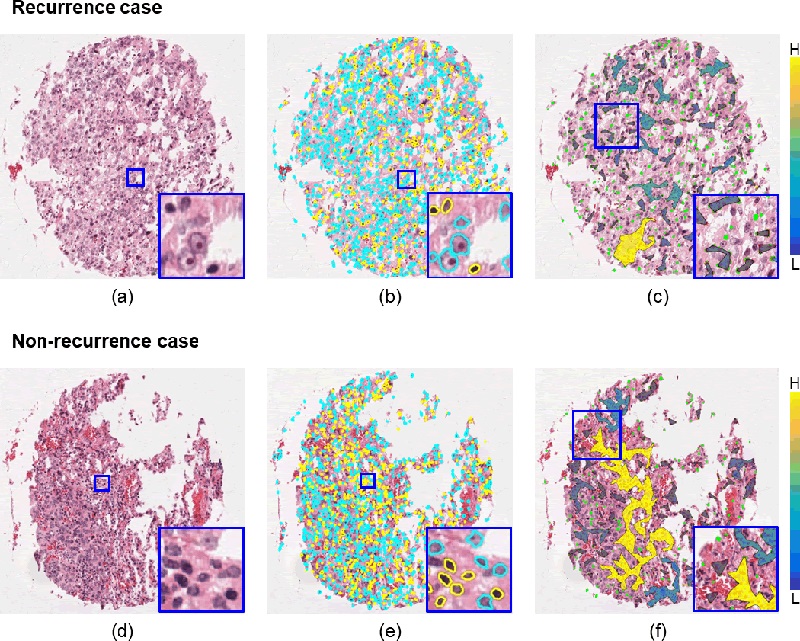
Purpose: The presence of a high degree of tumor-infiltrating lymphocytes (TIL) has been proven to be associated with outcome in patients with non-small cell lung cancer (NSCLC). However, recent evidence indicates that tissue architecture is also prognostic of disease-specific survival and recurrence. We show a set of descriptors (spatial TIL, SpaTIL) that capture density, and spatial colocalization of TILs and tumor cells across digital images that can predict likelihood of recurrence in early-stage NSCLC.
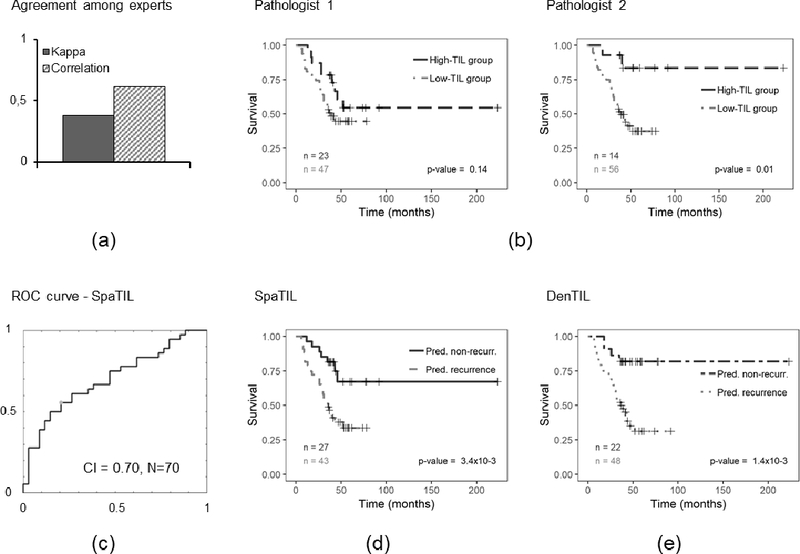
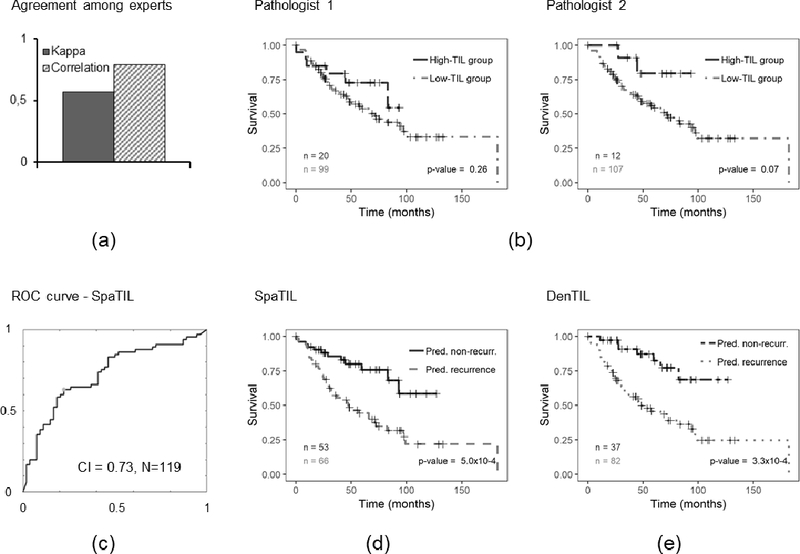
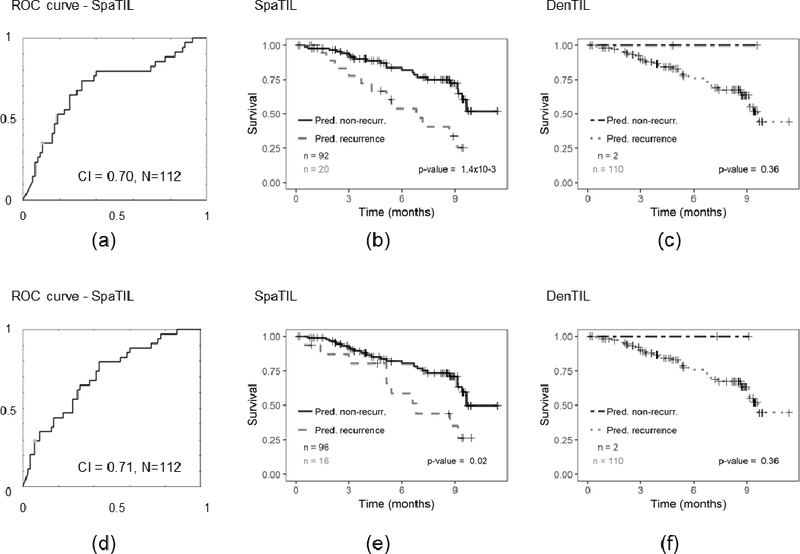
Experimental design: The association between recurrence in early-stage NSCLC and SpaTIL features was explored on 301 patients across four different cohorts. Cohort D1 (n = 70) was used to identify the most prognostic SpaTIL features and to train a classifier to predict the likelihood of recurrence. The classifier performance was evaluated in cohorts D2 (n = 119), D3 (n = 112), and D4 (n = 112). Two pathologists graded each sample of D1 and D2; intraobserver agreement and association between manual grading and likelihood of recurrence were analyzed.
Results: SpaTIL was associated with likelihood of recurrence in all test sets (log-rank P < 0.02). A multivariate Cox proportional hazards analysis revealed an HR of 3.08 (95% confidence interval, 2.1-4.5, P = 7.3 × 10⁻⁵). In contrast, agreement among expert pathologists using tumor grade was moderate (Kappa = 0.5), and the manual TIL grading was only prognostic for one reader in D2 (P = 8.0 × 10⁻³).
Conclusions: A set of features related to density and spatial architecture of TILs was found to be associated with a likelihood of recurrence of early-stage NSCLC. This information could potentially be used for helping in treatment planning and management of early-stage NSCLC.See related commentary by Peled et al., p. 1449.
©2018 American Association for Cancer Research.
Conflict of interest statement
Figures
Comment in
-
Tumor-Infiltrating Lymphocytes-Location for Prognostic Evaluation.Clin Cancer Res. 2019 Mar 1;25(5):1449-1451. doi: 10.1158/1078-0432.CCR-18-3803. Epub 2018 Dec 19. Clin Cancer Res. 2019. PMID: 30567833
References
-
- Geng Y, Shao Y, He W, Hu W, Xu Y, Chen J, et al. Prognostic Role of Tumor-Infiltrating Lymphocytes in Lung Cancer: a Meta-Analysis. Cellular Physiology and Biochemistry 2015;37:1560–1571. - PubMed
-
- Donnem T, Hald SM, Paulsen EE, Richardsen E, Al-Saad S, Kilvaer TK, et al. Stromal CD8+ T-cell Density - A Promising Supplement to TNM Staging in Non-Small Cell Lung Cancer. Clinical Cancer Research 2015;21:2635–2643. - PubMed
Publication types
MeSH terms
Grants and funding
LinkOut - more resources
Full Text Sources
Other Literature Sources
Medical
