Review
. 2018 Sep 10;10(9):484.
doi: 10.3390/v10090484.

Susceptibility Genes to Plant Viruses

Affiliations
Review

Susceptibility Genes to Plant Viruses

Hernan Garcia-Ruiz. Viruses. .

Abstract

Plant viruses use cellular factors and resources to replicate and move. Plants respond to viral infection by several mechanisms, including innate immunity, autophagy, and gene silencing, that viruses must evade or suppress. Thus, the establishment of infection is genetically determined by the availability of host factors necessary for virus replication and movement and by the balance between plant defense and viral suppression of defense responses. Host factors may have antiviral or proviral activities. Proviral factors condition susceptibility to viruses by participating in processes essential to the virus. Here, we review current advances in the identification and characterization of host factors that condition susceptibility to plant viruses. Host factors with proviral activity have been identified for all parts of the virus infection cycle: viral RNA translation, viral replication complex formation, accumulation or activity of virus replication proteins, virus movement, and virion assembly. These factors could be targets of gene editing to engineer resistance to plant viruses.

Keywords: antiviral defense; gene silencing; host factors; virus accumulation; virus movement; virus resistance; virus susceptibility genes.


Conflict of interest statement

The authors declare no conflict of interest. The founding sponsors had no role in the design of the study; in the collection, analyses, or interpretation of data; in the writing of the manuscript, and in the decision to publish the results.

Figures
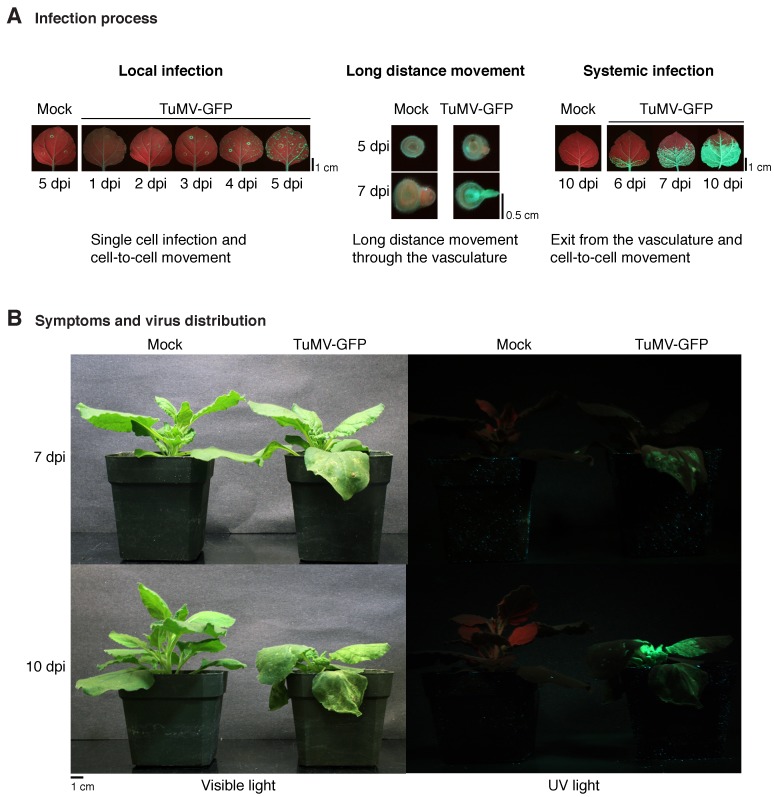
Figure 1
Figure 1
Plant virus infection progression, movement, and symptoms caused by virus infection. Nicotiana benthamiana plants were inoculated with GFP-tagged TuMV (TuMV-GFP) by agroinfiltration and leaves of whole plant pictures taken under visible or UV light. (A) Pictures showing representative local infection foci (green spots) in inoculated leaves, long-distance movement and infection of the vascular system, and progression of systemic infection in noninoculated leaves. (B) Symptoms of TuMV-GFP infection at 10 days post-inoculation (dpi) and distribution of virus infection as determined by UV illumination.
Figure 2
Figure 2
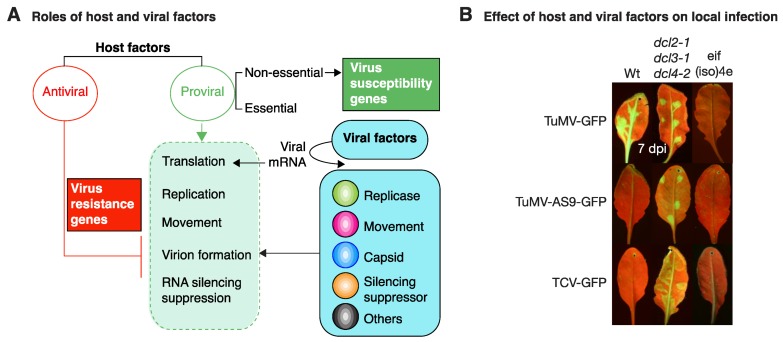
Functional groups of host and viral factors based on their role in virus infection. (A) Host factors may have antiviral or proviral activity. Antiviral factors (red line) condition resistance to virus infection by antagonizing one or more essential parts of the infection cycle (dotted green box). Proviral factors (green arrow) work in synchrony with viral factors in all parts of the infection cycle, determine virus susceptibility, and may be essential or nonessential to the host. (B) Gene silencing restricts virus infection and virus-encoded silencing suppressors are needed for infection. In the absence of translation initiation factor eIS(iso)4E, TuMV cannot infect A. thaliana. eIF(iso)4E is needed for potyvirus replication and/or cell-to-cell movement. A. thaliana leaves were mechanically inoculated with TuMV-GFP, suppressor deficient TuMV-AS9-GFP, or suppressor deficient TCV-GFP. Pictures were taken at 7 dpi under UV light.

Similar articles

Cited by

References

    1. Hull R. Plant Virology. 5th ed. Elsevier; New York, NY, USA: 2014.
    1. Makinen K., Hafren A. Intracellular coordination of potyviral RNA functions in infection. Front. Plant Sci. 2014;5:110. doi: 10.3389/fpls.2014.00110. - DOI - PMC - PubMed
    1. Heinlein M. Plant virus replication and movement. Virology. 2015;479–480:657–671. doi: 10.1016/j.virol.2015.01.025. - DOI - PubMed
    1. Ivanov K.I., Eskelin K., Lohmus A., Makinen K. Molecular and cellular mechanisms underlying potyvirus infection. J. Gen. Virol. 2014;95:1415–1429. doi: 10.1099/vir.0.064220-0. - DOI - PubMed
    1. Jin X., Cao X., Wang X., Jiang J., Wan J., Laliberté J.-F., Zhang Y. Three-dimensional architecture and biogenesis of membrane structures associated with plant virus replication. Front. Plant Sci. 2018;9:57. doi: 10.3389/fpls.2018.00057. - DOI - PMC - PubMed

Publication types

MeSH terms