. 2018 Sep 10;8(1):13546.
doi: 10.1038/s41598-018-31906-4.

Radiomics of US texture features in differential diagnosis between triple-negative breast cancer and fibroadenoma

Affiliations

Radiomics of US texture features in differential diagnosis between triple-negative breast cancer and fibroadenoma

Si Eun Lee et al. Sci Rep. .

Abstract

Triple-negative breast cancer (TNBC) is sometimes mistaken for fibroadenoma due to its tendency to show benign morphology on breast ultrasound (US) albeit its aggressive nature. This study aims to develop a radiomics score based on US texture analysis for differential diagnosis between TNBC and fibroadenoma, and to evaluate its diagnostic performance compared with pathologic results. We retrospectively included 715 pathology-proven fibroadenomas and 186 pathology-proven TNBCs which were examined by three different US machines. We developed the radiomics score by using penalized logistic regression with a least absolute shrinkage and selection operator (LASSO) analysis from 730 extracted features consisting of 14 intensity-based features, 132 textural features and 584 wavelet-based features. The constructed radiomics score showed significant difference between fibroadenoma and TNBC for all three US machines (p < 0.001). Although the radiomics score showed dependency on the type of US machine, we developed more elaborate radiomics score for a subgroup in which US examinations were performed with iU22. This subsequent radiomics score also showed good diagnostic performance, even for BI-RADS category 3 or 4a lesions (AUC 0.782) which were presumed as probably benign or low suspicious of malignancy by radiologists. It was expected to assist radiologist's diagnosis and reduce the number of invasive biopsies, although US standardization should be overcome before clinical application.


Conflict of interest statement

The authors declare no competing interests.

Figures

Figure 1
Figure 1
Flowchart for lesion selection. 1IU22, Philips Medical Systems, Bothell, WA. 2LOGIQ E9, GE Healthcare, Milwaukee, WI. 3HDI 5000, Philips Medical Systems, Bothell, WA.
Figure 2
Figure 2
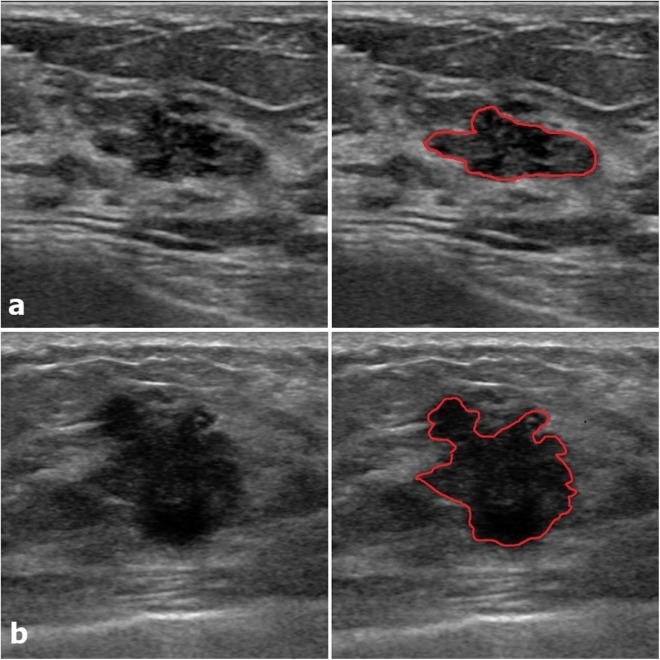
Two representative examples with defined ROI. (a) An 18mm-sized oval, microlobulated, hypoechoic lesion (BI-RADS category 4a) which was confirmed as fibroadenoma presented a low radiomics score (−3.83, predicted malignancy 0.4%). (b) A 20mm-sized irregular, spiculated, hypoechoic lesion (BI-RADS category 5) which was confirmed as TNBC presented a high radiomics score (3.01, predicted malignancy 99.6%).
Figure 3
Figure 3
Two couples of similar lesions with differences in the radiomics score. (a) A 10mm-sized round, microlobulated, hypoechoic lesion (BI-RADS 4a) confirmed as fibroadenoma showed a radiomics score of −2.19 (predicted malignancy 5%). (b) A 9mm-sized round, microlobulated, hypoechoic lesion (BI-RADS 4a) confirmed as TNBC showed a radiomics score of −1.36 (predicted malignancy 17%). (c) A 26mm-sized oval, angular, hypoechoic lesion (BI-RADS 4a) confirmed as fibroadenoma showed a radiomics score of −1.11 (predicted malignancy 24%). (d) A 25mm-sized oval, microlobulated, hypoechoic lesion (BI-RADS 4a) confirmed as TNBC showed a radiomics score of 0.22 (predicted malignancy 74%).

References

    1. Dent R, et al. Triple-negative breast cancer: clinical features and patterns of recurrence. Clinical cancer research. 2007;13:4429–4434. doi: 10.1158/1078-0432.CCR-06-3045. - DOI - PubMed
    1. Rodríguez-Pinilla SM, et al. Prognostic significance of basal-like phenotype and fascin expression in node-negative invasive breast carcinomas. Clinical cancer research. 2006;12:1533–1539. doi: 10.1158/1078-0432.CCR-05-2281. - DOI - PubMed
    1. Mersin H, Yildirim E, Berberoglu U, Gülben K. The prognostic importance of triple negative breast carcinoma. The Breast. 2008;17:341–346. doi: 10.1016/j.breast.2007.11.031. - DOI - PubMed
    1. Irshad A, et al. Assessing the role of ultrasound in predicting the biological behavior of breast cancer. American Journal of Roentgenology. 2013;200:284–290. doi: 10.2214/AJR.12.8781. - DOI - PubMed
    1. Cho N. Molecular subtypes and imaging phenotypes of breast cancer. Ultrasonography. 2016;35:281–288. doi: 10.14366/usg.16030. - DOI - PMC - PubMed

Publication types

MeSH terms