. 2018 Oct 12;46(18):9855-9863.
doi: 10.1093/nar/gky795.

Synthetic control systems for high performance gene expression in mammalian cells

Affiliations

Synthetic control systems for high performance gene expression in mammalian cells

Gabriele Lillacci et al. Nucleic Acids Res. .

Abstract

Tunable induction of gene expression is an essential tool in biology and biotechnology. In spite of that, current induction systems often exhibit unpredictable behavior and performance shortcomings, including high sensitivity to transactivator dosage and plasmid take-up variation, and excessive consumption of cellular resources. To mitigate these limitations, we introduce here a novel family of gene expression control systems of varying complexity with significantly enhanced performance. These include: (i) an incoherent feedforward circuit that exhibits output tunability and robustness to plasmid take-up variation; (ii) a negative feedback circuit that reduces burden and provides robustness to transactivator dosage variability; and (iii) a new hybrid circuit integrating negative feedback and incoherent feedforward that combines the benefits of both. As with endogenous circuits, the complexity of our genetic controllers is not gratuitous, but is the necessary outcome of more stringent performance requirements. We demonstrate the benefits of these controllers in two applications. In a culture of CHO cells for protein manufacturing, the circuits result in up to a 2.6-fold yield improvement over a standard system. In human-induced pluripotent stem cells they enable precisely regulated expression of an otherwise poorly tolerated gene of interest, resulting in a significant increase in the viability of the transfected cells.


Figures
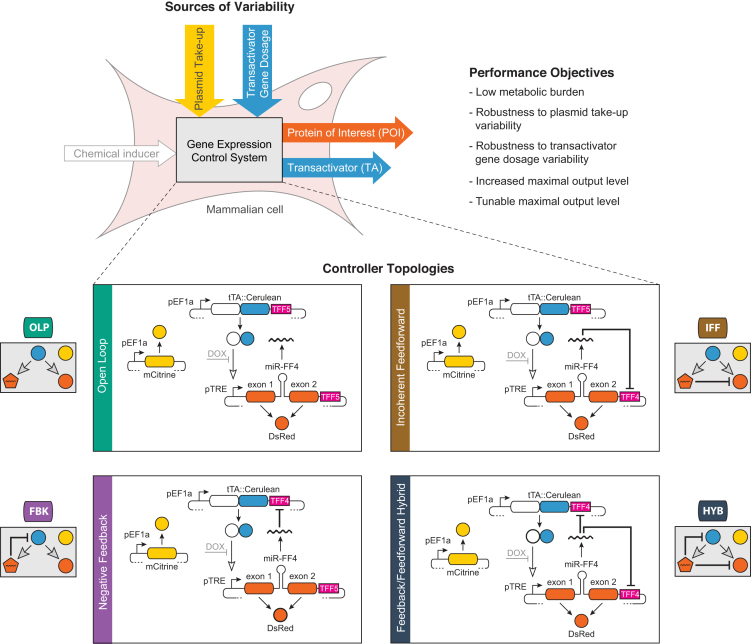
Figure 1.
Figure 1.
Study design. We introduce four cybergenetic circuits for controlling inducible gene expression in mammalian cells: an open loop circuit (OLP), a negative feedback controller circuit (FBK), an IFF controller circuit and a negative feedback/IFF hybrid controller circuit (HYB). We analyze their performance with respect to transactivator gene dosage and plasmid take-up variability (see Figure 2). Rounded rectangles denote coding sequences. Colored circles indicate fluorescent proteins of the corresponding color. The pentagon represents a post-transcriptional repressor. Solid pointed arrows denote gene expression, hollow pointed arrows show transcriptional activation, while blunt arrows denote post-transcriptional repression. Dashed lines represent variable circuit elements. Purple rectangles are micro-RNA targets.
Figure 2.
Figure 2.
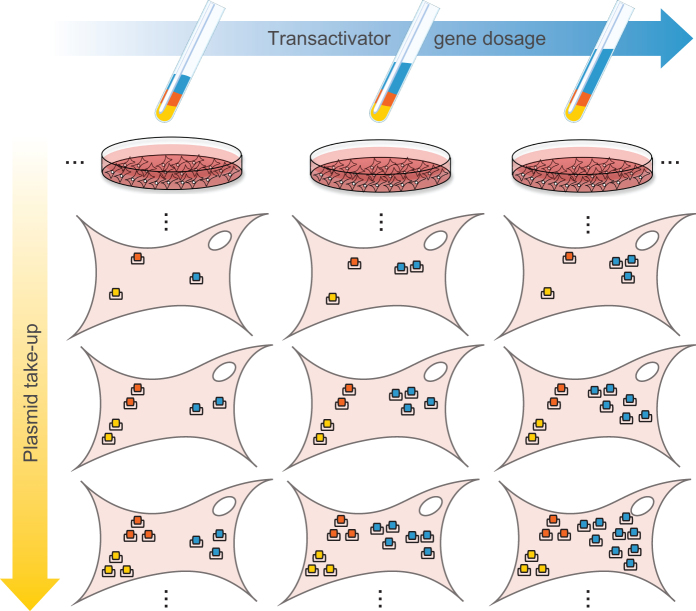
Experimental setup. Mammalian transient transfection results in a large variability in plasmid take-up. Additionally, we generate transactivator gene dosage variability by changing the relative amount of transactivator plasmid in the transfection samples. Individual cells will on average take up plasmids in the same relative amount as those in the transfection samples.
Figure 3.
Figure 3.
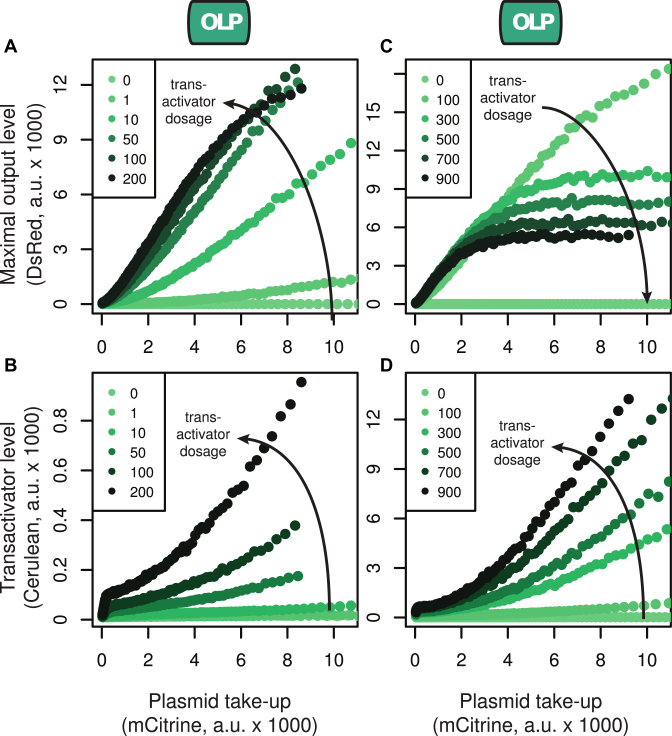
Maximal output level (MOL) in the open loop controller as a function of plasmid take-up and transactivator dosage. The plasmids comprising the open loop controller were co-transfected using variable amounts of the tTA::Cerulean plasmid, thus varying the relative amount of tTA::Cerulean taken up by the individual cells. Plasmid-takup/MOL (top) and plasmid-takeup/TA (bottom) functions were obtained for low tTA::Cerulean dosages (A and B) and high tTA::Cerulean dosages (C and D). The numbers in the legends indicate the amounts (in nanograms) of tTA::Cerulean plasmid used in the corresponding transfection. All curves were obtained by pooling data from N = 3 replicates per condition, each of which had an average of ∼240 000 positively transfected cells (with above-background mCitrine expression).
Figure 4.
Figure 4.
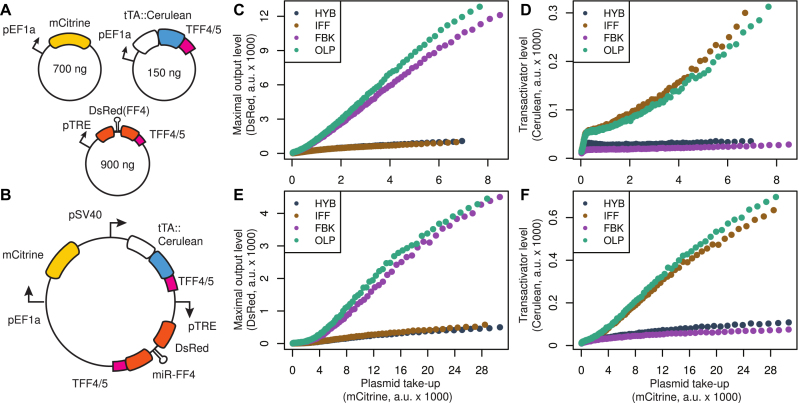
Characterization of the cybergenetic circuits. (A) Implementation of the four controller topologies using separate plasmids. To avoid resource burden induced by overexpression of tTA::Cerulean, we used 150 ng of tTA::Cerulean plasmids in the transfection mixes, while the amounts of mCitrine and DsRed plasmids were 700 and 900 ng, respectively. (B) Implementation of the four controllers on a single plasmid each. (CF) Experimental plasmid-takeup/MOL (left) and plasmid-takeup/TA (right) functions of the controllers on separate plasmids (top) or single plasmids (bottom). The colors indicate different topologies: hybrid feedback-feedforward (steel), feedback-only (lilac), feedforward-only (dark gold) and open loop (aqua). The curves were obtained by pooling data from N = 3 replicates per condition, each of which had an average of ∼460 000 positively transfected cells (with above-background mCitrine expression).
Figure 5.
Figure 5.
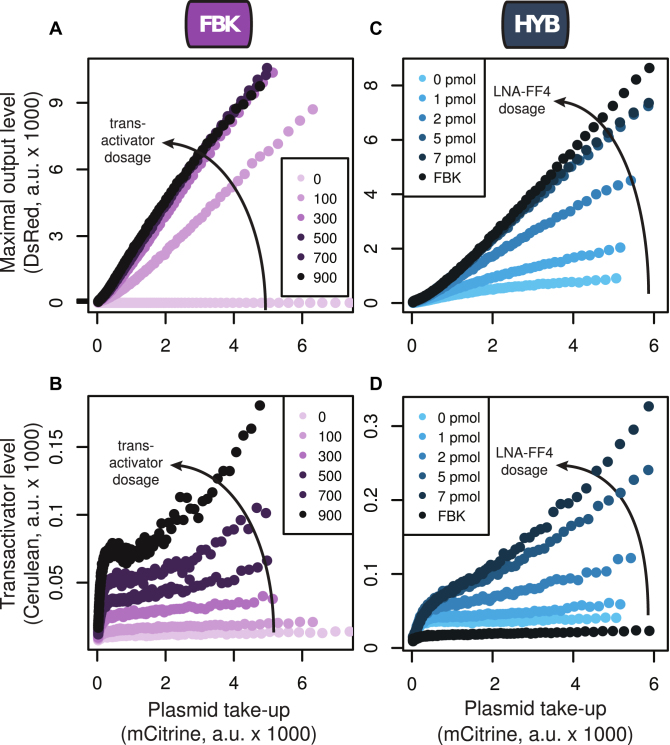
Robustness and tunability of MOL. (A and B) Plasmid-takeup/MOL (A) and plasmid-takeup/TA (B) functions for the transfections of the feedback controller with variable dosage of tTA::Cerulean. The numbers in the legends indicate the nanograms of tTA::Cerulean plasmid used in each transfection. (C and D) Plasmid-takeup/MOL (C) and plasmid-takeup/TA (D) functions for the transfections of the hybrid controller together with varying amounts of a miR-FF4 inhibitor. The numbers in the legend indicate the amount of inhibitor used in each transfection well. The black curve, denoted FBK, shows the results of a sample in which DsRed had FF5 targets instead of FF4 targets (thereby resulting in the feedback circuit). All curves were obtained by pooling data from N = 3 replicates per condition, each of which had an average of ∼600 000 positively transfected cells (with above-background mCitrine expression).
Figure 6.
Figure 6.
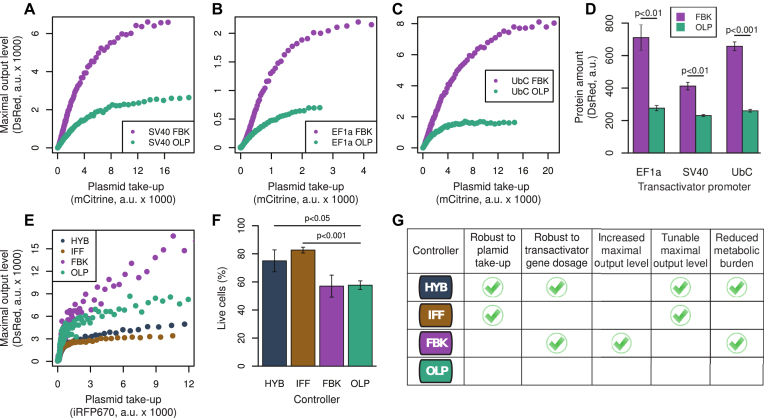
The cybergenetic circuits as a platform for transgene expression. (AC) Plasmid-takeup/MOL functions for the transfections in CHO-K1 cells with PEI. (D) Average DsRed levels in the populations of transfected CHO-K1. (E) Plasmid-takeup/MOL functions for the transfection in hIPSCs. (F) Percentage of transfected live hIPSCs as quantified by the calcein AM assay. In (A–C) and (E), the curves were obtained by pooling data from N = 3 replicates per condition, each of which had an average of ∼200 000 (A–C) or 28 000 (E) positively transfected cells (with above-background mCitrine or iRFP670 expression). In (D) and (F), the reported values are the means of N = 3 replicates, and the error bars denote standard deviation. The P-values were obtained using t-tests for the comparison of the means. (G) Summary of controller features.

References

    1. Hoppe P.S., Coutu D.L., Schroeder T.. Single-cell technologies sharpen up mammalian stem cell research. Nat. Cell Biol. 2014; 16:919–927. - PubMed
    1. Ausländer S., Fussenegger M.. From gene switches to mammalian designer cells: present and future prospects. Trends Biotechnol. 2013; 31:155–168. - PubMed
    1. Gossen M., Freundlieb S., Bender G., Muller G., Hillen W., Bujard H.. Transcriptional activation by tetracyclines in mammalian cells. Science. 1995; 268:1766–1769. - PubMed
    1. Cronin C.A., Gluba W., Scrable H.. The lac operator-repressor system is functional in the mouse. Genes Dev. 2001; 15:1506–1517. - PMC - PubMed
    1. Roney I.J., Rudner A.D., Couture J.-F., Kærn M.. Improvement of the reverse tetracycline transactivator by single amino acid substitutions that reduce leaky target gene expression to undetectable levels. Sci.Rep. 2016; 6:27697. - PMC - PubMed

Publication types

Substances