


Life Expectancies With Depression by Age of Migration and Gender Among Older Mexican Americans
- PMID: 30203062
- PMCID: PMC6857755
- DOI: 10.1093/geront/gny107
Life Expectancies With Depression by Age of Migration and Gender Among Older Mexican Americans
Abstract
Background and objectives: Prior studies examining depression among older Mexican Americans suggest both women and immigrants are at higher risk of depressive symptomatology than males and U.S.-born Mexican Americans. We use data from the Hispanic Established Populations for the Epidemiologic Study of the Elderly to examine whether life expectancy with depression and without depression varies by nativity, age of migration, and gender.
Research design and methods: Sullivan-based life tables were used to estimate depression life expectancies among Mexican Americans aged 65 years and older residing in the Southwestern United States. Depression is based on the 20-item Center for Epidemiological Studies Depression scale (CES-D). The CES-D is a continuous scale (0-60) with higher values indicating worse mental health. We dichotomize depression as a score of 16 or greater.
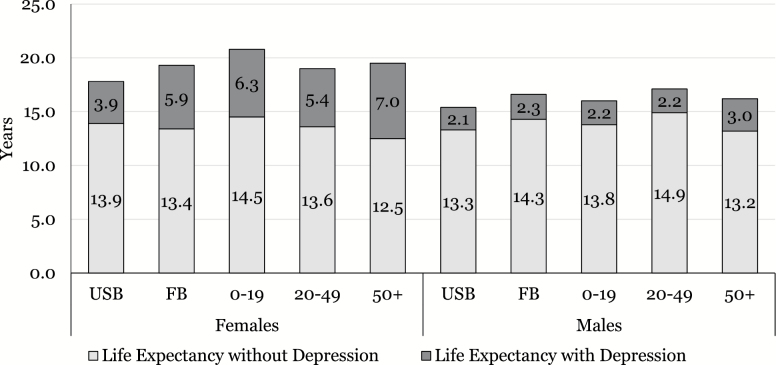
Results: Immigrant women, particularly those who migrated in late-life (after age 50) are at a significant disadvantage in the number of years after age 65 lived with depression and the ratio of years spent without depression relative to U.S.-born women. Among men, only late-life immigrants were disadvantaged in the number of years spent with depression. Early- and mid-life immigrant males did not differ from U.S.-born males.
Discussion and implications: Our results highlight the heterogeneity among older Mexican Americans in life expectancies with depression. These findings illustrate the importance of considering age of migration as a high-risk factor for depression among Mexican-origin immigrants. Including this risk factor as a part of depression screening is a key step for timely interventions in preventing disability and comorbidities associated with untreated depression.
Keywords: Age of migration; Depression; Life expectancy; Mexican-origin population.
© The Author(s) 2018. Published by Oxford University Press on behalf of The Gerontological Society of America. All rights reserved. For permissions, please e-mail: journals.permissions@oup.com.
Figures
References
-
- Angel J. L., Rote S., & Markides K (2017). The Role of the latino family in late-life caregiving. In Wilmoth J. M. & Silverstein M. (Eds.), Later-life social support and service provision in diverse and vulnerable populations (pp. 58–73). New York: Routledge.
MeSH terms
Grants and funding
LinkOut - more resources
Full Text Sources
Other Literature Sources
Medical
