Review
. 2018 Dec;37(4):779-790.
doi: 10.1007/s10555-018-9759-4.

Cross-talk between lung cancer and bones results in neutrophils that promote tumor progression

Affiliations
Review

Cross-talk between lung cancer and bones results in neutrophils that promote tumor progression

Patrick O Azevedo et al. Cancer Metastasis Rev. 2018 Dec.

Abstract

Lung cancer is the leading cause of cancer mortality around the world. The lack of detailed understanding of the cellular and molecular mechanisms participating in the lung tumor progression restrains the development of efficient treatments. Recently, by using state-of-the-art technologies, including in vivo sophisticated Cre/loxP technologies in combination with lung tumor models, it was revealed that osteoblasts activate neutrophils that promote tumor growth in the lung. Strikingly, genetic ablation of osteoblasts abolished lung tumor progression via interruption of SiglecFhigh-expressing neutrophils supply to the tumor microenvironment. Interestingly, SiglecFhigh neutrophil signature was associated with worse lung adenocarcinoma patients outcome. This study identifies novel cellular targets for lung cancer treatment. Here, we summarize and evaluate recent advances in our understanding of lung tumor microenvironment.

Keywords: Lung; Neutrophils; Osteoblasts; Tumor microenvironment.


Conflict of interest statement

CONFLICT OF INTEREST

The authors indicate no potential conflicts of interest.

Figures
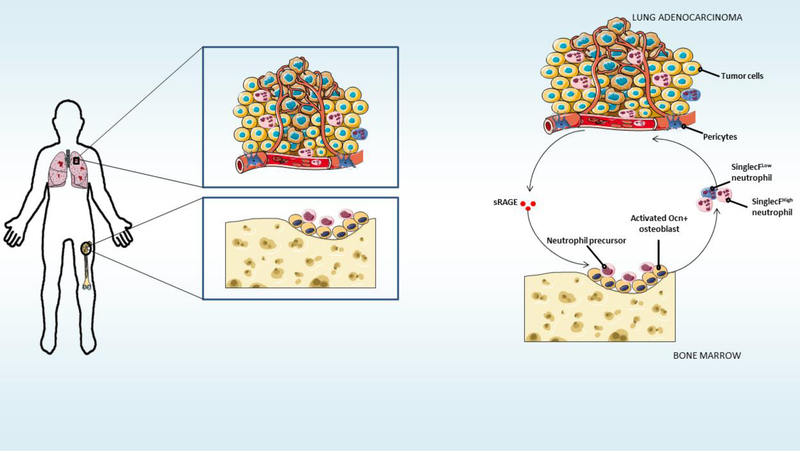
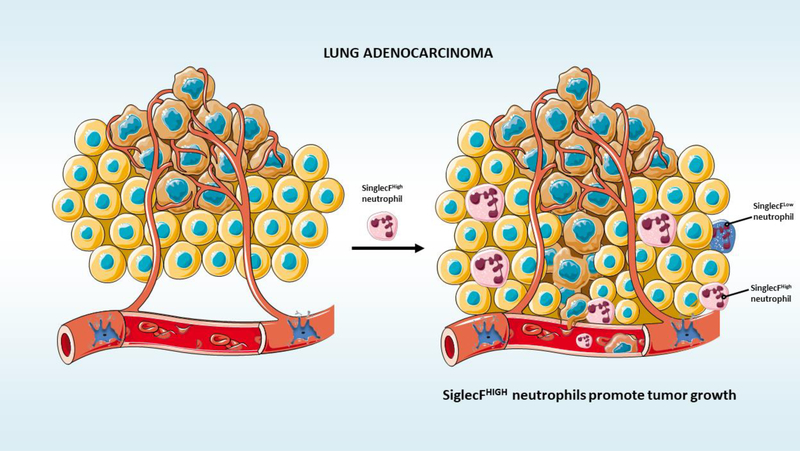
Figure 1
Figure 1. Osteoblasts prime neutrophils that promote tumor growth in the lung.
The relationship between the lung tumor and its surroundings plays a pivotal role in determining whether and how malignant cancer cells grow. The study of Engblom and colleagues now reveals a novel very important function of systemic cross-talk between lung tumor and the bone that regulates cancer progression [42]. Lung tumors increase the number of osteocalcin (Ocn)expressing osteoblasts through tumor-secreted factors. These osteoblasts prime SiglecFhigh– expressing neutrophils, which in turn expand lung tumor growth in vivo. With the appearance of state-of-art techniques, future studies will reveal in detail the cellular and molecular components that regulate the lung tumor microenvironment.
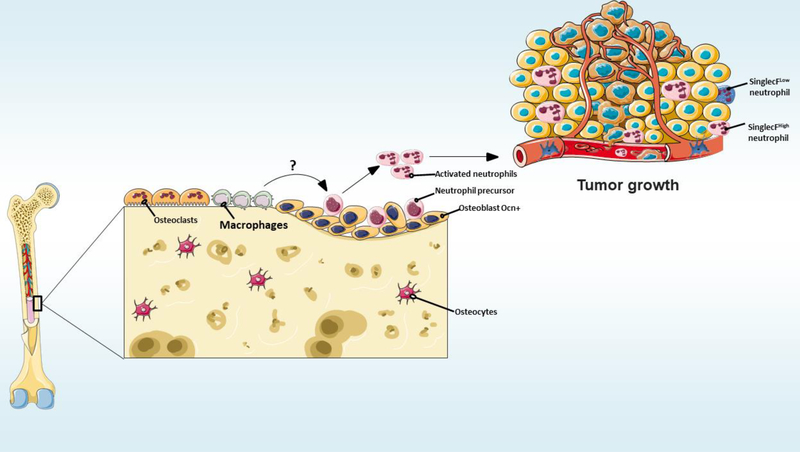
Figure 2
Figure 2. SiglecFhigh–expressing neutrophils expand tumor growth in vivo.
SiglecFhigh–expressing neutrophils promote lung adenocarcinoma.
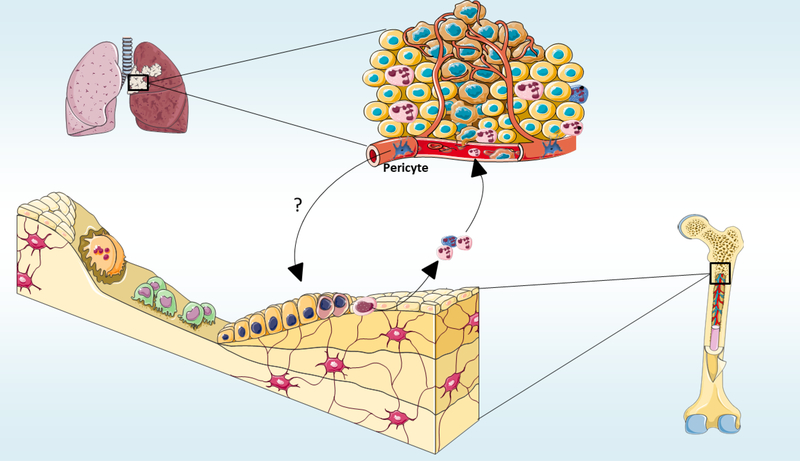
Figure 3
Figure 3. Do bone marrow macrophages modulate neutrophil activation?
The details of the mechanisms by which bone marrow macrophages enhance lung metastasis remain poorly understood. Future studies should explore whether macrophages are important niche cells for neutrophil priming by osteoblasts.
Figure 4
Figure 4. Do pulmonary pericytes communicate with osteoblasts in the bones to induce tumor development?
Lung pericytes are essential components of the lung pre-metastatic niche. Whether adenocarcinoma pericytes communication is important for osteoblasts to activate Siglechigh– expressing neutrophils remains unknown.

References

    1. Mendes F, Antunes C, Abrantes AM, Goncalves AC, Nobre-Gois I, Sarmento AB, et al. (2015). Lung cancer: the immune system and radiation. Br J Biomed Sci, 72(2), 7884. - PubMed
    1. Chapman AM, Sun KY, Ruestow P, Cowan DM, & Madl AK (2016). Lung cancer mutation profile of EGFR, ALK, and KRAS: Meta-analysis and comparison of never and ever smokers. Lung Cancer, 102, 122–134, doi:10.1016/j.lungcan.2016.10.010. - DOI - PubMed
    1. Skowronek J (2015). Brachytherapy in the treatment of lung cancer - a valuable solution. J Contemp Brachytherapy, 7(4), 297–311, doi:10.5114/jcb.2015.54038. - DOI - PMC - PubMed
    1. Birbrair A, Sattiraju A, Zhu D, Zulato G, Batista I, Nguyen VT, et al. (2017). Novel Peripherally Derived Neural-Like Stem Cells as Therapeutic Carriers for Treating Glioblastomas. Stem Cells Transl Med, 6(2), 471–481, doi:10.5966/sctm.2016-0007. - DOI - PMC - PubMed
    1. Vannucci L (2015). Stroma as an Active Player in the Development of the Tumor Microenvironment. Cancer Microenviron, 8(3), 159–166, doi:10.1007/s12307-014-0150x. - DOI - PMC - PubMed

Publication types

LinkOut - more resources