


Replicating measurements of total hemoglobin mass (tHb-mass) within a single day: precision of measurement; feasibility and safety of using oxygen to expedite carbon monoxide clearance
- PMID: 30203465
- PMCID: PMC6131726
- DOI: 10.14814/phy2.13829
Replicating measurements of total hemoglobin mass (tHb-mass) within a single day: precision of measurement; feasibility and safety of using oxygen to expedite carbon monoxide clearance
Abstract
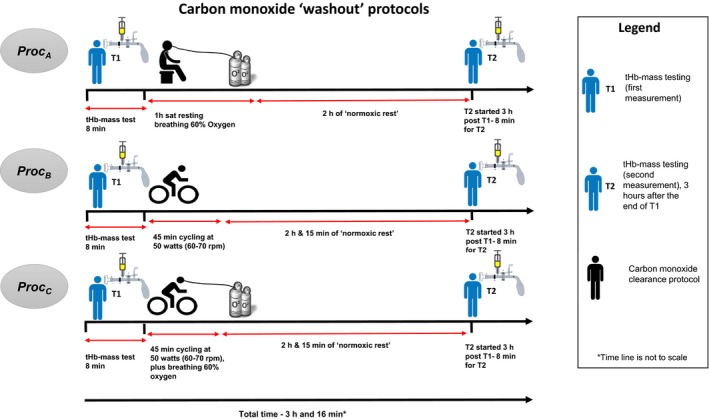
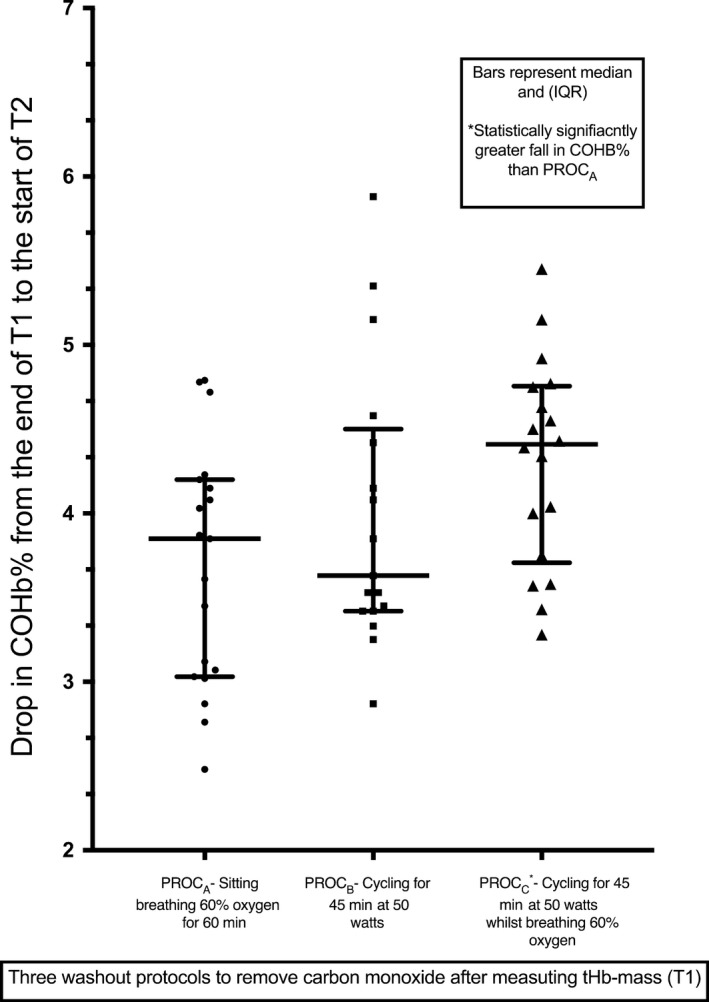
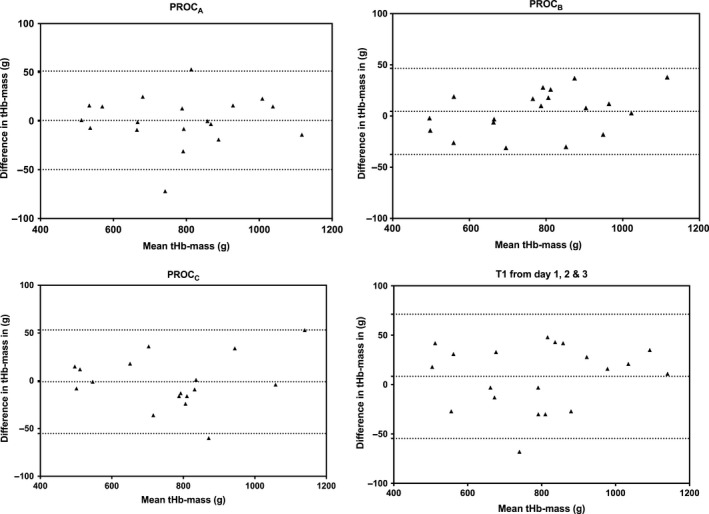
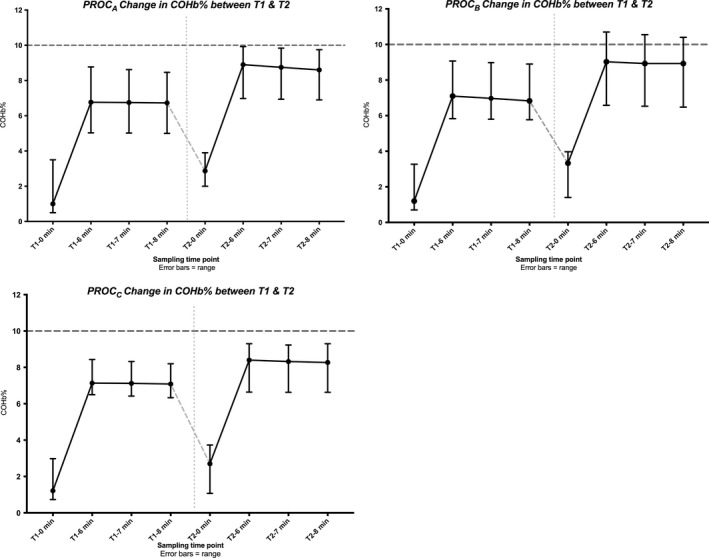
Hemoglobin concentration ([Hb]) is a function of total hemoglobin mass (tHb-mass) and plasma volume. [Hb] may fall by dilution due to plasma volume expansion and changes in the perioperative period may therefore correlate poorly with blood loss. A simple, reliable, repeatable way to measure plasma volume and tHb-mass would have substantial clinical utility. The "optimized carbon monoxide re-breathing method" (oCOR) meets these criteria. However, it is recommended that a minimum of 12 h (when breathing room air) is left between repeat measurements. Twenty-four subjects underwent 3 days of testing. Two oCOR tests were performed (T1 and T2), 3 h apart, with a different CO clearance method employed between tests aiming to keep the carboxyhemoglobin level below 10%. The primary aim was to ascertain whether tHb-mass testing could be safely repeated within 3 h if carboxyhemoglobin levels were actively reduced by breathing supplemental oxygen (PROCA ). Secondary aims were to compare two other clearance methods; moderate exercise (PROCB ), or a combination of the two (PROCC ). Finally, the reliability of the oCOR method was assessed. Mean (SD) tHb-mass was 807.9 ± (189.7 g) (for T1 on day 1). PROCA lowered the carboxyhemoglobin level from the end of T1 (mean 6.64%) to the start of T2 (mean 2.95%) by a mean absolute value of 3.69%. For PROCB and PROCC the mean absolute decreases in carboxyhemoglobin were 4.00% and 4.31%, respectively. The fall in carboxyhemoglobin between T1 and T2 was greatest in PROCC ; this was statistically significantly lower than that of PROCA (P = 0.0039) and PROCB (P = 0.0289). The test-retest reliability for the measurement of total hemoglobin mass was good with a mean typical error (TE) of 2.0%. The oCOR method is safe and can be repeated within 3 h when carbon monoxide is suitably cleared between tests. Using oxygen therapy alone adequately achieves this.
Keywords: Blood volume; optimized carbon monoxide re-breathing; plasma volume; red cell volume; total hemoglobin mass (tHb-mass).
© 2018 The Authors. Physiological Reports published by Wiley Periodicals, Inc. on behalf of The Physiological Society and the American Physiological Society.
Figures
References
-
- Bland, J. M. , and Altman D. G.. 1986. Statistical methods for assessing agreement between two methods of clinical measurement. Lancet 1:307–310. - PubMed
-
- Burge, C. M. , and Skinner S. L.. 1995. Determination of hemoglobin mass and blood volume with CO: evaluation and application of a method. J. Appl. Physiol. 79:623–631. - PubMed
-
- Dellweg, D. , Siemon K., Mahler F., Appelhans P., Klauke M., and Köhler D.. 2008. Cardiopulmonary exercise testing before and after blood donation. Pneumologie 62:372–377. - PubMed
-
- Eastwood, A. , Hopkins W. G., Bourdon P. C., Withers R. T., and Gore C. J.. 2008. Stability of hemoglobin mass over 100 days in active men. J. Appl. Physiol. 104:982–985. - PubMed
Publication types
MeSH terms
Substances
Grants and funding
LinkOut - more resources
Full Text Sources
Other Literature Sources
