


Postpartum psychological distress after emergency team response during childbirth
- PMID: 30204531
- PMCID: PMC6411455
- DOI: 10.1080/0167482X.2018.1512095
Postpartum psychological distress after emergency team response during childbirth
Abstract
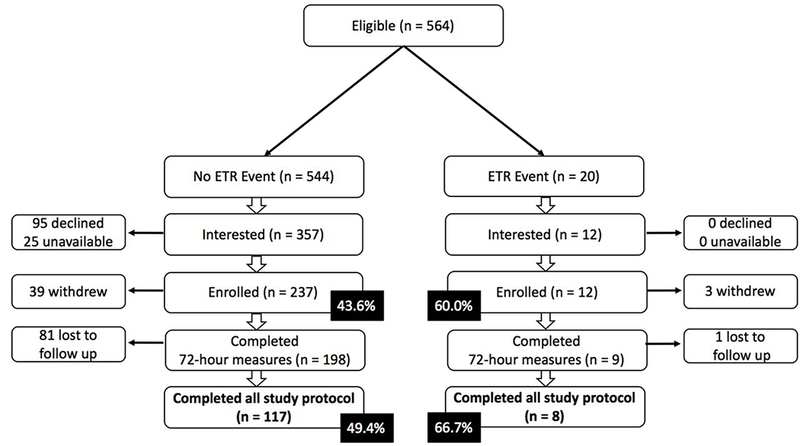
Purpose: To evaluate the feasibility and acceptability of a protocol determining the relationship between emergency team response (ETR) during childbirth and acute stress disorder (ASD) and post-traumatic stress disorder (PTSD) symptoms. Methods: In a prospective, observational, cohort design, women experiencing ETR during childbirth were approached and recruited on postpartum day-1 and followed for six weeks. Demographics, obstetric and birth characteristics, ASD scores and PTSD scores (by Impact of Events Scale, IES and PCL-civilian) were recorded. Recruitment and retention rates were recorded, and scores were compared to women who did not experience ETR. Results: Three hundred sixty-nine were approached and 249 were enrolled (67.5% recruitment rate). One hundred twenty-five completed all procedures (50.2% retention). Twenty experienced ETR (3.5% event rate), 12 enrolled (60.0% recruitment rate) and 8 completed the study (66.7% retention). The ETR group had higher PCL and IES scores (PCL: ETR median 12, non-ETR median 2, p = .08; IES: ETR median 22.5, non-ETR median 20, p = .08). ASD scores were similar between groups. Conclusions: Methodology investigating the link between ETR and postpartum psychological distress is feasible and acceptable. A relationship between ETR and PTSD symptoms appears to exist, with ETR being associated with higher PTSD scores compared to non-ETR childbirths. Methods that incorporate awareness of the unique concerns of vulnerable populations are needed.
Keywords: ASD; PTSD; Postpartum; morbidity; obstetric; trauma.
Conflict of interest statement
Disclosure of Interest
The authors report no financial conflicts of interest
Figures
References
-
- Alcorn KL ODA, Patrick JC, Creedy D, Devilly GJ. A prospective longitudinal study of the prevalence of post-traumatic stress disorder resulting from childbirth events. Psychological Medicine. 2010;40(11):1849–59. PubMed PMID: . - PubMed
-
- Ayers S, Joseph S, McKenzie-McHarg K, et al. Post-traumatic stress disorder following childbirth: current issues and recommendations for future research. Journal of Psychosomatic Obstetrics & Gynecology. 2008;29(4):240–250. PubMed PMID: . - PubMed
-
- Ayers S, Eagle A, Waring H. The effects of childbirth-related posttraumatic stress disorder on women and their relationships: a qualitative study. Psychol Health Med 2006;11:389–398. PubMed PMID: . - PubMed
-
- Shaw R, Bernard R, Deblois T, et al. The relationship between acute stress disorder and posttraumatic stress disorder in the neonatal intensive care unit. Psychosomatics. 2009;50:131–137. PubMed PMID: . - PubMed
Publication types
MeSH terms
Grants and funding
LinkOut - more resources
Full Text Sources
Other Literature Sources
Medical
