. 2018 Nov 1;159(11):3605-3614.
doi: 10.1210/en.2018-00536.

Glucose Availability Predicts the Feeding Response to Ghrelin in Male Mice, an Effect Dependent on AMPK in AgRP Neurons

Affiliations

Glucose Availability Predicts the Feeding Response to Ghrelin in Male Mice, an Effect Dependent on AMPK in AgRP Neurons

Sarah H Lockie et al. Endocrinology. .

Abstract

Metabolic feedback from the periphery to the brain results from a dynamic physiologic fluctuation of nutrients and hormones, including glucose and fatty acids, ghrelin, leptin, and insulin. The specific interactions between humoral factors and how they influence feeding is largely unknown. We hypothesized that acute glucose availability may alter how the brain responds to ghrelin, a hormonal signal of energy availability. Acute glucose administration suppressed a range of ghrelin-induced behaviors as well as gene expression changes in hypothalamic neuropeptide Y (NPY) and agouti-related peptide (AgRP) neurons after ghrelin administration. Knockdown of the energy-sensing molecule AMP-activated protein kinase (AMPK) in AgRP neurons resulted in loss of the glucose effect, and mice responded as though pretreated with saline. Conversely, 2-deoxyglucose (2-DG), which decreases glucose availability, potentiated ghrelin-induced feeding and increased hypothalamic NPY mRNA levels. AMPK knockdown did not alter the additive effect of 2-DG and ghrelin on feeding. Our findings support the idea that computation of energy status is dynamic, is informed by multiple signals, and responds to acute fluctuations in metabolic state. These observations are broadly relevant to the investigation of neuroendocrine control of feeding and highlight the underappreciated complexity of control within these systems.


Figures
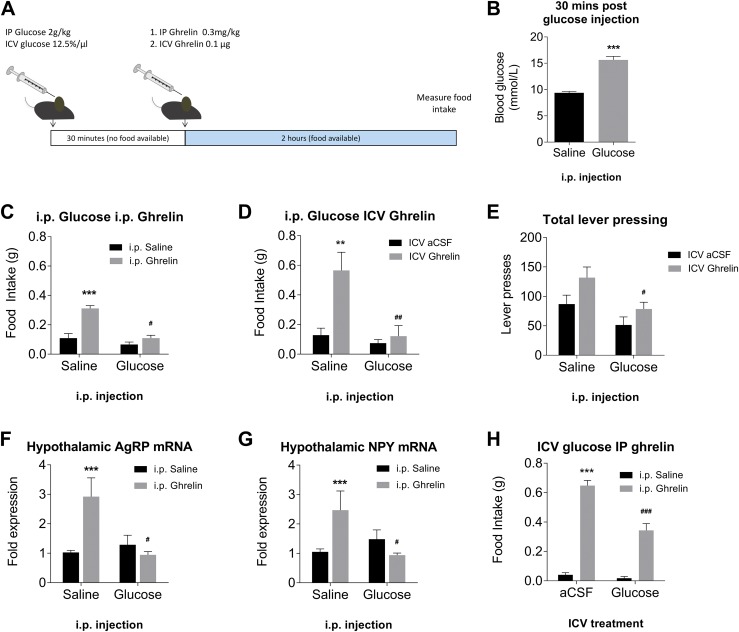
Figure 1.
Figure 1.
Hyperglycemia suppresses physiological responses to ghrelin injection. (A) Schematic of experimental procedure. (B) Blood glucose is significantly increased after IP glucose injection. ***P < 0.01, independent measures t test (n = 34 per group). IP administration of glucose abolishes feeding response to (C) IP ghrelin injection (n = 9 to 10) or (D) ICV ghrelin injection (n = 7). (E) Glucose pretreatment significantly suppresses ghrelin-induced lever pressing in operant responding task (n = 11 to 16 per group). Glucose pretreatment suppresses induction of (F) AgRP and (G) NPY mRNA in the ARC following ghrelin injection (n = 7 to 10 per group). (H) ICV glucose attenuates ghrelin induced feeding (n = 9 to 10). **P < 0.01, ***P < 0.001 compared with saline/saline; #P < 0.05, ##P < 0.01, ###P < 0.001 compared with saline/ghrelin (two-way ANOVA with Tukey post hoc test).
Figure 2.
Figure 2.
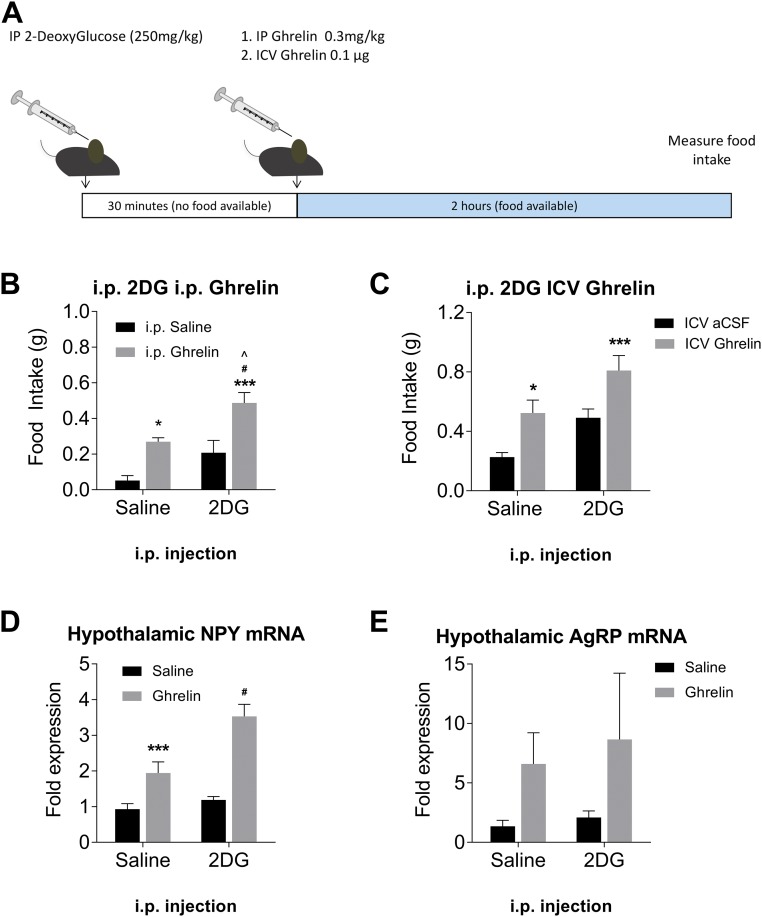
Glucopenia enhances physiological responses to ghrelin injection. (A) Schematic of experimental procedure. IP administration of 2-DG enhances feeding response to (B) IP ghrelin injection (n = 9 to 10) or (C) ICV ghrelin injection (n = 11 to 12). Pretreatment with 2-DG suppresses induction of (D) NPY and does not significantly affect (E) AgRP mRNA in the ARC (n = 5). *P < 0.05, ***P < 0.001 compared with saline/saline; #P < 0.05 compared with saline/ghrelin; ^P < 0.05 compared with saline/2-DG (two-way ANOVA with Tukey post hoc test).
Figure 3.
Figure 3.
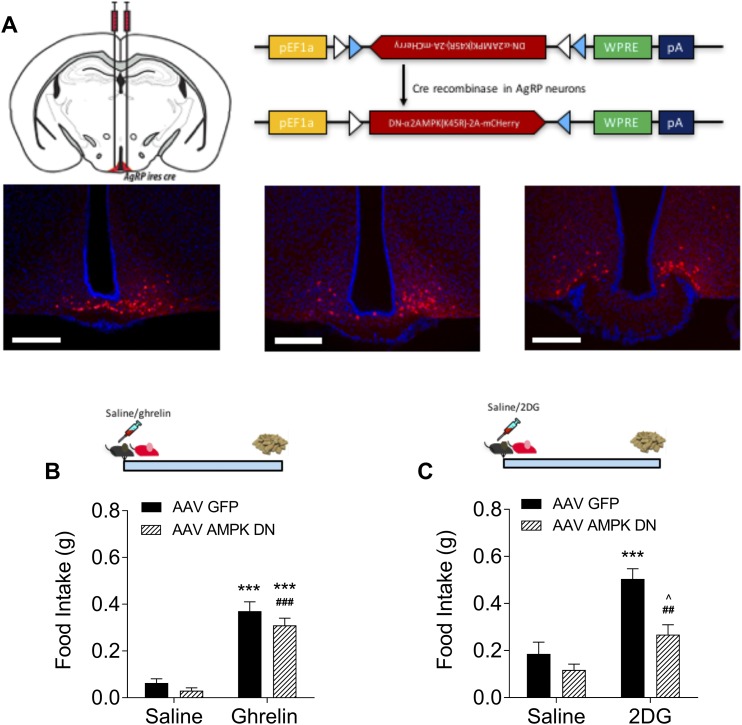
AMPK knockdown in AgRP neurons does not affect ghrelin sensitivity but reduces food intake in response to 2-DG. (A) Schematic of viral construct and micrographs showing targeting of virus to the ARC. Scale bar, 200 μm. (B) AgRPAMPK mice show similar sensitivity to ghrelin as AgRPGFP mice (n = 18 to 28). Main effect of ghrelin: ***P < 0.001 compared with GFP/saline; ###P < 0.001 compared with AMPK DN/saline (two-way ANOVA with Tukey post hoc test). (D) AgRPAMPK mice are less sensitive to glucoprivic feeding (n = 7 to 9). ***P < 0.001 compared with GFP/saline; ##P < 0.01 compared with DN AMPK/saline; ^P < 0.05 compared with DN AMPK/2-DG (two-way ANOVA with Tukey post hoc test).
Figure 4.
Figure 4.
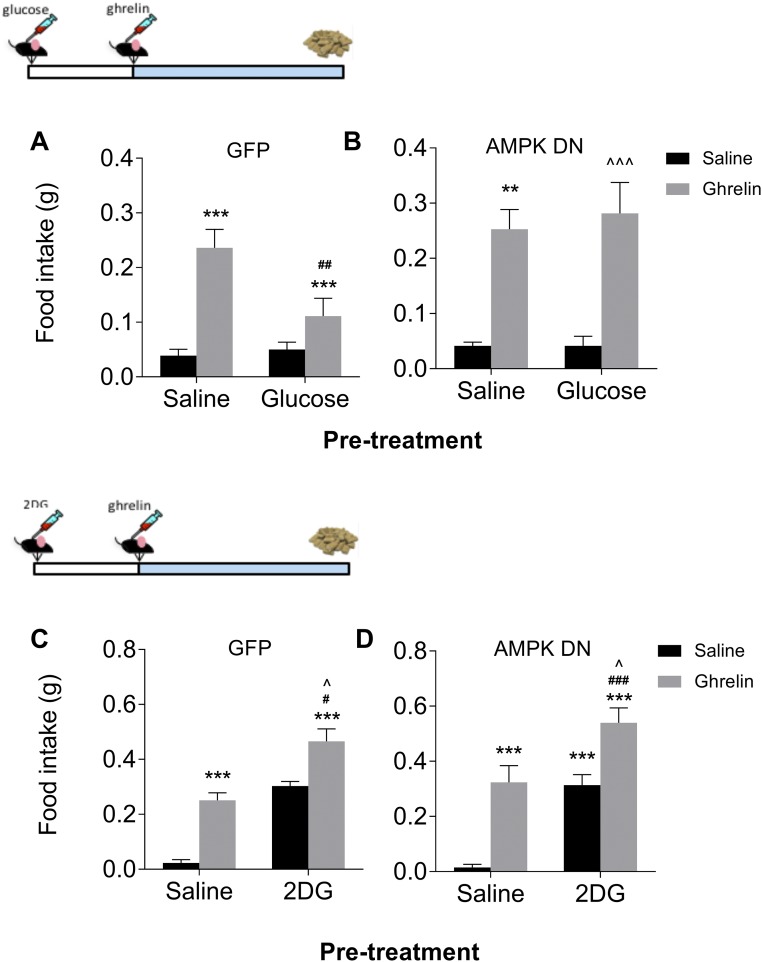
AMPK knockdown in AgRP neurons abolishes glucose-induced suppression but does not affect 2-DG–induced potentiation of ghrelin-induced feeding. (A) In AgRPGFP mice, glucose suppresses ghrelin-induced feeding (n = 8 to 10). (B) This effect is lost in AgRPAMPK mice (n = 6 to 7). Both (C) AgRPGFP (D) and AgRPAMPK mice have a similar feeding response to 2-DG (n = 7 to 9). **P < 0.01, ***P < 0.001 compared with saline/saline; #P < 0.05, ##P < 0.01, ###P < 0.001 compared with saline/ghrelin; ^P < 0.05, ^^^P < 0.001 compared with saline/2-DG (two-way ANOVA with Tukey post hoc test).
Figure 5.
Figure 5.
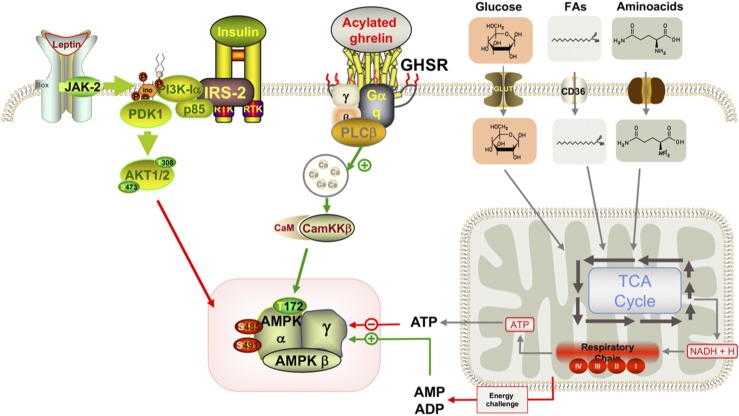
Schematic representation of the availability of glucose to augment the feeding response to ghrelin. Ca, calcium; CaM, calmodulim; CamKKβ, calcium calmodulin–dependent kinase kinase β; FA, fatty acid; IRS1, insulin receptor substrate 1; JAK-2, Janus kinase 2; NADH, nicotinamide adenine dinucleotide; PDK1, phosphoinositide-dependent kinase-1; PI3K, phosphatidylinositide 3-kinase; PLC, phospholipase C; RTK, receptor tyrosine kinase; TCA, tricarboxylic acid.

References

    1. Tschöp M, Smiley DL, Heiman ML. Ghrelin induces adiposity in rodents. Nature. 2000;407(6806):908–913. - PubMed
    1. Howard AD, Feighner SD, Cully DF, Arena JP, Liberator PA, Rosenblum CI, Hamelin M, Hreniuk DL, Palyha OC, Anderson J, Paress PS, Diaz C, Chou M, Liu KK, McKee KK, Pong SS, Chaung LY, Elbrecht A, Dashkevicz M, Heavens R, Rigby M, Sirinathsinghji DJS, Dean DC, Melillo DG, Patchett AA, Nargund R, Griffin PR, DeMartino JA, Gupta SK, Schaeffer JM, Smith RG, Van der Ploeg LHT. A receptor in pituitary and hypothalamus that functions in growth hormone release. Science. 1996;273(5277):974–977. - PubMed
    1. Willesen MG, Kristensen P, Rømer J. Co-localization of growth hormone secretagogue receptor and NPY mRNA in the arcuate nucleus of the rat. Neuroendocrinology. 1999;70(5):306–316. - PubMed
    1. Lockie SH, Dinan T, Lawrence AJ, Spencer SJ, Andrews ZB. Diet-induced obesity causes ghrelin resistance in reward processing tasks. Psychoneuroendocrinology. 2015;62:114–120. - PubMed
    1. Perez-Tilve D, Heppner K, Kirchner H, Lockie SH, Woods SC, Smiley DL, Tschöp M, Pfluger P. Ghrelin-induced adiposity is independent of orexigenic effects. FASEB J. 2011;25(8):2814–2822. - PMC - PubMed

Publication types

MeSH terms