


Role of cognitive ability in the association between functional health literacy and mortality in the Lothian Birth Cohort 1936: a prospective cohort study
- PMID: 30206087
- PMCID: PMC6144414
- DOI: 10.1136/bmjopen-2018-022502
Role of cognitive ability in the association between functional health literacy and mortality in the Lothian Birth Cohort 1936: a prospective cohort study
Abstract
Objectives: We investigated the role that childhood and old age cognitive ability play in the association between functional health literacy and mortality.
Design: Prospective cohort study.
Setting: This study used data from the Lothian Birth Cohort 1936 (LBC1936) study, which recruited participants living in the Lothian region of Scotland when aged 70 years, most of whom had completed an intelligence test at age 11 years.
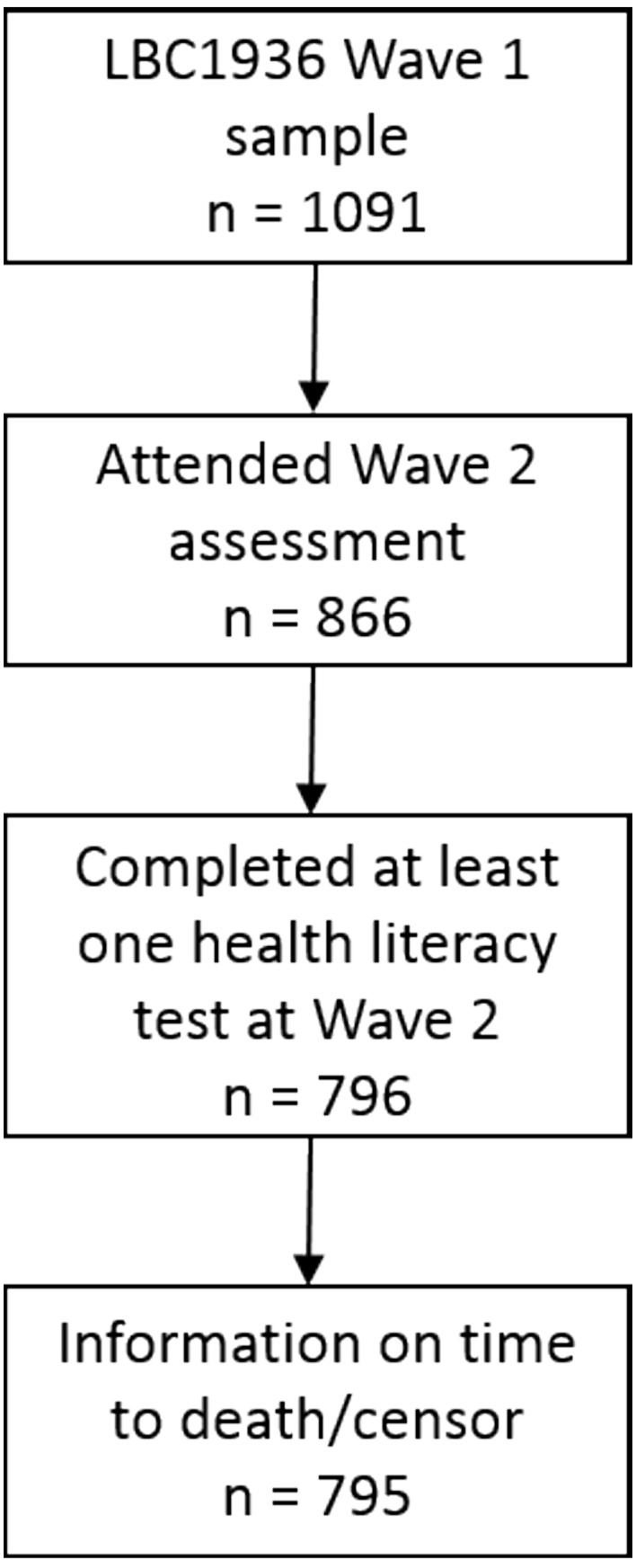
Participants: 795 members of the LBC1936 with scores on tests of functional health literacy and cognitive ability in childhood and older adulthood.
Primary and secondary outcome measures: Participants were followed up for 8 years to determine mortality. Time to death in days was used as the primary outcome measure.
Results: Using Cox regression, higher functional health literacy was associated with lower risk of mortality adjusting for age and sex, using the Shortened Test of Functional Health Literacy in Adults (HR 0.95, 95% CI 0.92 to 0.98), the Newest Vital Sign (HR 0.88, 95% CI 0.80 to 0.97) and a functional health literacy composite measure (HR 0.77, 95% CI 0.65 to 0.92), but not the Rapid Estimate of Adult Literacy in Medicine (HR 0.95, 95% CI 0.90 to 1.01). Adjusting for childhood intelligence did not change these associations. When additionally adjusting for fluid-type cognitive ability in older age, associations between functional health literacy and mortality were attenuated and non-significant.
Conclusions: Current fluid ability, but not childhood intelligence, attenuated the association between functional health literacy and mortality. Functional health literacy measures may, in part, assess fluid-type cognitive abilities, and this may account for the association between functional health literacy and mortality.
Keywords: epidemiology; public health; statistics & research methods.
© Author(s) (or their employer(s)) 2018. Re-use permitted under CC BY. Published by BMJ.
Conflict of interest statement
Competing interests: None declared.
Figures
References
-
- Institute of Medicine. Health Literacy: a prescription to end confusion. Washinton, DC: The National Academies Press, 2004. - PubMed
-
- Nutbeam D. Health literacy as a public health goal: a challenge for contemporary health education and communication strategies into the 21st century. Health Promot Int 2000;15:259–67. 10.1093/heapro/15.3.259 - DOI
Publication types
MeSH terms
Grants and funding
LinkOut - more resources
Full Text Sources
Other Literature Sources
Medical
