Is a matched unrelated donor search needed for all allogeneic transplant candidates?
- PMID: 30206098
- PMCID: PMC6134218
- DOI: 10.1182/bloodadvances.2018021899
Is a matched unrelated donor search needed for all allogeneic transplant candidates?
Abstract
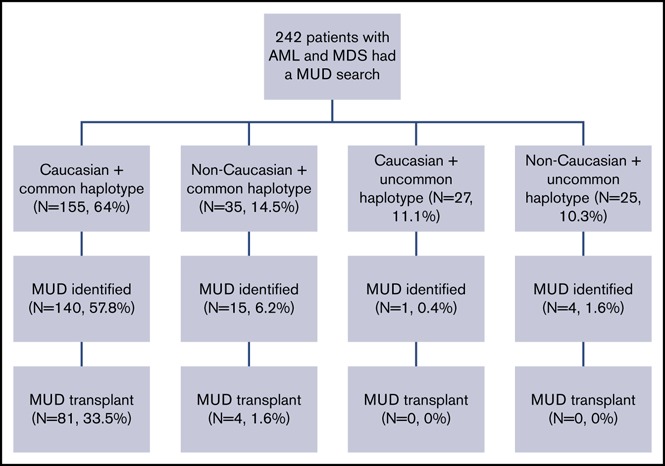
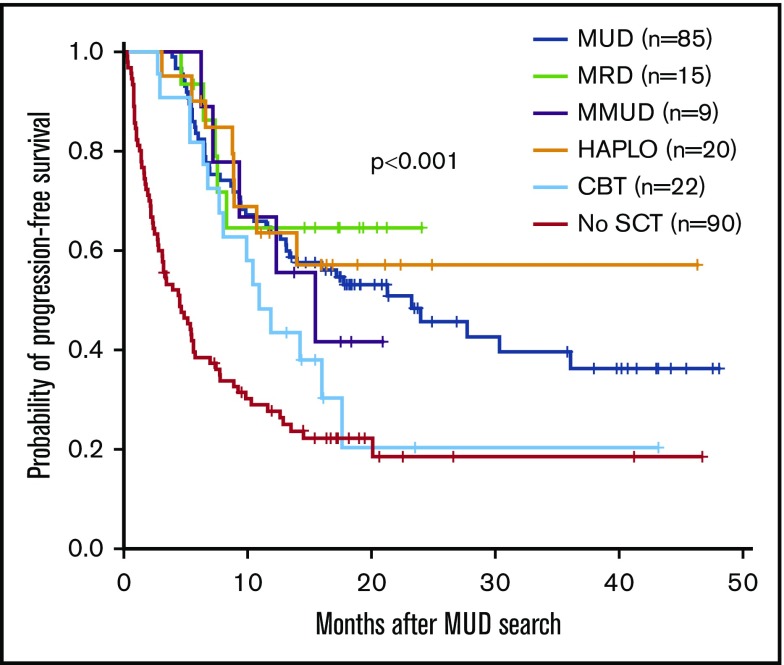
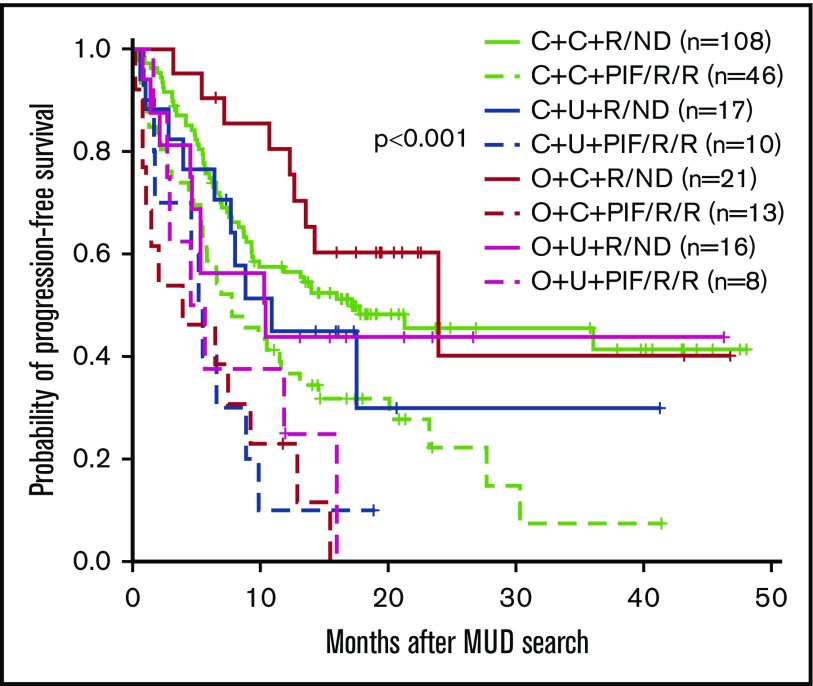
Donor availability for allogeneic transplantation remains an important factor in determining outcomes of a successful transplant. We examined outcomes of 242 patients treated over 3 years who had a matched unrelated donor (MUD) search at our institution. One hundred sixty patients (66%) had a 10 of 10 MUD identified, and 85 (53%) proceeded to MUD transplantation. White patients and those with common haplotypes were more likely to have a MUD identified (odds ratio [OR], 7.4 [P < .0001]; OR, 41.6 [P < .0001]), and were more likely to proceed to transplantation with a MUD (OR, 11.2 [P < .0001]; OR, 85.1 [P = .002]). In addition, patients who were newly diagnosed/in remission at the time of MUD search had a higher probability of receiving a transplant (OR, 2.01 [P = .013]) and better progression-free survival (PFS; P < .0001). In multivariate analysis for patients who received a transplant, donor type did not influence PFS at 3 years, which was 40% for MUD and 57% for haploidentical transplants, respectively (hazard ratio, 1.2 [P = .50]). In conclusion, race, haplotype frequency, and disease status at the time of MUD search influence the probability of identifying a MUD and receiving a transplant. Patients with a low likelihood of receiving a MUD transplant may proceed to a haploidentical transplant as soon as indicated, as this approach does not appear to compromise transplant outcomes.
© 2018 by The American Society of Hematology.
Conflict of interest statement
Conflict-of-interest disclosure: The authors declare no competing financial interests.
Figures
References
-
- Copelan EA. Hematopoietic stem-cell transplantation. N Engl J Med. 2006;354(17):1813-1826. - PubMed
-
- Gratwohl A, Pasquini MC, Aljurf M, et al. ; Worldwide Network for Blood and Marrow Transplantation (WBMT). One million haemopoietic stem-cell transplants: a retrospective observational study. Lancet Haematol. 2015;2(3):e91-e100. - PubMed
-
- Ballen KK, King RJ, Chitphakdithai P, et al. The National Marrow Donor Program 20 years of unrelated donor hematopoietic cell transplantation. Biol Blood Marrow Transplant. 2008;14(suppl 9):2-7. - PubMed
Publication types
MeSH terms
Grants and funding
LinkOut - more resources
Full Text Sources
Other Literature Sources
Medical