. 2018 Sep 11;8(1):13634.
doi: 10.1038/s41598-018-31093-2.

Population level mitogenomics of long-lived bats reveals dynamic heteroplasmy and challenges the Free Radical Theory of Ageing

Affiliations

Population level mitogenomics of long-lived bats reveals dynamic heteroplasmy and challenges the Free Radical Theory of Ageing

David Jebb et al. Sci Rep. .

Abstract

Bats are the only mammals capable of true, powered flight, which drives an extremely high metabolic rate. The "Free Radical Theory of Ageing" (FTRA) posits that a high metabolic rate causes mitochondrial heteroplasmy and the progressive ageing phenotype. Contrary to this, bats are the longest-lived order of mammals given their small size and high metabolic rate. To investigate if bats exhibit increased mitochondrial heteroplasmy with age, we performed targeted, deep sequencing of mitogenomes and measured point heteroplasmy in wild, long lived Myotis myotis. Blood was sampled from 195 individuals, aged between <1 and at 6+ years old, and whole mitochondria deep-sequenced, with a subset sampled over multiple years. The majority of heteroplasmies were at a low frequency and were transitions. Oxidative mutations were present in only a small number of individuals, suggesting local oxidative stress events. Cohort data showed no significant increase in heteroplasmy with age, while longitudinal data from recaptured individuals showed heteroplasmy is dynamic, and does not increase uniformly over time. We show that bats do not suffer from the predicted, inevitable increase in heteroplasmy as posited by the FRTA, instead heteroplasmy was found to be dynamic, questioning its presumed role as a primary driver of ageing.


Conflict of interest statement

The authors declare no competing interests.

Figures
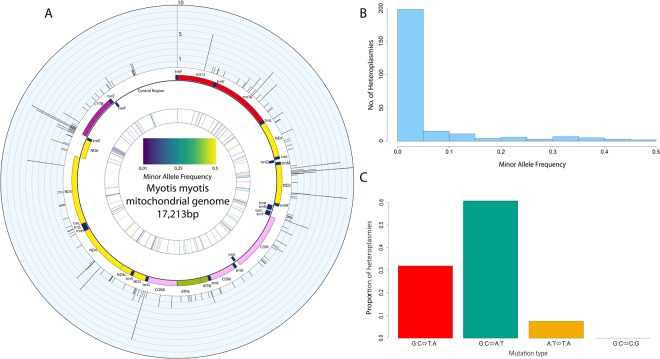
Figure 1
Figure 1
Characteristics of heteroplasmy in M. myotis. (A) A circos plot of the mitogenome of M. myotis. In the outer ring histogram, each bar is one of the 143 unique sites which were heteroplasmic in the population, with the height representing the number of individuals sharing the site. The middle ring is a schematic of the mitogenome generated with OGDRAW. The inner most ring is a heat plot showing the average minor allele frequency at each heteroplasmic site, with low frequencies in purple and high frequencies in yellow. (B) Histogram of minor allele frequencies of 254 heteroplasmies discovered. The vast majority of heteroplasmies were at a frequency below 5%. (C) Bar chart showing the proportion of mutations attributable to one of four transition or transversion classes. The transition transversion ratio (Ts/Tv) for M. myotis was 1.8. Oxidative mutations, G:C⇔T:A transversions, were at a higher level than reported previously in humans.
Figure 2
Figure 2
Heteroplasmy is not significantly associated with age in Myotis myotis. Boxplots of the distribution of heteroplasmy counts in each age cohort used for age analysis. No significant association was found between age and heteroplasmy using a negative binomial generalized linear model, after the removal of unduly influential points.
Figure 3
Figure 3
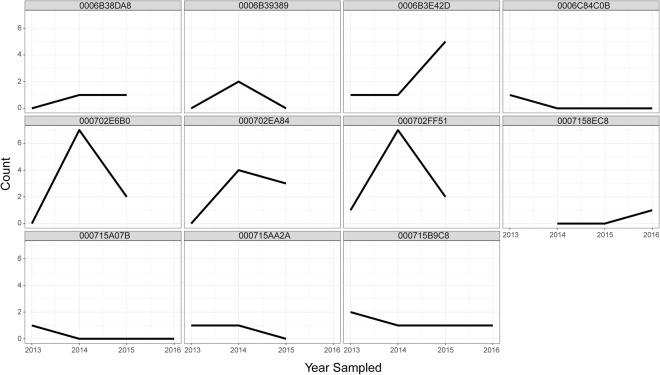
Plots of heteroplasmy count against year sampled for 11 individuals. Heteroplasmy counts through time for 11 individual bats which were sampled 3 or 4 times. Numbers above each plot indicate PIT number used to identify each individual. Some individuals were extremely consistent while others increased sharply, always followed by a decrease where subsequent samples were available.

References

    1. Rensch T, Villar D, Horvath J, Odom DT, Flicek P. Mitochondrial heteroplasmy in vertebrates using ChIP-sequencing data. Genome Biol. 2016;17:139. doi: 10.1186/s13059-016-0996-y. - DOI - PMC - PubMed
    1. Gustafsson CM, Falkenberg M, Larsson N-G. Maintenance and Expression of Mammalian Mitochondrial DNA. Annu. Rev. Biochem. 2016;85:133–60. doi: 10.1146/annurev-biochem-060815-014402. - DOI - PubMed
    1. Harman D. Aging: a theory based on free radical and radiation chemistry. J. Gerontol. 1956;11:298–300. doi: 10.1093/geronj/11.3.298. - DOI - PubMed
    1. Alexeyev M, Shokolenko I, Wilson G, LeDoux S. The Maintenance of Mitochondrial DNA Integrity - Critical Analysis andUpdate. Cold Spring Harb. Perspect. Biol. 2013;5:a012641–a012641. doi: 10.1101/cshperspect.a012641. - DOI - PMC - PubMed
    1. Lagouge M, Larsson N-G. The role of mitochondrial DNA mutations and free radicals in disease and ageing. J. Intern. Med. 2013;273:529–43. doi: 10.1111/joim.12055. - DOI - PMC - PubMed

Publication types