Review
. 2018 Nov;75(22):4177-4185.
doi: 10.1007/s00018-018-2913-x. Epub 2018 Sep 11.

Integrin and microtubule crosstalk in the regulation of cellular processes

Affiliations
Review

Integrin and microtubule crosstalk in the regulation of cellular processes

Susan E LaFlamme et al. Cell Mol Life Sci. 2018 Nov.

Abstract

Integrins engage components of the extracellular matrix, and in collaboration with other receptors, regulate signaling cascades that impact cell behavior in part by modulating the cell's cytoskeleton. Integrins have long been known to function together with the actin cytoskeleton to promote cell adhesion, migration, and invasion, and with the intermediate filament cytoskeleton to mediate the strong adhesion needed for the maintenance and integrity of epithelial tissues. Recent studies have shed light on the crosstalk between integrin and the microtubule cytoskeleton. Integrins promote microtubule nucleation, growth, and stabilization at the cell cortex, whereas microtubules regulate integrin activity and remodeling of adhesion sites. Integrin-dependent stabilization of microtubules at the cell cortex is critical to the establishment of apical-basal polarity required for the formation of epithelial tissues. During cell migration, integrin-dependent microtubule stabilization contributes to front-rear polarity, whereas microtubules promote the turnover of integrin-mediated adhesions. This review focuses on this interdependent relationship and its impact on cell behavior and function.

Keywords: Adhesion complexes; Apical–basal polarity; Cell migration; Focal adhesions.


Figures
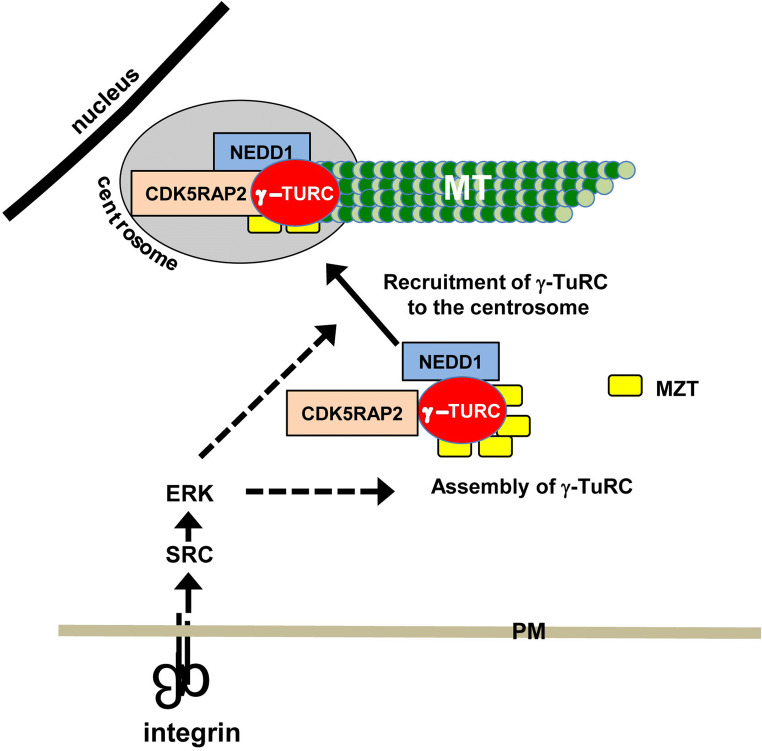
Fig. 1
Fig. 1
Regulation of microtubule nucleation by integrins. The integrin-dependent activation of SRC and ERK regulates microtubule (MT) nucleation at least in part by regulating the localization of γ-tubulin to the centrosome. γ-TuRC is assembled in the cytoplasm where it associates with additional proteins that regulate its centrosomal localization and microtubule nucleating ability. The integrin regulation of microtubule nucleation through SRC–ERK signaling could be due to integrin regulation of the assembly of the γ-TuRC complex, the association of this complex with NEDD1, CDK5RAP2 or MOZART (MZT) or the binding of the complex to the centrosome (dashed arrows). PM plasma membrane
Fig. 2
Fig. 2
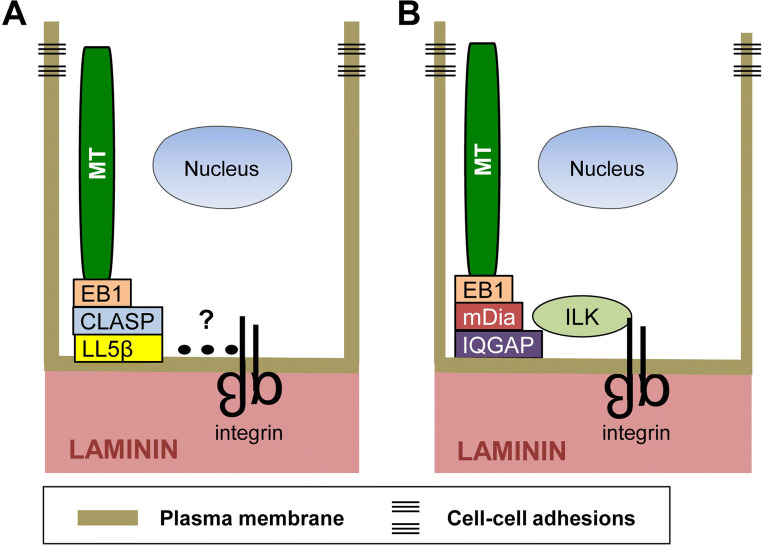
Integrins promote the stabilization of microtubules at the basal surface of polarized epithelial cells. Integrins stabilize microtubules at the basal cell cortex through two distinct protein complexes. a Microtubules bind to EB1, which binds to CLASP, which in turn binds to LL5β. LL5β is known to be present in a complex with α3β1 integrins; however, protein interactions (dotted line) mediating this association have not been identified. b Microtubules can also be associated with integrins through ILK, which is a cytoskeleton adaptor and integrin β subunit cytoplasmic domain-binding protein. ILK plays a role in stabilizing microtubules at the basal cell surface through a microtubule–EB1–mDia–IQGAP–ILK–integrin linkage
Fig. 3
Fig. 3
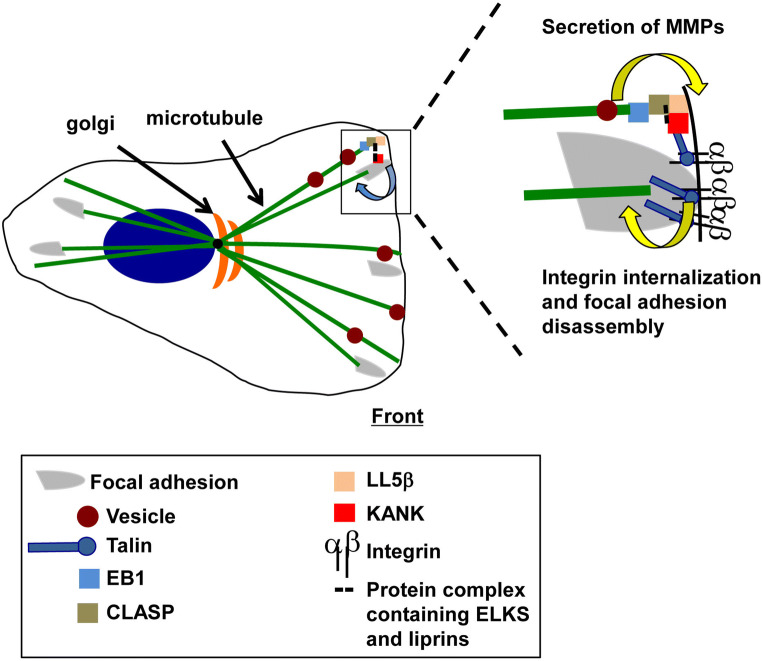
Microtubule–integrin crosstalk in migrating cells. Microtubules are stabilized at the rim of focal adhesions but are also thought to target focal adhesions directly to trigger adhesion site disassembly. Microtubules that are stabilized at the rim of focal adhesions deliver proteins including matrix metalloproteases (MMPs) for secretion to promote focal adhesion turnover. The proteins involved in this stabilization include EB1, CLASP, LL5β and a protein complex containing ELKS and liprins that link the plus ends of microtubules to KANK. Talin provides the linkage between KANK and integrins

References

    1. Hynes RO. Integrins: bidirectional, allosteric signaling machines. Cell. 2002;110:673–687. doi: 10.1016/S0092-8674(02)00971-6. - DOI - PubMed
    1. Danen EH, Sonnenberg A. Integrins in regulation of tissue development and function. J Pathol. 2003;201:632–641. doi: 10.1002/path.1472. - DOI - PubMed
    1. Streuli CH, Akhtar N. Signal co-operation between integrins and other receptor systems. Biochem J. 2009;418:491–506. doi: 10.1042/BJ20081948. - DOI - PubMed
    1. Akhmanova A, Steinmetz MO. Control of microtubule organization and dynamics: two ends in the limelight. Nat Rev Mol Cell Biol. 2015;16:711–726. doi: 10.1038/nrm4084. - DOI - PubMed
    1. Alfaro-Aco R, Petry S. Building the microtubule cytoskeleton piece by piece. J Biol Chem. 2015;290:17154–17162. doi: 10.1074/jbc.R115.638452. - DOI - PMC - PubMed

LinkOut - more resources