. 2018 Nov;60(11):1231-1241.
doi: 10.1007/s00234-018-2083-4. Epub 2018 Sep 11.

Percutaneous ozone nucleolysis for lumbar disc herniation

Affiliations

Percutaneous ozone nucleolysis for lumbar disc herniation

Mohamed Ezeldin et al. Neuroradiology. 2018 Nov.

Erratum in

Abstract

Purpose: All percutaneous minimally invasive disc treatments are typically indicated to contained disc herniations. Our study's aim is to evaluate prospectively the efficacy of ozone nucleolysis in the treatment of either contained or uncontained lumbar disc herniations.

Methods: Fifty-two patients, aged 27-87 years, with symptomatic herniated lumbar discs, without migration, sequestration, or severe degenerative disc changes, who failed conservative treatment, were included in our study. The patients underwent fluoroscopic-guided intradiscal oxygen-ozone mixture injection (5 ml) at a concentration of 27-30 μg/ml and periradicular injection of the same O2-O3 mixture (10 ml), steroid (1 ml), and local anesthetic (1 ml). Clinical outcomes were evaluated, based on the Oswestry Disability Index (ODI) and pain intensity (0-5) scale results, obtained initially and at 2- and 6-month controls. Our results were analyzed by ANOVA and chi-squared (χ2) tests.

Results: Our initial results obtained at 2-month control were promising, indicating a significant decrease in pain disability and intensity in 74% (37) and 76% (38) of the patients respectively, and minimally increased to 76% (38) and 78% (39) at 6-month control (P < 0.001 and CI 99.9%). The mean preprocedure ODI and pain intensity scores were 35 ± 14.36 and 2.38 ± 0.90, respectively, which were reduced to 19.36 ± 13.12 and 1.04 ± 0.92 at 6-month control. Our failure had been mostly related to long symptoms duration of more than 1 year. No complications were recorded.

Conclusion: Ozone nucleolysis is a safe cost-effective minimally invasive technique for treatment of contained and uncontained lumbar disc herniations.

Keywords: Lumbar disc herniation; Oswestry Disability Index; Ozone; Pain.


Conflict of interest statement

The authors declare that they have no conflict of interest.

Figures
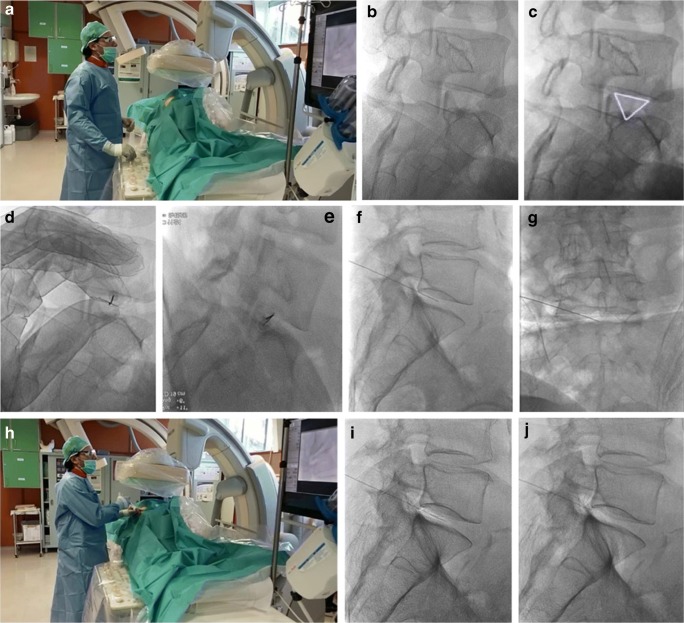
Fig. 1
Fig. 1
Demonstration of the injection technique. a Photographic image shows the operator (a) starting to adjust C-arm positioning, required for needle guidance and insertion. b, c Oblique fluoroscopic views at the level of L5-S1 space, showing the so-called Scotty dog appearance with superimposed virtual (white) triangle, through which the needle should be inserted. d, e Oblique fluoroscopic images, obtained during and after needle insertion and advancement, showing the needle appearing as a small radiolucent line projected over the concerned disc space. f, g Lateral and anteroposterior fluoroscopic views, obtained prior to oxygen-ozone mixture injection, showing the needle tip inside the center of the concerned disc space. h Another photograph for the operator demonstrates the injection procedure of an oxygen-ozone mixture. i, j Lateral fluoroscopic views obtained after oxygen-ozone mixture injection, demonstrating the injected intradiscal (i) and intraforaminal (j) oxygen-ozone gas as a faint opacity around the needle tip
Fig. 2
Fig. 2
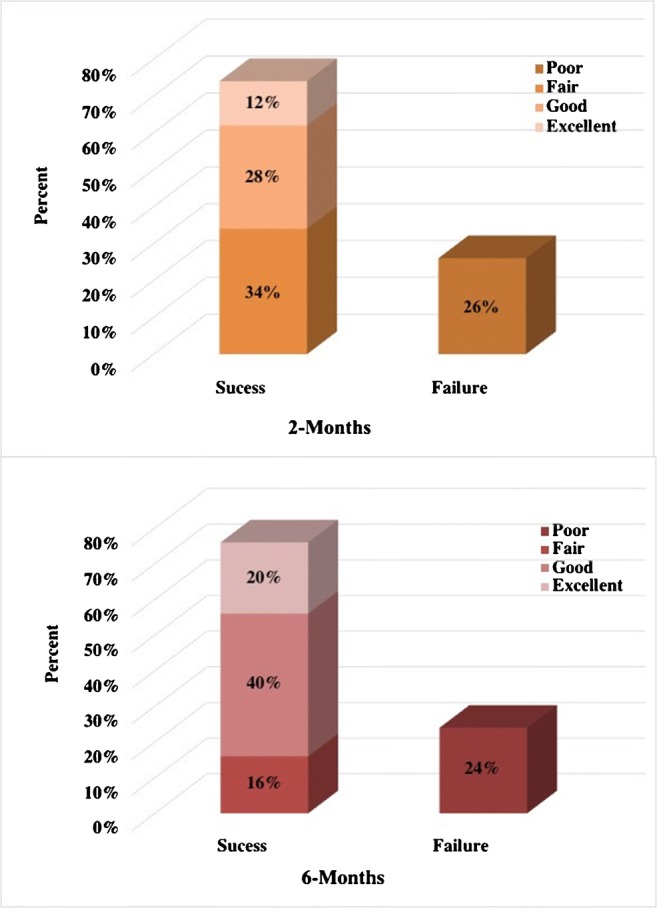
Two graphs show outcomes of pain disability during the follow-up
Fig. 3
Fig. 3
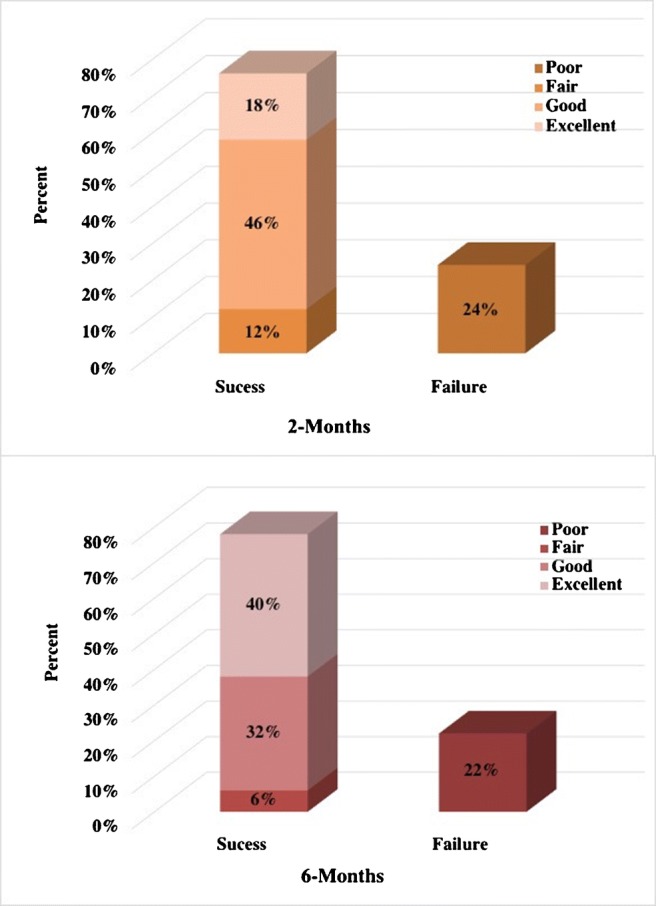
Two graphs show outcomes of pain intensity during the follow-up
Fig. 4
Fig. 4
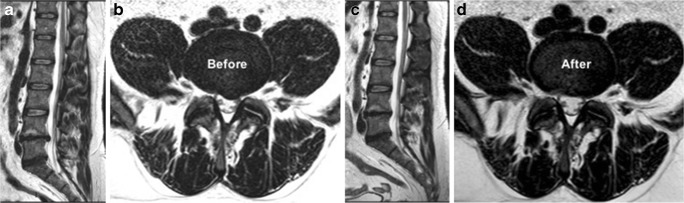
MR images of a 71-year- old man complaining of left lumbosciatica of 2-year duration and showed a significant clinical and radiological improvement after intradiscal O2-O3 injection. a, b Preprocedure sagittal and axial MRI T2-weighted images showing an extruded left para-centeral disc herniation at the level of L4–5, compressing the dural sac and the descending nerve roots. c, d Follow-up sagittal and axial MRI images obtained 6 months after the procedure showing near-complete resolution of the extruded disc hernia
Fig. 5
Fig. 5
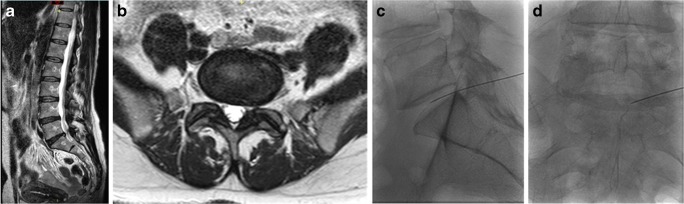
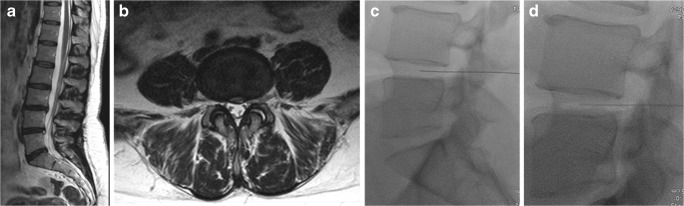
A 52-year-old women complaining of left lumbosciatica of 1-year duration and treated by intradiscal injection of an O2-O3 mixture. a MRI T2-weighted sagittal image, showing diffuse degenerative changes, with an associated bulging disc at L5-S1 level. b Axial MR T2-weighted image of the same patient shows diffuse disc bulge at the aforementioned level, more inclined to the left side with encroachment on the ipsilateral neural foramen. c, d Lateral and anteroposterior fluoroscopic images displaying the needle tip inside the disc center
Fig. 6
Fig. 6
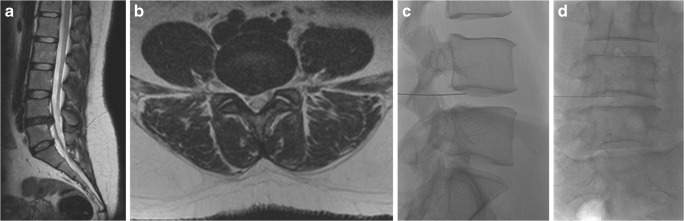
A 43-year-old women presented with lumbalgia and treated by of O2-O3 discolysis. a MRI T2-weighted sagittal image shows diffuse degenerative changes with small disc protrusion at the level of L4–5, associated with a high signal annular tear. b The corresponding axial MRI T2-weighted image shows a left para-median disc protrusion, minimally indenting the dural sac, at the aforementioned level. c, d Lateral fluoroscopic images of the same patient show the needle placed inside the disc center as well as the distribution of O2-O3 mixture (d) after the injection that displayed as a faint white opacity inside the disc and epidural space
Fig. 7
Fig. 7
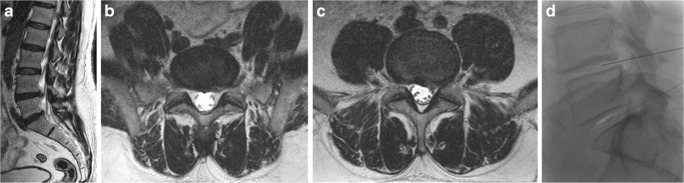
A 57-year-old man complaining of left lumbosciatica of 10-month duration and treated by O2-O3 chemonucleolysis. a Sagittal MRI T2-weighted image shows diffuse degenerative disc changes with small disc protrusions at the lower two lumbar levels. b, c The corresponding axial MRI T2-weighted images show left postero-lateral protrusions; at the levels of L4–5 and L5-S1, more evident at the latter one. d Lateral fluoroscopic image of the same patient shows the needles inside the center of corresponding discs, with ozone gas displayed as white linear opacity at L5–1 disc space
Fig. 8
Fig. 8
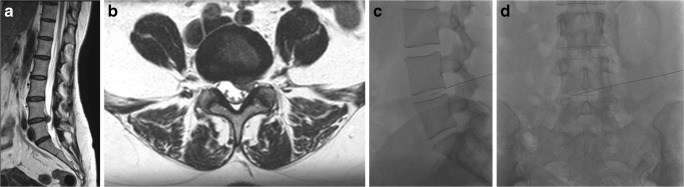
A 34-year-old women complaining of right lumbosciatica of 2-year duration and treated with ozone chemonucleolysis. a MRI T2-weighted sagittal image showing an extruded disc herniation at the level of L4–5, with pressure on the dural sac. b The corresponding axial MR T2-weighted image shows the disc herniation located at a right para-median site, compressing the dural sac as well as the traversing L5 nerve roots. c, d Lateral and anteroposterior fluoroscopic images showing the needle inside the disc center
Fig. 9
Fig. 9
A 59-year-old women complaining of left lumbosciatica of 6-month duration and treated with ozone chemonucleolysis. a Sagittal MRI T2-weighted image showing degenerative disc changes and a large extruded disc herniation at the level of L4–5, compressing the dural sac. b The corresponding axial MR T2-weighted image shows the disc herniation located at a left para-median site, obliterating the lateral canal recess with compression of the dural sac and traversing L5 nerve roots. c, d Lateral and anteroposterior fluoroscopic images showing the needle inside the disc center

References

    1. Simonetti L, Agati R, Cenni P, De Santis F, Leonardi M. Mechanism of pain in disc disease. Riv Neuroradiol. 2001;14(2):171–174. doi: 10.1177/197140090101400214. - DOI
    1. Yang H, Liu H, Li Z, Zhang K, Wang J, Wang H, Zheng Z. Low back pain associated with lumbar disc herniation: role of moderately degenerative disc and annulus fibrous tears. Int J Clin Exp Med. 2015;8(2):1634–1644. - PMC - PubMed
    1. Rhee JM, Schaufele M, Abdu WA. Radiculopathy and the herniated lumbar disc: controversies regarding pathophysiology and management. JBJS. 2006;88(9):2069–2080. doi: 10.2106/00004623-200609000-00023. - DOI - PubMed
    1. Buy X, Gangi A. Percutaneous treatment of intervertebral disc herniation. Semin Interv Radiol. 2010;27(2):148–159. doi: 10.1055/s-0030-1253513. - DOI - PMC - PubMed
    1. Awad JN, Moskovich R. Lumbar disc herniations: surgical versus nonsurgical treatment. Clin Orthop Relat Res. 2006;443:183–197. doi: 10.1097/01.blo.0000198724.54891.3a. - DOI - PubMed

LinkOut - more resources