


Weight Loss Maintenance: Have We Missed the Brain?
- PMID: 30208568
- PMCID: PMC6162665
- DOI: 10.3390/brainsci8090174
Weight Loss Maintenance: Have We Missed the Brain?
Abstract
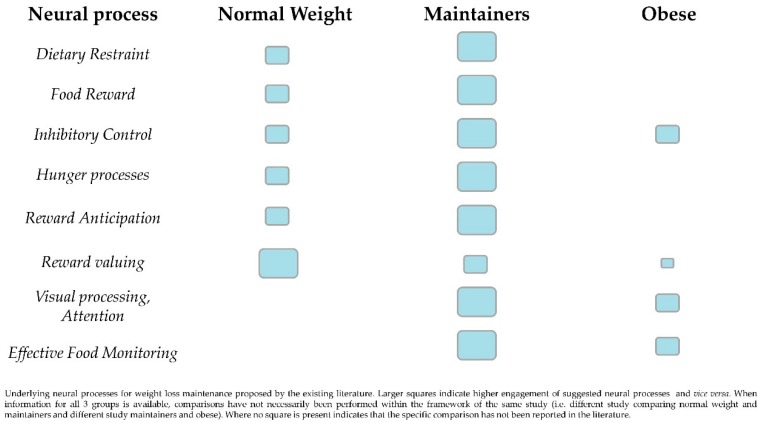
Even though obese individuals often succeed with weight loss, long-term weight loss maintenance remains elusive. Dietary, lifestyle and psychosocial correlates of weight loss maintenance have been researched, yet the nature of maintenance is still poorly understood. Studying the neural processing of weight loss maintainers may provide a much-needed insight towards sustained obesity management. In this narrative review, we evaluate and critically discuss available evidence regarding the food-related neural responses of weight loss maintainers, as opposed to those of obese or lean persons. While research is still ongoing, available data indicate that following weight loss, maintainers exhibit persistent reward related feeling over food, similar to that of obese persons. However, unlike in obese persons, in maintainers, reward-related brain activity appears to be counteracted by subsequently heightened inhibition. These findings suggest that post-dieting, maintainers acquire a certain level of cognitive control which possibly protects them from weight regaining. The prefrontal cortex, as well as the limbic system, encompass key regions of interest for weight loss maintenance, and their contributions to long term successful weight loss should be further explored. Future possibilities and supportive theories are discussed.
Keywords: functional neuroimaging; maintainers; neural processing; obesity; regainers; weight loss maintenance.
Conflict of interest statement
Mary Yannakoulia was the PI of the MedWeight study (2012–2015), that was partially funded by the Coca Cola Foundation (KA 221). Nikolaos Scarmeas reportspersonal fees from Merck Consumer Health. Dimitrios Poulimeneas and Costas A. Anastasiou declare no conflicts of interest.
Figures
References
-
- Langenberg C., Sharp S.J., Schulze M.B., Rolandsson O., Overvad K., Forouhi N.G., Spranger J., Drogan D., Huerta J.M., Arriola L., et al. Long-term risk of incident type 2 diabetes and measures of overall and regional obesity: The epic-interact case-cohort study. PLoS Med. 2012;9:e1001230. - PMC - PubMed
-
- Monda V., La Marra M., Perrella R., Caviglia G., Iavarone A., Chieffi S., Messina G., Carotenuto M., Monda M., Messina A. Obesity and brain illness: From cognitive and psychological evidences to obesity paradox. Diabetes Metab. Syndr. Obes. 2017;10:473–479. doi: 10.2147/DMSO.S148392. - DOI - PMC - PubMed
-
- Sone H., Mizuno S., Yamada N. Vascular risk factors and diabetic neuropathy. N. Engl. J. Med. 2005;352:1925–1927. - PubMed
Publication types
LinkOut - more resources
Full Text Sources
Other Literature Sources
