Review
. 2018 Sep 11;19(9):2699.
doi: 10.3390/ijms19092699.

The Cutaneous Microbiome and Wounds: New Molecular Targets to Promote Wound Healing

Affiliations
Review

The Cutaneous Microbiome and Wounds: New Molecular Targets to Promote Wound Healing

Taylor R Johnson et al. Int J Mol Sci. .

Abstract

The ecological community of microorganisms in/on humans, termed the microbiome, is vital for sustaining homeostasis. While culture-independent techniques have revealed the role of the gut microbiome in human health and disease, the role of the cutaneous microbiome in wound healing is less defined. Skin commensals are essential in the maintenance of the epithelial barrier function, regulation of the host immune system, and protection from invading pathogenic microorganisms. In this review, we summarize the literature derived from pre-clinical and clinical studies on how changes in the microbiome of various acute and chronic skin wounds impact wound healing tissue regeneration. Furthermore, we review the mechanistic insights garnered from model wound healing systems. Finally, in the face of growing concern about antibiotic-resistance, we will discuss alternative strategies for the treatment of infected wounds to improve wound healing and outcomes. Taken together, it has become apparent that commensals, symbionts, and pathogens on human skin have an intimate role in the inflammatory response that highlights several potential strategies to treat infected, non-healing wounds. Despite these promising results, there are some contradictory and controversial findings from existing studies and more research is needed to define the role of the human skin microbiome in acute and chronic wound healing.

Keywords: antibiotic resistance; commensals; infection; microbiome; skin; wound healing.


Conflict of interest statement

The authors declare no conflict of interest. The opinions or assertions contained herein are the private views of the author and are not to be construed as official or as reflecting the views of the Department of the Army or the Department of Defense.

Figures
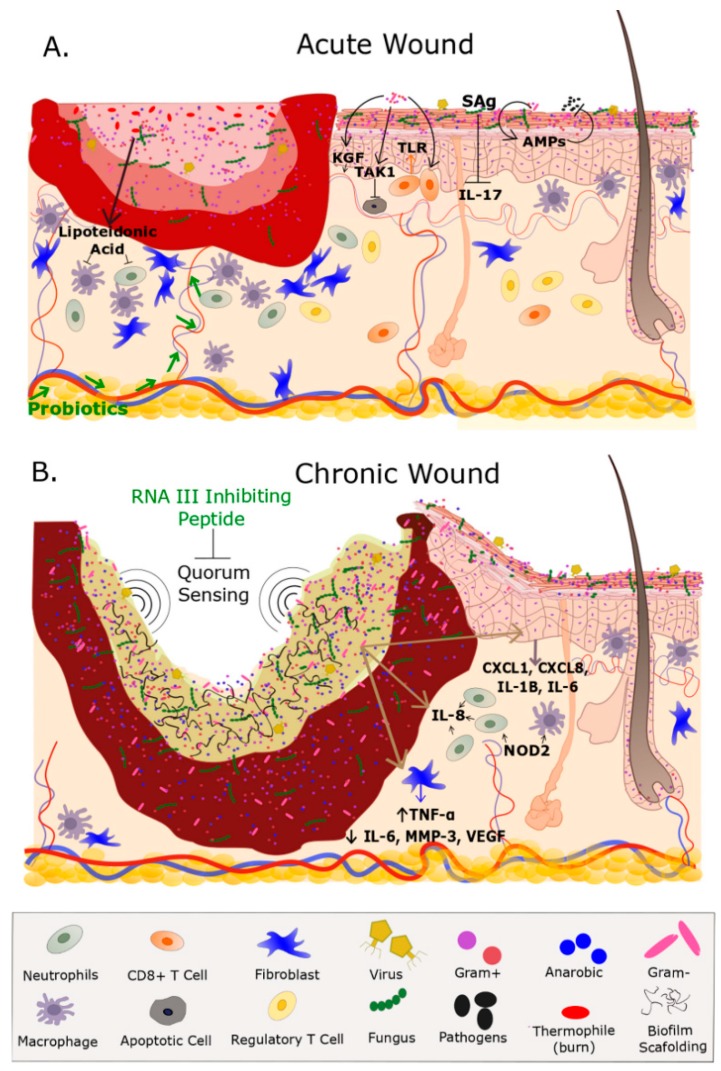
Figure 1
Figure 1
Microbiome, Wound Healing, and Wound Healing Impairment. (A) Acute wounds such as burns and open fractures contain a microbiome that may or not contain a vastly different population than what is on undamaged adjacent skin. The microbes present on an acute wound don’t necessarily impede the inflammatory response therefore allowing for the highly coordinated events that promote wound healing. Several fibroblast, and inflammatory cells such as macrophages, neutrophils, and T Cells are highly involved in the healing process. Production of lipoteichoic acid by S. epidermidis deceases inflammation. Keratinocytes express anti-microbial peptides (AMPs) in response to S. epidermidis, S. aureus, Group A streptococcus which provides protection for pathogenic bacterium. Supplementation with probiotics (e.g., Lactobacillus reuteri) accelerates wound healing although the mechanism is unknown. CD8+ T Cells in response to S. epidermidis enhance rapid keratinocyte progression via Toll-like receptor (TLR). Additionally, Pseudomonas accelerates epithelization and blood vessel growth through transforming growth factor beta-activated kinase 1 (TAK1) signaling. Overabundance of S. aureus produces superantigens (Sag) that are decreases interleukin (IL-17) and subsequently promoting wound healing. Note the greater numbers of healthy fibroblast, macrophages, and neutrophils near the wound bed and the intact vasculature that are essential in the healing process. Adjacent to the wound is undamaged (healthy) skin that contains macrophages, fibroblast, and a healthy ecological community of microorganisms that includes Gram Negatives, Gram Positives, fungi, and viruses within the epidermis and hair shaft; (B) chronic wounds contain a biofilm and a dense population of microorganisms which include anaerobic bacteria that obstruct wound healing by preventing topical antibiotics reaching the wound bed. Quorum sensing within the biofilm promotes biofilm formation, whereas exogenous topicals such as RNA inhibiting peptide inhibits biofilm formation. The biofilm elevates the expression of cytokines IL-1B, IL-6, chemokine ligand (CXCL) 1 and 8. Bacterium in the biofilm increase levels of IL-8 which is a potent neutrophil chemoattractant. Additionally, the biofilm increases levels of TNF-α, and decreases IL-6, MMP-3, and vascular endothelial growth factor (VEGF). Nucleotide-binding oligomerization domain-containing protein 2 (NOD2) stimulates a host response and is highly expressed in chronic wounds. The loss of vasculature to the wound bed further prevents the migration of immune-related factors and delivery of exogenous therapeutics. Fibroblast migration is impeded by biofilm formation Note the hyper-proliferative epidermis on the outer region of the wound bed in an attempt to epithelialize the wound. Although inflammation is present in chronic wounds the overall number of normal functioning fibroblasts and macrophages are low which further prevents healing. Green font represents an exogenous treatment for wound healing.

References

    1. DuPont A.W., DuPont H.L. The intestinal microbiota and chronic disorders of the gut. Nature reviews. Gastroenterol. Hepatol. 2011;8:523–531. - PubMed
    1. Jostins L., Ripke S., Weersma R.K., Duerr R.H., McGovern D.P., Hui K.Y., Lee J.C., Schumm L.P., Sharma Y., Anderson C.A., et al. Host-microbe interactions have shaped the genetic architecture of inflammatory bowel disease. Nature. 2012;491:119–124. doi: 10.1038/nature11582. - DOI - PMC - PubMed
    1. Marsh P.D. The commensal microbiota and the development of human disease—An introduction. J. Oral Microbiol. 2015;7:29128. doi: 10.3402/jom.v7.29128. - DOI - PMC - PubMed
    1. Williams M.R., Gallo R.L. The role of the skin microbiome in atopic dermatitis. Curr. Allergy Asthma Rep. 2015;15:65. doi: 10.1007/s11882-015-0567-4. - DOI - PubMed
    1. Grice E.A. The skin microbiome: Potential for novel diagnostic and therapeutic approaches to cutaneous disease. Semin. Cutan. Med. Surg. 2014;33:98–103. doi: 10.12788/j.sder.0087. - DOI - PMC - PubMed

Substances

LinkOut - more resources
