


Hair-Growth Potential of Ginseng and Its Major Metabolites: A Review on Its Molecular Mechanisms
- PMID: 30208587
- PMCID: PMC6163201
- DOI: 10.3390/ijms19092703
Hair-Growth Potential of Ginseng and Its Major Metabolites: A Review on Its Molecular Mechanisms
Abstract
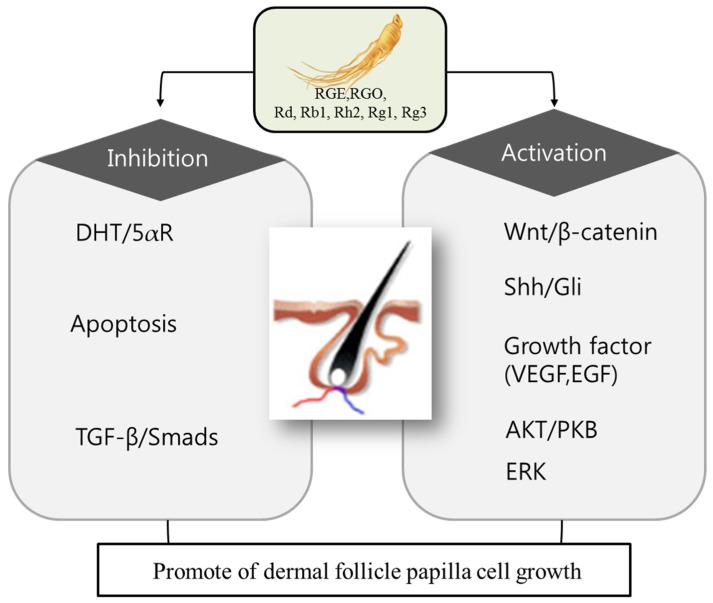
The functional aspect of scalp hair is not only to protect from solar radiation and heat/cold exposure but also to contribute to one's appearance and personality. Progressive hair loss has a cosmetic and social impact. Hair undergoes three stages of hair cycle: the anagen, catagen, and telogen phases. Through cyclical loss and new-hair growth, the number of hairs remains relatively constant. A variety of factors, such as hormones, nutritional status, and exposure to radiations, environmental toxicants, and medications, may affect hair growth. Androgens are the most important of these factors that cause androgenic alopecia. Other forms of hair loss include immunogenic hair loss, that is, alopecia areata. Although a number of therapies, such as finasteride and minoxidil, are approved medications, and a few others (e.g., tofacitinib) are in progress, a wide variety of structurally diverse classes of phytochemicals, including those present in ginseng, have demonstrated hair growth-promoting effects in a large number of preclinical studies. The purpose of this review is to focus on the potential of ginseng and its metabolites on the prevention of hair loss and its underlying mechanisms.
Keywords: BMP/Smad; Shh/Gli; TGF-β; WNT/β-catenin; ginseng; human-hair-follicle dermal papilla cells; mouse-hair growth.
Conflict of interest statement
The author declares no conflict of interest.
Figures
References
-
- Dong Hyun K. Review: Herbal medicines are activated by intestinal microflora. Nat. Prod. Sci. 2002;8:35–43.
-
- Oh S.J., Kim K., Lim C.J. Suppressive properties of ginsenoside Rb2, a protopanaxadiol-type ginseng saponin, on reactive oxygen species and matrix metalloproteinase-2 in UV-B-irradiated human dermal keratinocytes. Biosci. Biotechnol. Biochem. 2015;79:1075–1081. doi: 10.1080/09168451.2015.1020752. - DOI - PubMed
-
- Oh S.J., Lee S., Kho Y.E., Kim K., Jin C.D., Lim C.J. Stereoselective suppressive effects of protopanaxadiol epimers on uv-b-induced reactive oxygen species and matrix metalloproteinase-2 in human dermal keratinocytes. Can. J. Physiol. Pharmacol. 2015;93:91–95. doi: 10.1139/cjpp-2014-0273. - DOI - PubMed
Publication types
MeSH terms
Substances
LinkOut - more resources
Full Text Sources
Other Literature Sources
Medical
