


Assessing quality of life using WHOQOL-BREF: a cross-sectional study on the association between quality of life and neighborhood environmental satisfaction, and the mediating effect of health-related behaviors
- PMID: 30208869
- PMCID: PMC6134517
- DOI: 10.1186/s12889-018-5942-3
Assessing quality of life using WHOQOL-BREF: a cross-sectional study on the association between quality of life and neighborhood environmental satisfaction, and the mediating effect of health-related behaviors
Abstract
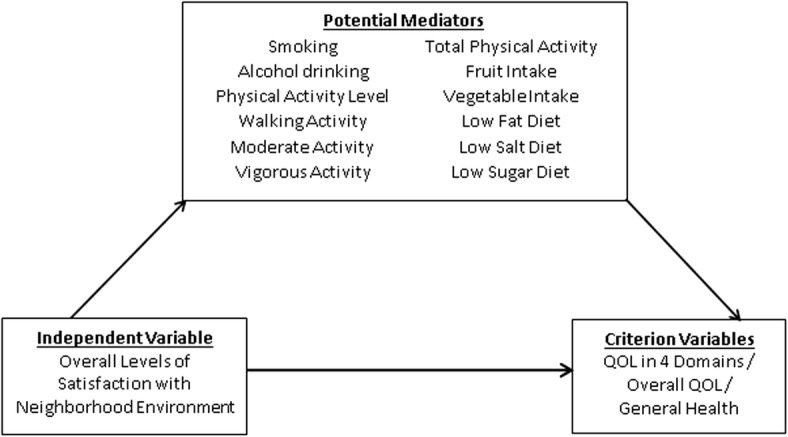
Background: Quality of life (QOL) is an important component in assessing people's health. Environmental quality can influence people's QOL in the physical health, psychological, social relationships and environment domains. QOL in the four domains, overall QOL and general heath of residents living in the Kowloon Peninsula of Hong Kong were assessed. The association between satisfaction with the neighborhood environment and QOL, and health-related behaviors which mediated the effect were investigated.
Methods: A sample of 317 residents completed a questionnaire which comprised the WHOQOL-BREF (Hong Kong version) to assess QOL, the International Physical Activity Questionnaire (IPAQ) to study physical activities, and questions on satisfaction with the neighborhood environment, health-related behaviors and socio-demographics. One-way ANOVA and linear regression were used to study the associations between environmental satisfaction and QOL in the four domains, overall QOL and general health, followed by assessing the relationships between environmental satisfaction and the potential health-related behavior mediators with regression tests. Mediation analysis was conducted using multiple linear regressions to study the effects of environmental satisfaction on QOL in the four domains, overall QOL and general health, as well as the potential mediating roles played by various health-related behaviors. A P-value of < 0.05 was considered as statistically significant.
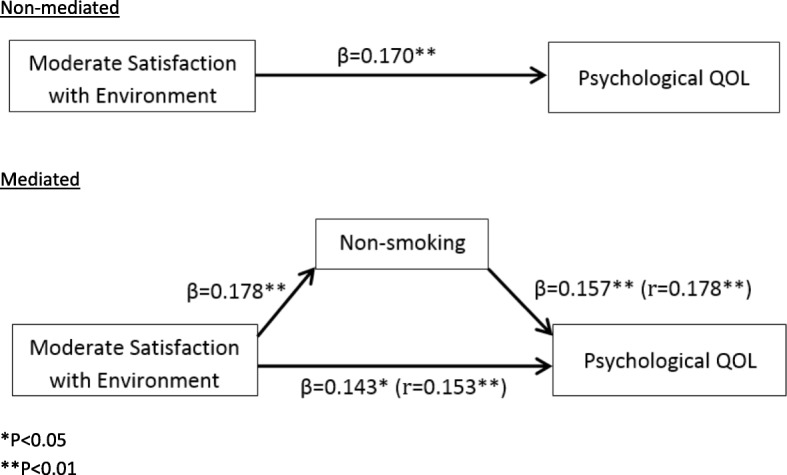
Results: The residents had a relatively higher physical health mean score of 70.83 ± 12.69, and a lower environmental mean score of 61.98 ± 13.76. Moderate satisfaction with the neighborhood environment had a significant relationship with QOL in the psychological domain (β = 0.170, P = 0.006), however, this effect was partially mediated by the non-smoking behavior of the residents (β = 0.143, P = 0.022).
Conclusions: Our residents had lower QOL in the physical health and psychological domains but similar QOL in the social relationships and environmental domains compared to other countries. Only QOL in the psychological domain could be predicted by the satisfaction with the neighborhood environment, and non-smoking status was a partial mediator of the effect of moderate environmental satisfaction on QOL in the psychological domain. Refrain from smoking seems to be able to lower the influence of neighborhood environment on people's QOL in the psychological domain to a certain extent.
Keywords: Neighborhood environment; Psychological health; Quality of life; Smoking; WHOQOL-BREF.
Conflict of interest statement
Ethics approval and consent to participate
All procedures performed in studies involving human participants were in accordance with the ethical standards of the institutional and/or national research committee and with the 1964 Helsinki declaration and its later amendments or comparable ethical standards. The study protocol was approved by the Human Subjects Ethics Sub-committee (HSESC) of The Hong Kong Polytechnic University (Reference Nos: HSEARS20150121008–01).
A verbal informed consent was obtained from each of the participants. The answered questionnaire and the signing for receiving the token of appreciation were also the implied consent to participate and provide data. The above arrangement was approved by the HSESC of The Hong Kong Polytechnic University. Names of the participants, first four digits of their Hong Kong identity cards, and dates providing verbal consent and receiving the token of appreciation were recorded.
Consent for publication
Not applicable.
Competing interests
The authors declare that they have no competing interests.
Publisher’s Note
Springer Nature remains neutral with regard to jurisdictional claims in published maps and institutional affiliations.
Figures
References
-
- World Health Organization (1996) WHO-BREF: Introduction, administration, scoring and generic version of the assessment. 1996. Geneva: WHO. http://www.who.int/mental_health/media/en/76.pdf. Accessed 9 August 2017.
-
- Apidechkul T. Comparison of quality of life and mental health among elderly people in rural and suburban areas, Thailand. Southeast Asian J Trop Med Public Health. 2011;42:1282–1292. - PubMed
MeSH terms
LinkOut - more resources
Full Text Sources
Other Literature Sources
