. 2018 Sep 12;8(1):13659.
doi: 10.1038/s41598-018-31717-7.

Mercury and arsenic attenuate canonical and non-canonical NLRP3 inflammasome activation

Affiliations

Mercury and arsenic attenuate canonical and non-canonical NLRP3 inflammasome activation

Huijeong Ahn et al. Sci Rep. .

Abstract

Exposure to heavy metals can cause several diseases associated with the immune system. Although the effects of heavy metals on production of inflammatory cytokines have been previously studied, the role of heavy metals in inflammasome activation remains poorly studied. The inflammasome is an intracellular multi-protein complex that detects intracellular danger signals, resulting in inflammatory responses such as cytokine maturation and pyroptosis. In this study, we elucidated the effects of four heavy metals, including cadmium (Cd), mercury (Hg), arsenic (As), and lead (Pb), on the activation of NLRP3, NLRC4, and AIM2 inflammasomes. In our results, mercury and arsenic inhibited interleukin (IL)-1β and IL-18 secretion resulting from canonical and non-canonical NLRP3 inflammasome activation in macrophages and attenuated elevation of serum IL-1β in response to LPS treatment in mice. In the mechanical studies, mercury interrupted production of mitochondrial reactive oxygen species, release of mitochondrial DNA, and activity of recombinant caspase-1, whereas arsenic down-regulated expression of promyelocytic leukemia protein. Both mercury and arsenic inhibited Asc pyroptosome formation and gasdermin D cleavage. Thus, we suggest that exposure to mercury and/or arsenic could disrupt inflammasome-mediated inflammatory responses, which might cause unexpected side effects.


Conflict of interest statement

The authors declare no competing interests.

Figures
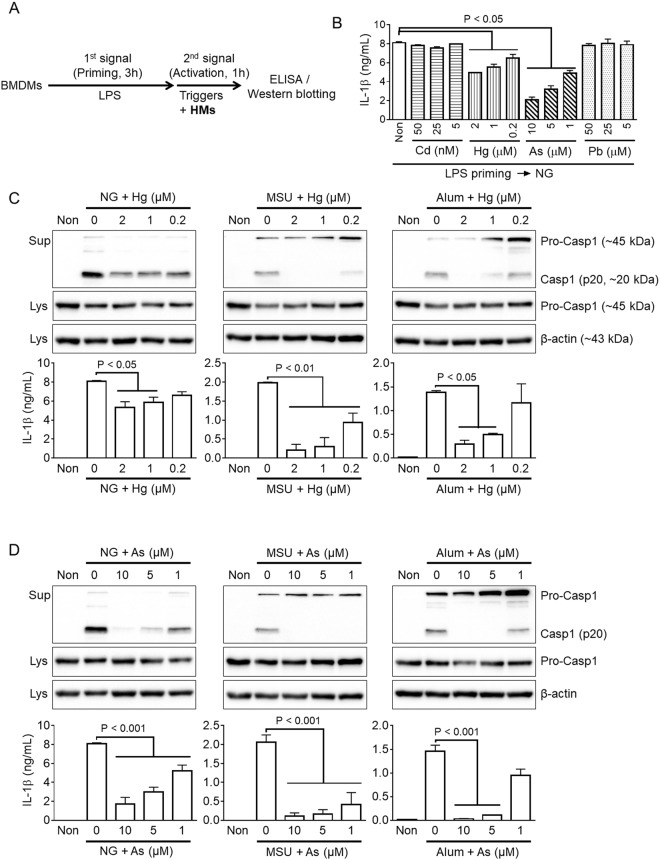
Figure 1
Figure 1
Effects of heavy metals on NLRP3 inflammasome activation. (A) Schematic diagram for inflammasome activation. BMDMs (1 × 10⁶ cells per well) were treated with LPS (1 μg/ml) as a 1st signal for priming, after which cells were replaced with media containing an inflammasome trigger (2nd signal) with/without heavy metals (HMs) as indicated. Inflammasome activation was assessed by ELISA and/or immunoblotting. (B) LPS-primed BMDMs were treated with nigericin (NG) in the presence of media only (Non), cadmium (Cd), mercury (Hg), arsenic (As), or lead (Pb). Release of IL-1β was analyzed by ELISA. (C) LPS-primed BMDMs were subjected to activation of NLRP3 inflammasome by NG, monosodium urate crystal (MSU), or aluminum (Alum) treatment in the presence of an increasing dosage of mercury (Hg). The cleaved form of caspase-1 (Casp1, p20) was detected by immunoblotting, and secretion of IL-1β was observed with ELISA. (D) LPS-primed BMDMs were treated with NG, MSU, or Alum in the presence of arsenic (As). Release of Casp1 and IL-1β was analyzed with immunoblotting and ELISA. All immunoblot data shown are representative of at least three independent experiments. Bar graph presents the mean ± SD with at least two independent experiments.
Figure 2
Figure 2
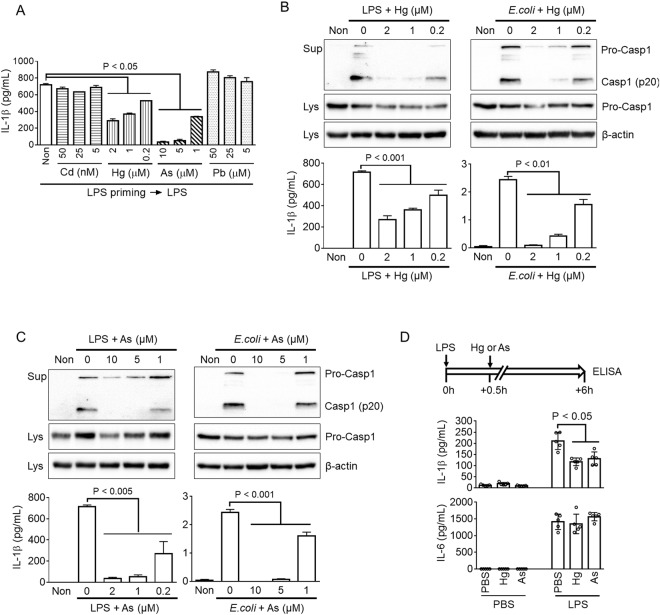
Effects of heavy metals on non-canonical NLRP3 inflammasome activation. (A) LPS-primed BMDMs were transfected with LPS to activate non-canonical inflammasome in the presence of media only (Non), cadmium (Cd), mercury (Hg), arsenic (As), or lead (Pb). Release of IL-1β was analyzed by ELISA. (B) LPS-primed BMDMs were subjected to activation of NLRP3 inflammasome activation via the non-canonical pathway using LPS transfection (left panel) or E. coli infection (right panel) in the presence of an increasing dosage of mercury (Hg). The cleaved form of caspase-1 (Casp1, p20) was detected by immunoblotting, and secretion of IL-1β was observed with ELISA. (C) LPS-primed BMDMs were treated with LPS or E. coli with/without arsenic (As). Release of Casp1 and IL-1β was detected by immunoblotting or ELISA. Mice (n = 5 per group, total n = 30) were intraperitoneally administrated with PBS, mercury, or arsenic 30 min after ip injection of PBS or LPS. After an additional 5.5 h, serum IL-1β and IL-6 were analyzed by ELISA. All immunoblot data shown are representative of at least three independent experiments. Bar graph presents the mean ± SD with at least two independent experiments.
Figure 3
Figure 3
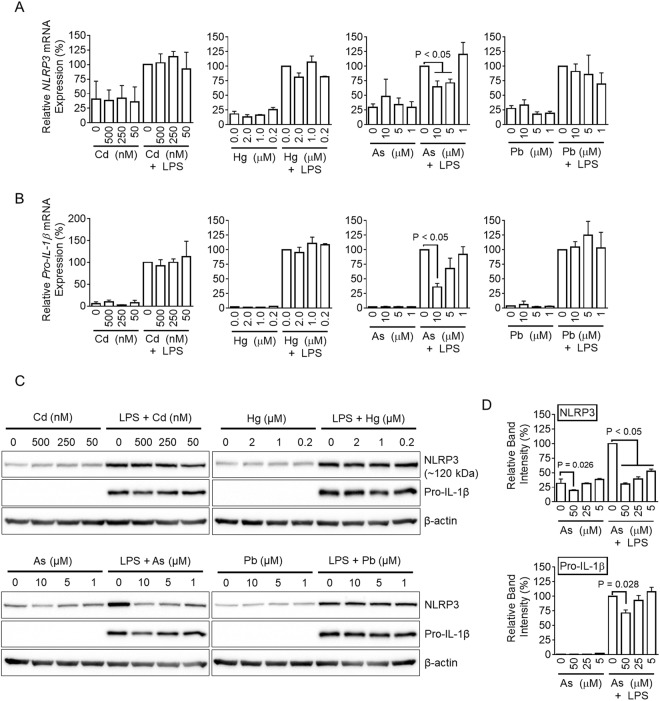
Effects of heavy metals on the priming step. BMDMs were treated with cadmium (Cd), mercury (Hg), arsenic (As), or lead (Pb) with/without LPS (10 ng/ml) for 3 h. The mRNA expression levels of NLRP3 (A) and the pro-form of IL-1β (pro-IL-1β, B) mRNAs were detected by real-time qPCR. (C) Protein levels of NLRP3 and pro-IL-1β were detected by immunoblotting. (D) Band densities of NLRP3 and pro-IL-1β proteins in response to arsenic treatment are represented as bar graphs. All immunoblot data shown are representative of at least three independent experiments. Bar graph presents the mean ± SD with at least two independent experiments.
Figure 4
Figure 4
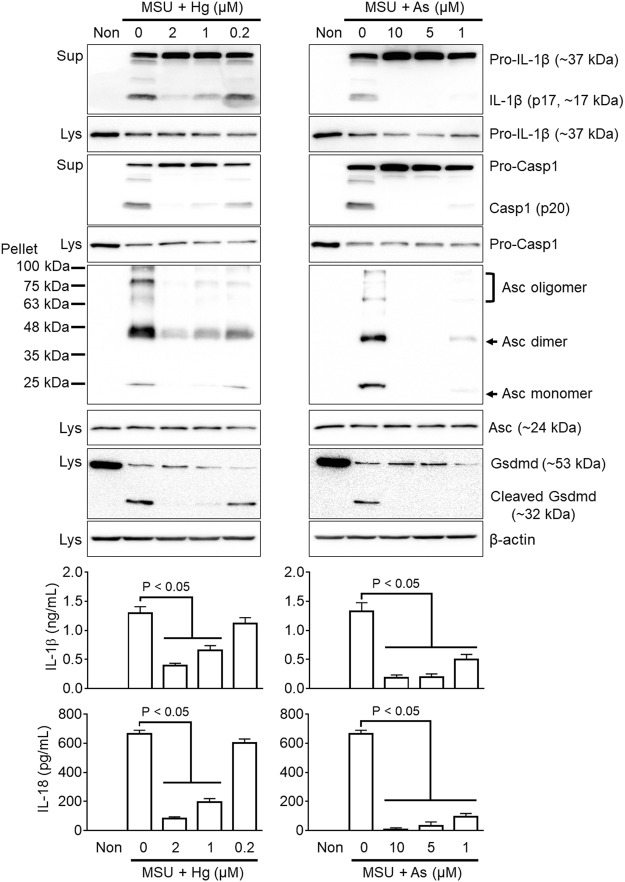
Effects of mercury and arsenic on Asc oligomerization and IL-18 secretion resulting from NLRP3 inflammasome activation. BMDMs were primed with LPS and then treated with MSU in the presence of mercury (Hg, left side) or arsenic (As, right side). Secretion of IL-1β (p17) and Casp1 (p20), Asc pyroptosome formation, and gasdermin D (Gsdmd) cleavage were elucidated by immunoblotting. In addition, release of IL-1β and IL-18 was detected by ELISA. All immunoblot data shown are representative of at least three independent experiments. Bar graph presents the mean ± SD with at least two independent experiments.
Figure 5
Figure 5
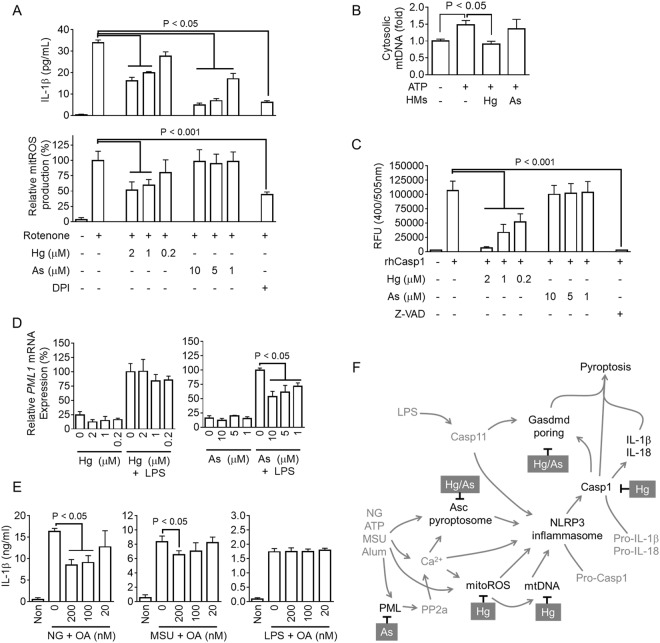
Effects of mercury and arsenic on mitochondrial ROS production, mitochondrial DNA release, caspase-1 activity, and PML1 gene expression. (A) BMDMs were treated with rotenone (160 μM) for 6 h in the presence of mercury (Hg), arsenic (As), or DPI (ROS scavenger). IL-1β secretion was measured by ELISA, and the production of mitochondrial ROS (mitROS) was detected by mitoSOXTM. (B) LPS-primed BMDMs were treated with ATP (5 mM) and rotenone (5 μM) with/without Hg or As, after which cytosolic release of mitochondrial DNA (mtDNA, cytochrome c oxygenase 1/18r DNA) was analyzed. (C) Activity of recombinant human caspase-1 (rhCasp1) was measured in the presence of Hg, As, or Z-VAD-FMK (Z-VAD, pan-caspase inhibitor). (D) BMDMs were treated with/without LPS or heavy metals, and expression of PML1 mRNA was quantitated with real-time PCR. (E) LPS-primed BMDMs were stimulated for NLRP3 inflammasome activation by treatment with NG or MSU or LPS transfection in the presence of okadaic acid (OA, PP2a inhibitor) as indicated. IL-1β secretion was measured by ELISA. (F) Summary of anti-NLRP3 inflammasome properties of Hg and As. Bar graph presents the mean ± SD with at least two independent experiments. RFU, relative fluorescence unit.

References

    1. Tchounwou PB, Yedjou CG, Patlolla AK, Sutton DJ. Heavy metal toxicity and the environment. Exs. 2012;101:133–164. - PMC - PubMed
    1. Giacoppo S, et al. Heavy metals and neurodegenerative diseases: an observational study. Biological trace element research. 2014;161:151–160. doi: 10.1007/s12011-014-0094-5. - DOI - PubMed
    1. Moon SS. Additive effect of heavy metals on metabolic syndrome in the Korean population: the Korea National Health and Nutrition Examination Survey (KNHANES) 2009-2010. Endocrine. 2014;46:263–271. doi: 10.1007/s12020-013-0061-5. - DOI - PubMed
    1. Muller S, et al. Effects of cadmium on the immune system of mice. Experientia. 1979;35:909–910. doi: 10.1007/BF01955143. - DOI - PubMed
    1. Dietert RR, Piepenbrink MS. Lead and immune function. Critical reviews in toxicology. 2006;36:359–385. doi: 10.1080/10408440500534297. - DOI - PubMed

Publication types

MeSH terms

Substances