. 2018 Aug 19:2018:3692752.
doi: 10.1155/2018/3692752. eCollection 2018.

Propionibacterium acnes Induces Intervertebral Disc Degeneration by Promoting iNOS/NO and COX-2/PGE2 Activation via the ROS-Dependent NF- κ B Pathway

Affiliations

Propionibacterium acnes Induces Intervertebral Disc Degeneration by Promoting iNOS/NO and COX-2/PGE2 Activation via the ROS-Dependent NF- κ B Pathway

Yazhou Lin et al. Oxid Med Cell Longev. .

Abstract

Accumulating evidence suggests that Propionibacterium acnes (P. acnes) is a novel pathogenic factor promoting intervertebral disc degeneration (IVDD). However, the underlying mechanisms by which P. acnes induces IVDD have been unclear. In this study, we quantified the severity of IVDD, as well as the expressions of inducible nitric oxide synthase (iNOS)/nitric oxide (NO) and cyclooxygenase (COX-2)/prostaglandin (PGE2) in human intervertebral discs (IVDs) infected with P. acnes. Compared with P. acnes-negative IVDs, P. acnes-positive IVDs showed increased iNOS/NO and COX-2/PGE2 activity concomitant with more severe IVDD. In order to detect the potential correlation between iNOS/NO expression, COX-2/PGE2 expression, and IVDD, we developed a P. acnes-induced IVDD rat model and found that the upregulation of iNOS/NO and COX-2/PGE2 was essential to the occurrence of P. acnes-induced IVDD. This finding was supported by the fact that the inhibition of iNOS/NO and COX-2/PGE2 activity ameliorated IVDD significantly, as evidenced by restored aggrecan and collagen II expression both in vivo and in vitro. Mechanistically, we found that P. acnes induced iNOS/NO and COX-2/PGE2 expressions via a reactive oxygen species- (ROS-) dependent NF-κB cascade. Furthermore, NADPH oxidase participated in P. acnes-induced ROS, iNOS/NO, and COX-2/PGE2 expressions. Overall, these findings further validated the involvement of P. acnes in the pathology of IVDD and provided evidence that P. acnes-induced iNOS/NO and COX-2/PGE2 activation via the ROS-dependent NF-κB pathway is likely responsible for the pathology of IVDD.


Figures
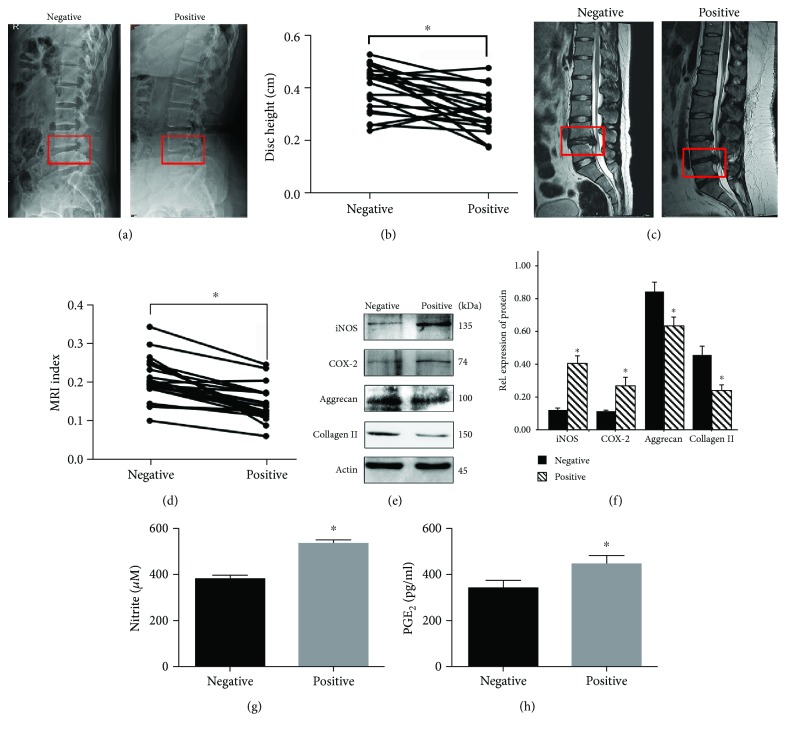
Figure 1
Figure 1
The IVDs infected with P. acnes had increased iNOS/NO and COX-2/PGE2 expressions, concomitant with severe disc degeneration. (a–d) Representative images from lateral X-rays and magnetic resonance imaging point to severe degeneration in P. acnes-positive IVDs (n = 23 for each group). (e–f) Western blot analysis of aggrecan, collagen II, iNOS, and COX-2 in human IVDs. The P. acnes-positive groups compared with the P. acnes-negative groups. (g, h) The concentration of NO and PGE2 were tested by the Griess reaction and ELISA, respectively. The P. acnes-positive groups compared with the P. acnes-negative groups; P < 0.05. P values were analyzed by paired t-test, Student's t-test, and one-way ANOVA. Data are presented as the mean ± SD from three independent experiments.
Figure 2
Figure 2
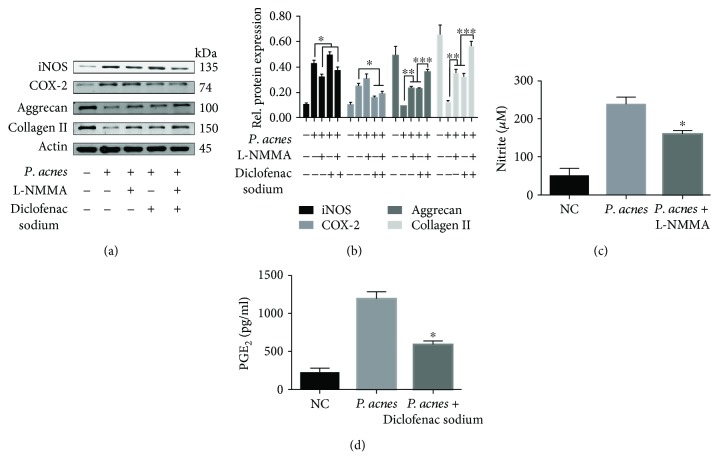
Caudal IVD inoculation with P. acnes-induced IVDD by promoting iNOS/NO and COX-2/PGE2 expression in rats. (a, b) Western blot analysis of aggrecan, collagen II, iNOS, and COX-2 expression in the IVDs of rats inoculated with P. acnes for 72 h, with or without L-NMMA (1 mM) and DS (200 μM) pretreatment. /∗∗The infected group compared with the infection + L-NMMA and/or DS groups. ∗∗∗The infection + L-NMMA and DS group compared with the infection + L-NMMA or DS groups. (c, d) The concentration of NO and PGE2 as tested in different groups. The infected group compared with the infection + L-NMMA or DS groups; P < 0.05. P values were analyzed by Student's t-test and one-way ANOVA. Data are presented as the mean ± SD from three independent experiments.
Figure 3
Figure 3
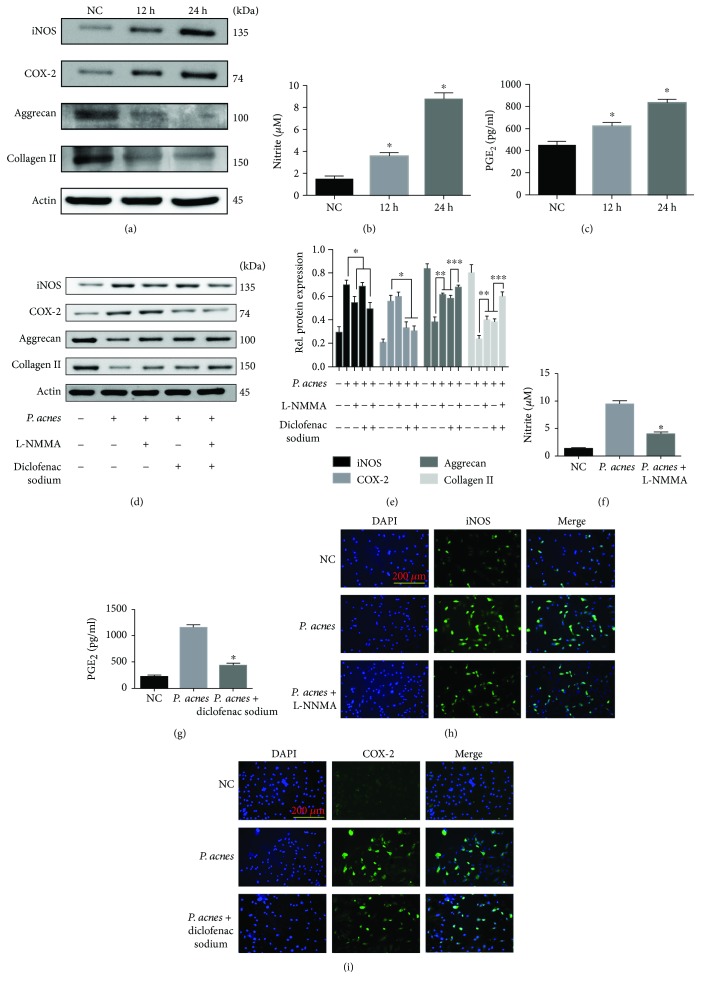
Inoculation with P. acnes induced iNOS/NO and COX-2/PGE2 expressions in NPCs. (a) Time curve expression of iNOS, COX-2, aggrecan, and collagen II in NPCs induced by P. acnes at a MOI = 100 : 1. (b, c) P. acnes inoculation increased NO and PGE2 production in a time-dependent manner. The groups with different incubation times compared with the negative control group. (d, e) Western blot analysis of iNOS, COX-2, aggrecan, and collagen II expression in NPCs infected with P. acnes for 24 hours, pretreated with or without L-NMMA (100 μM) and DS (200 nM). /∗∗The infected group compared with the infection + L-NMMA and/or DS groups. ∗∗∗The infection + L-NMMA and DS group compared with the infection + L-NMMA or DS groups. (f, g) The concentration of NO and PGE2 production induced by P. acnes infection for 24 hours, pretreated with or without L-NMMA (100 μM) and DS (200 nM). The infection group compared with the infection + L-NMMA or DS groups. (h, i) Immunofluorescence analysis of iNOS and COX-2 expressions in NPCs induced by P. acnes infection for 24 hours, pretreated with or without L-NMMA (100 μM) and DS (200 nM); P < 0.05. P values were analyzed by one-way ANOVA. Data are presented as the mean ± SD from three independent experiments.
Figure 4
Figure 4
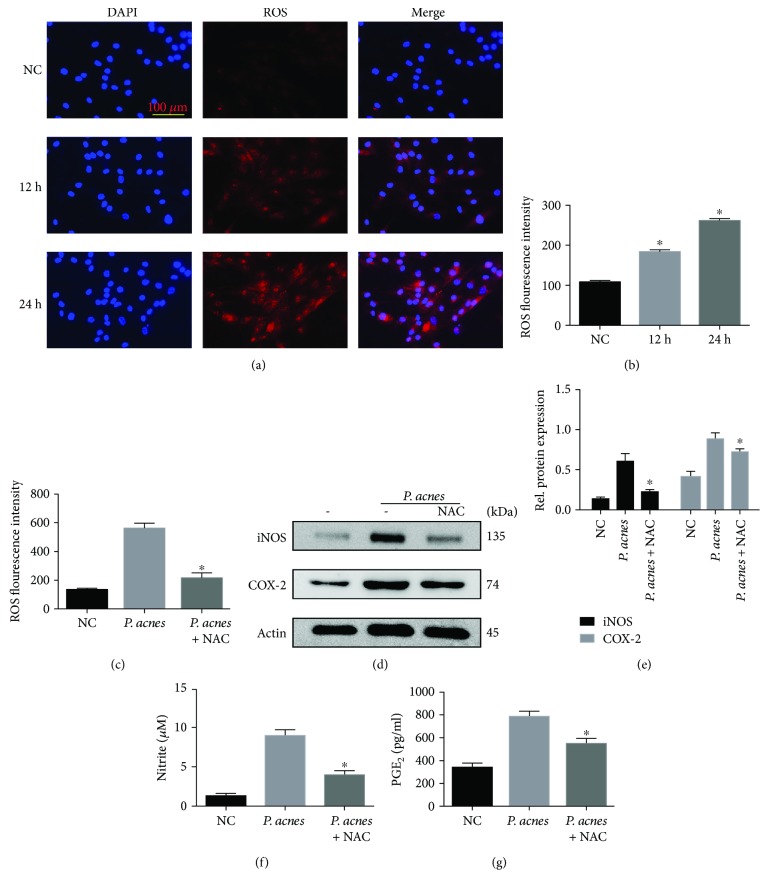
P. acnes induced iNOS/NO and COX-2/PGE2 production via increased ROS production in NPCs. (a) Immunofluorescence analysis of ROS in NPCs in response to P. acnes infection at a MOI = 100 : 1 for different time periods. (b) The ROS fluorescence intensity was tested by flow cytometric analysis. The different incubation time groups compared with the negative control group. (c–g) The flow cytometric analysis of ROS, Western blot of iNOS and COX-2, and the production of NO and PGE2 in NPCs infected with P. acnes for 24 hours, with or without NAC (10 mM) preincubation. The infection + NAC group compared with the infection group. P < 0.05; P values were analyzed by one-way ANOVA. Data are presented as the mean ± SD from three independent experiments.
Figure 5
Figure 5
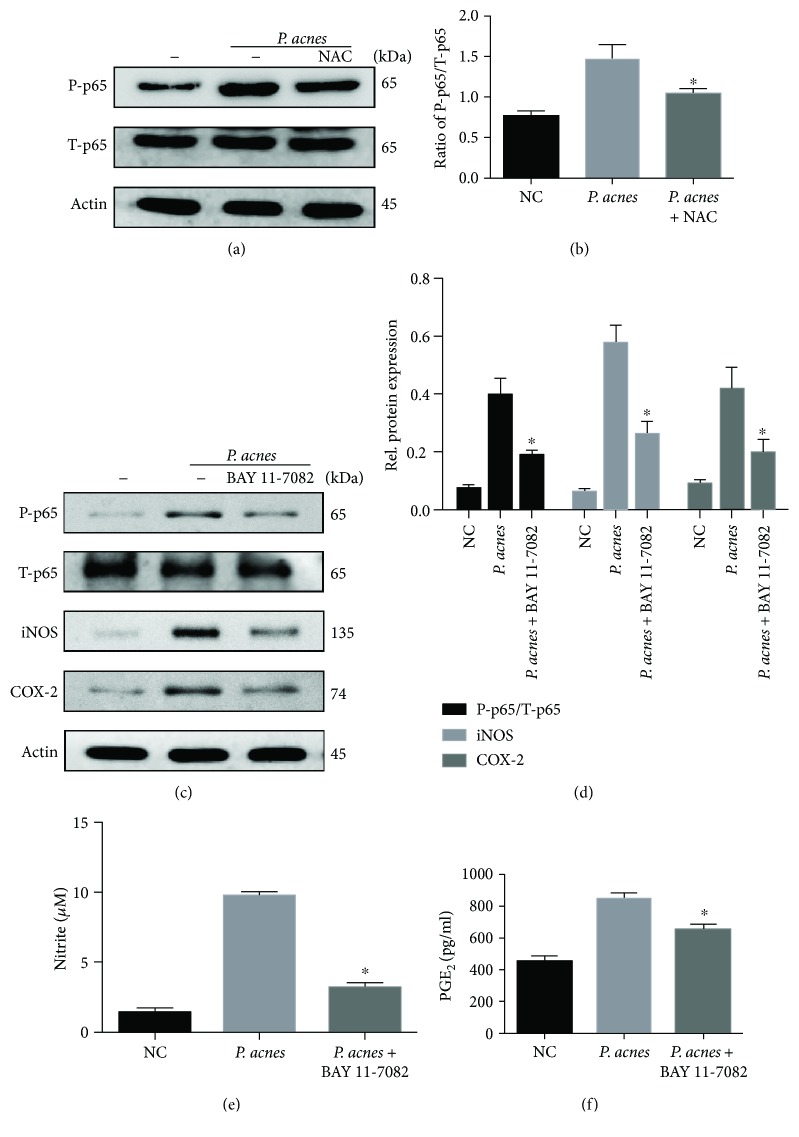
P. acnes induced iNOS/NO and COX-2/PGE2 expressions via a ROS-dependent NF-κB cascade. (a, b) Western blot analysis of NF-κB p65 activation in the presence of P. acnes for 1 hour, pretreated with or without NAC (10 mM) in NPCs. (c–f) The activation of NF-κB p65, expression of iNOS and COX-2 (c, d), and production of NO and PGE2 (e, f) were analyzed. The NPCs were incubated with P. acnes for 1 hour (for NF-κB p65 activation) and 24 hours (for iNOS, COX-2, NO, and PGE2 expression), pretreated with or without NF-κB-specific inhibitors (BAY 11-7082, 10 μM) for 1 hour. The infection + BAY 11-7082/NCA group compared with the infection group; P < 0.05. P values were analyzed by one-way ANOVA. Data are presented as the mean ± SD from three independent experiments. P-p65: phosphorylated-p65; T-p65: total-p65.
Figure 6
Figure 6
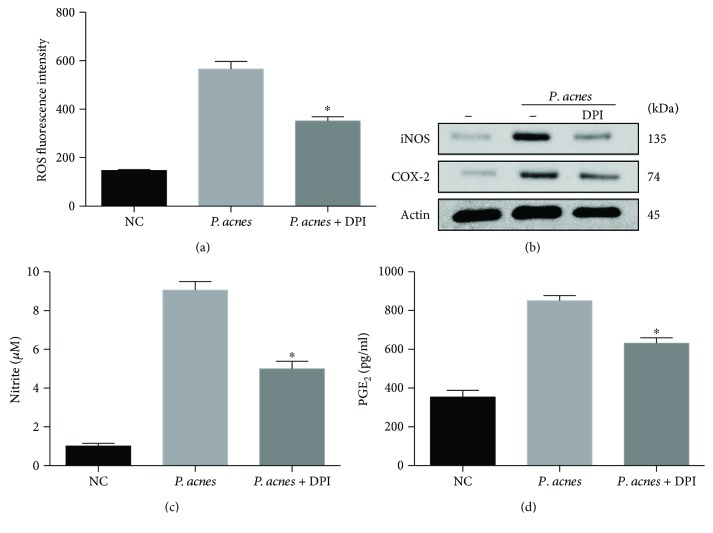
Participation of NADPH oxidase in P. acnes-induced ROS, iNOS/NO, and COX-2/PGE2 expressions. (a) Flow cytometric analysis of ROS fluorescence intensity in NPCs infected with P. acnes for 24 hours, pretreated with or without DPI (10 μM). The infection + DPI group compared with the infection group. (b–d) DPI inhibited P. acnes-induced iNOS/NO and COX-2/PGE2 production in NPCs. The infection + DPI group compared with the infection group; P < 0.05. P values were analyzed by one-way ANOVA. Data are presented as the mean ± SD from three independent experiments.
Figure 7
Figure 7
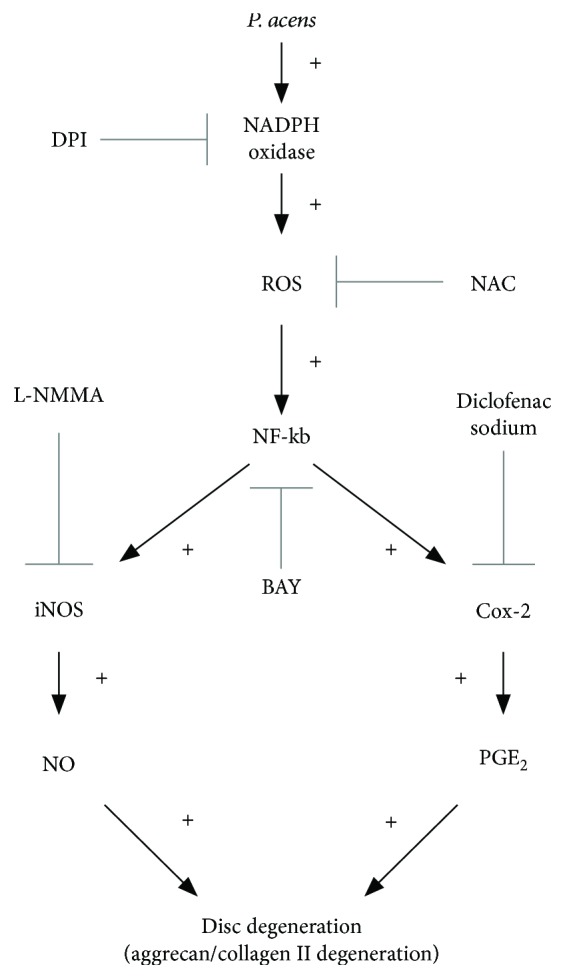
Schematic illustration of P. acnes-induced IVDD by promoting iNOS/NO and COX-2/PGE2.

References

    1. Modic M. T., Ross J. S. Lumbar degenerative disk disease. Radiology. 2007;245(1):43–61. doi: 10.1148/radiol.2451051706. - DOI - PubMed
    1. Chen Z., Cao P., Zhou Z., Yuan Y., Jiao Y., Zheng Y. Overview: the role of Propionibacterium acnes in nonpyogenic intervertebral discs. International Orthopaedics. 2016;40(6):1291–1298. doi: 10.1007/s00264-016-3115-5. - DOI - PubMed
    1. Stirling A., Worthington T., Rafiq M., Lambert P. A., Elliott T. S. J. Association between sciatica and Propionibacterium acnes . Lancet. 2001;357(9273):2024–2025. doi: 10.1016/S0140-6736(00)05109-6. - DOI - PubMed
    1. Albert H. B., Lambert P., Rollason J., et al. Does nuclear tissue infected with bacteria following disc herniations lead to Modic changes in the adjacent vertebrae? European Spine Journal. 2013;22(4):690–696. doi: 10.1007/s00586-013-2674-z. - DOI - PMC - PubMed
    1. Coscia M. F., Denys G. A., Wack M. F. Propionibacterium acnes, coagulase-negative Staphylococcus, and the “biofilm-like” intervertebral disc. Spine. 2016;41(24):1860–1865. doi: 10.1097/BRS.0000000000001909. - DOI - PMC - PubMed

LinkOut - more resources