


Effectiveness of cognitive, developmental, and behavioural interventions for Autism Spectrum Disorder in preschool-aged children: A systematic review and meta-analysis
- PMID: 30211331
- PMCID: PMC6129682
- DOI: 10.1016/j.heliyon.2018.e00763
Effectiveness of cognitive, developmental, and behavioural interventions for Autism Spectrum Disorder in preschool-aged children: A systematic review and meta-analysis
Abstract
Background: Autism spectrum disorder (ASD) is characterised by significant impairment in social communication and the presence of restrictive and repetitive behaviour or interest. Intervention during early childhood could decrease ASD symptoms. We aimed to identify the most effective intervention based on cognitive, developmental, and behavioural approaches and the factors that impact the effectiveness of the intervention.
Methods: We performed a systematic review and meta-analysis of existing interventions for ASD in preschool-aged children. Electronic databases were searched for related articles with randomised controlled trial (RCT) designs published between 2001 to 2015. Outcome measures were communication, behavioural and cognitive skills, reported as standardised mean differences (SMD) compared to a control group. A Random-effects model was utilised to calculate the pooled estimate effect. Between-study variability was also assessed. The registering number of this study is CRD42017035354.
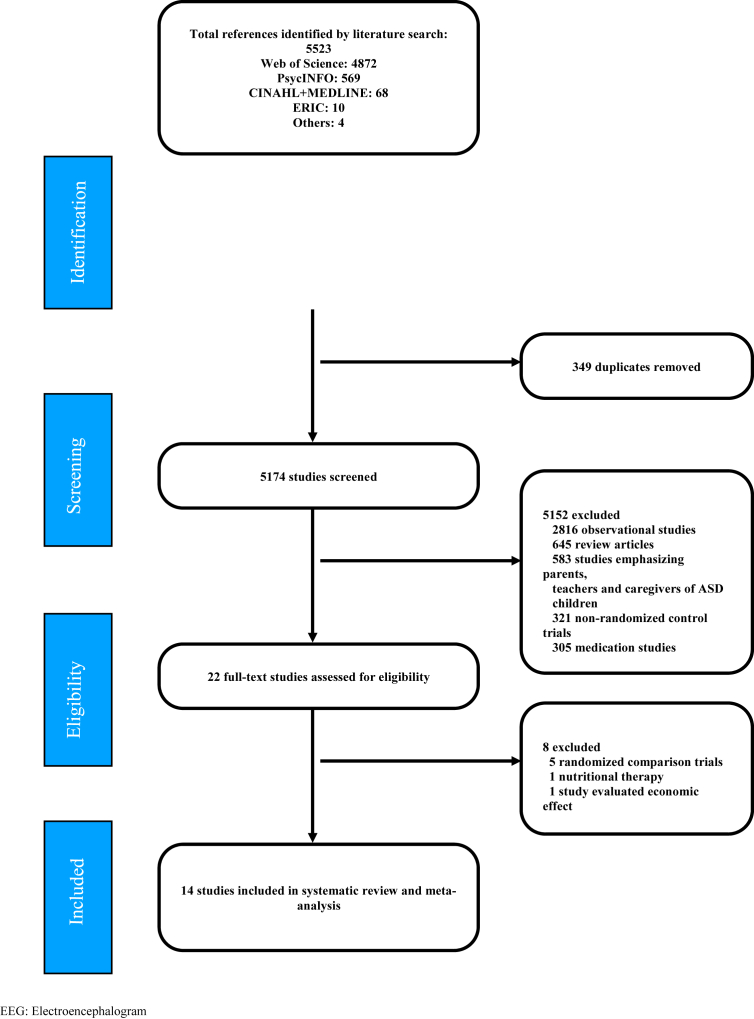
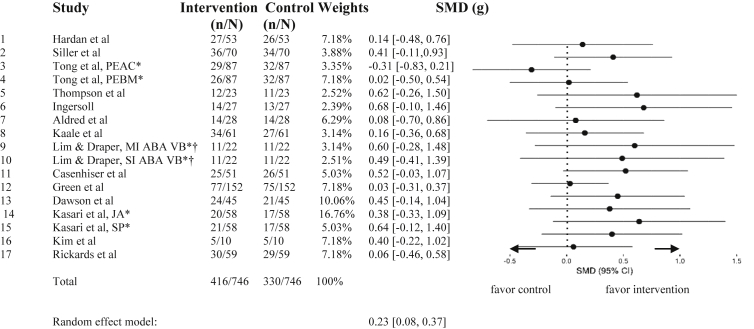
Findings: Out of the initial 5174 studies that were identified, there were 14 RCTs (746 children) that were included in the final systematic review and meta-analysis. Pooled estimate effect provided by random-effects model was 0.23 (95% confidence interval, CI [0.08-0.37]) with no between-study heterogeneity (I2 = 0.00%, p = 0.0018). Three studies of music therapy interventions provided the greatest outcome effects with a shorter duration and lower intensity. SMD for music therapies ranged from 0.40 to 0.62 with 95% CI [0.22 to 1.85]. The quality of the health care provider, the duration, and the intensity of intervention played an important role in the effectiveness of the intervention.
Interpretation: Music therapy appears to be an effective tool for improving social interaction in preschool-aged children with ASD. However, more evidence-based trials are required to further validate the effectiveness of music therapy in ASD.
Keywords: Education; Psychiatry.
Figures
References
-
- American Psychiatric Association . fifth ed. vol. 5. American Psychiatric Association; Washington DC: 2013. (Diagnostic and Statistical Manual of Mental Disorders).
-
- Brugha T.S., McManus S., Bankart J. Epidemiology of autism spectrum disorders in adults in the community in England. Arch. Gen. Psychiatry. 2011;68:459–466. - PubMed
-
- Magiati I., Tay X.W., Howlin P. Cognitive, language, social and behavioural outcomes in adults with autism spectrum disorders: a systematic review of longitudinal follow-up studies in adulthood. Clin. Psychol. Rev. 2014;34:73–86. - PubMed
-
- Locke J., Ishijima E.H., Kasari C., London N. Loneliness, friendship quality and the social networks of adolescents with high-functioning autism in an inclusive school setting. J. Res. Spec. Educ. Needs. 2010;10:74–81.
Publication types
LinkOut - more resources
Full Text Sources
Other Literature Sources
