. 2020 Apr;25(4):750-760.
doi: 10.1038/s41380-018-0234-y. Epub 2018 Sep 13.

mGluR5 hypofunction is integral to glutamatergic dysregulation in schizophrenia

Affiliations

mGluR5 hypofunction is integral to glutamatergic dysregulation in schizophrenia

Hoau-Yan Wang et al. Mol Psychiatry. 2020 Apr.

Retraction in

Abstract

Multiple lines of evidence point to glutamatergic signaling in the postsynaptic density (PSD) as a pathophysiologic mechanism in schizophrenia. Integral to PSD glutamatergic signaling is reciprocal interplay between GluN and mGluR5 signaling. We examined agonist-induced mGluR5 signaling in the postmortem dorsolateral prefrontal cortex (DLPFC) derived from 17 patients and age-matched and sex-matched controls. The patient group showed a striking reduction in mGluR5 signaling, manifested by decreases in Gq/11 coupling and association with PI3K and Homer compared to controls (p < 0.01 for all). This was accompanied by increases in serine and tyrosine phosphorylation of mGluR5, which can decrease mGluR5 activity via desensitization (p < 0.01). In addition, we find altered protein-protein interaction (PPI) of mGluR5 with RGS4, norbin, Preso 1 and tamalin, which can also attenuate mGluR5 activity. We previously reported molecular underpinnings of GluN hypofunction (decreased GluN2 phosphorylation) and here we show those of reduced mGluR5 signaling in schizophrenia. We find that reduced GluN2 phosphorylation can be precipitated by attenuated mGluR5 activity and that increased mGluR5 phosphorylation can result from decreased GluN function, suggesting a reciprocal interplay between the two pathways in schizophrenia. Interestingly, the patient group showed decreased mGluR5-GluN association (p < 0.01), a mechanistic basis for the reciprocal facilitation. In sum, we present the first direct evidence for mGluR5 hypoactivity, propose a reciprocal interplay between GluN and mGluR5 pathways as integral to glutamatergic dysregulation and suggest protein-protein interactions in mGluR5-GluN complexes as potential targets for intervention in schizophrenia.


Conflict of interest statement

Conflict of Interest: The authors have no conflict of interest in relation to the work described.

Figures

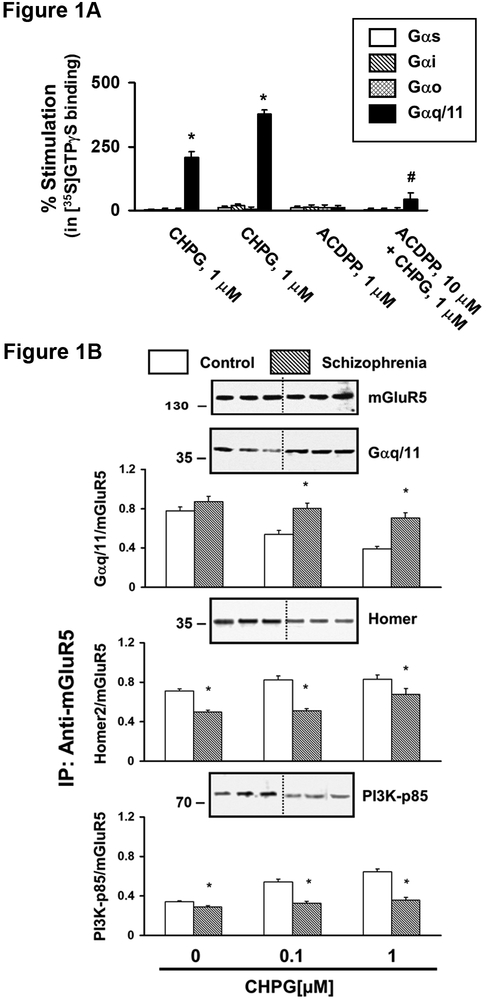
Figure 1 A-B.
Figure 1 A-B.. mGluR5 signaling is reduced in the DLPFC of patients
Fig 1A. mGluR5 activation increases coupling of the receptor specifically with Gq/11 in the DLPFC. Synaptic membranes derived from DLPFC tissues were preincubated with 0.5 nM [35S]GTPɤS for 5 min and with or without 10 µM of mGluR5 antagonist, ACDPP. The reaction was further incubated with or without 0.1 or 1 µM of CHPG for 10 min. [35S]GTPγS binding to Gα was captured by IP for specific Gα subunit. N = 4. Fig 1B. CHPG induced downstream signaling is reduced in the DLPFC of patients compared to controls. Postmortem DLPFC slices were analyzed for CHPG induced activation of mGluR5 signaling using the postmortem receptor activation paradigm. Tissue slices from 17 matched pairs of patients and controls were incubated with 0, 0.1, 1 μM CHPG, synaptic membranes were IPed for mGluR5 and Gq/11 coupling, activation of PI3K and association with Homer were assessed. Striking alterations in all three parameters in the patient group.
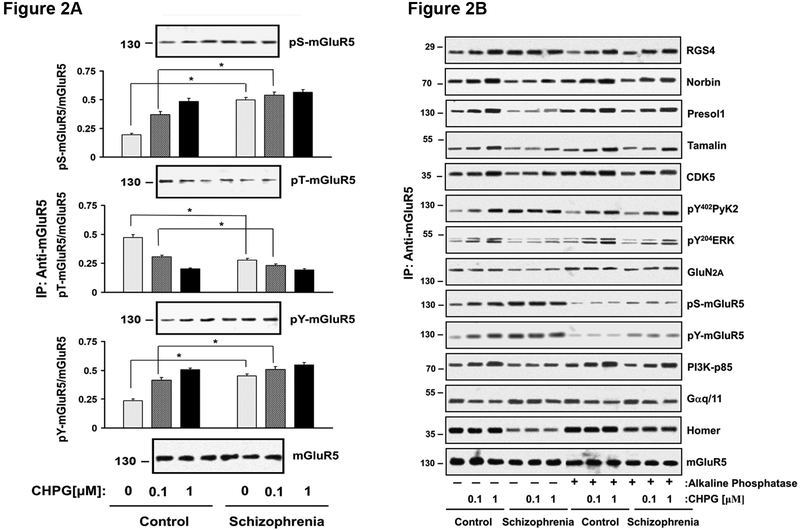
Fig 2A-B.
Fig 2A-B.
Fig 2A. mGluR5 phosphorylation is altered in schizophrenia. DLPFC slices from 17 matched pairs were incubated with 0, 0.1 or 1 µM of CHPG for 15 min. Protein extracts were immunoprecipitated with anti-mGluR5 in a denaturing condition, which were then probed for phosphor-serine (pS), -threonine (pT) and -tyrosine (pY). Fig 2B. Phosphorylation of mGluR5 can reduce coupling of mGluR5 to its diverse binders. Cortical slices were treated with alkaline phosphatase to eliminate phosphorylation, which were then incubated with 0, 0.1 or 1 µM of CHPG for 15 min. Tissue lysates were IPed for mGluR5 complexes and probed for mGluR5 binders including Gαq/11, Homer, PI3K, RGS4 and GluN2A by immunoblotting. N = 9
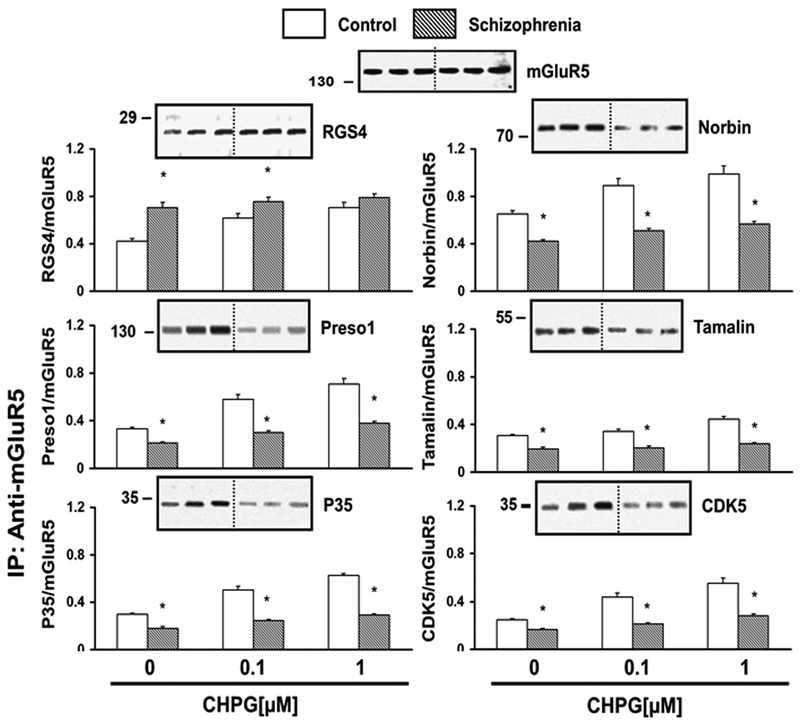
Figure 3.
Figure 3.. mGluR5 association with its interactors are altered in the DLPFC of patients compared to controls.
DLPFC slices were incubated with 0, 0.1 or 1 µM of CHPG for 15 min and resultant tissue lysates were IPed for mGluR5 complexes and probed for RGS4, Norbin, Preso 1, Tamalin, P35 and CDK5 by immunoblotting. N = 17.
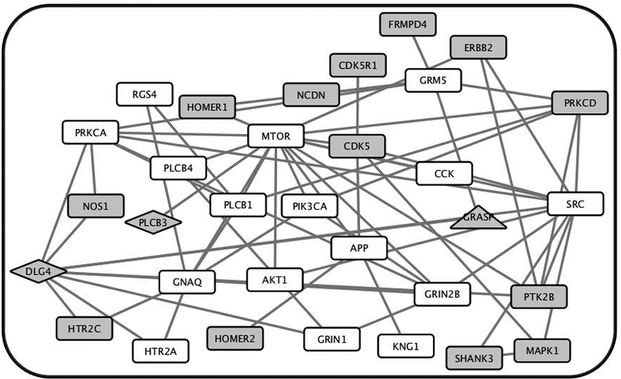
Figure 4.
Figure 4.. The protein - protein interaction derived mGluR5 subnetwork is enriched for SCZ risk variants.
A subnetwork of mGluR5 was constructed that consists of 32 genes based on protein–protein interactions previously reported. Nodes represent genes in the subnetwork and connecting lines (or edges) show previously reported direct protein interactions. Of the 32 genes in the subnetwork, 15 showed gene-wise significance greater than 0.05 in the schizophrenia cohort whereas only 3 showed gene-wise significance in the Crohn’s disease cohort (Figure 4). Gray = all associated genes, gray rectangle = schizophrenia only, gray triangle = Crohn’s only, gray diamond = both.
Figure 5.
Figure 5.
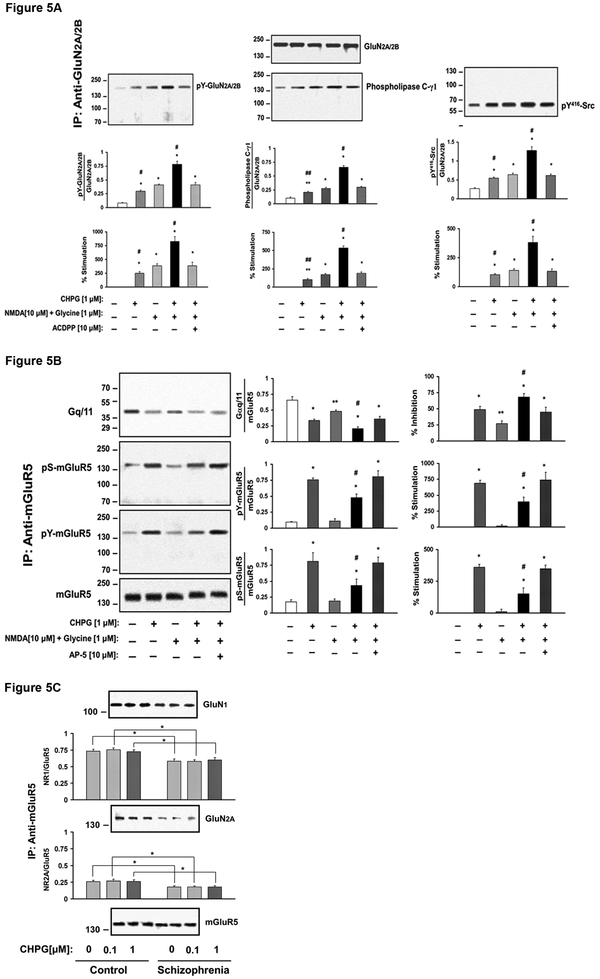
Fig 5A. GluN activation increases mGluR5 signaling in the DLPFC. DLPFC slices from 3 control subjects were examined for the effects of GluN activation on mGluR5-Gq/11 coupling. Prefrontal cortical slices were incubated 1 µM CHPG, NMDA (10 µM) + glycine (1 µM) or combination of CHPG, NMDA+glycine for 15 min in the presence or absence of 10 µM of ACDPP, a mGluR5 antagonist. The results indicate GluN activation leads to dephosphorylation of mGluR5 and enhance mGluR5 coupling to Gq/11. N = 3. Fig 5B. mGluR5 activation enhances GluN activation. DLPFC slices were incubated with 1 µM CHPG, NMDA (10 µM) + glycine (1 µM) or combination of CHPG, NMDA+glycine in the presence of absence of 10 µM of AP-5, a GluN antagonist. Protein extracts were immunoprecipitated with anti-GluN2A and –GluN2B and pS416Src, phospholipase Cγ1 was probed by immunoblotting. N = 3. Fig 5C. mGluR5 association with GluN is markedly reduced in postmortem DLPFC from schizophrenia subjects. DLPFC slices were incubated with 0, 0.1 or 1 µM of CHPG for 15 min, and tissue lysates were IPed for mGluR5 complexes. IPs were probed for GluN1 and GluN2A by immunoblotting. mGluR5 –GluN association is reduced in schizophrenia. N = 17.

References

    1. Network & Pathway Analysis Subgroup of Psychiatric Genomics, C. Psychiatric genome-wide association study analyses implicate neuronal, immune and histone pathways. Nat Neurosci 18, 199–209, doi:10.1038/nn.3922 (2015). - DOI - PMC - PubMed
    1. Purcell SM et al. A polygenic burden of rare disruptive mutations in schizophrenia. Nature 506, 185–190, doi:10.1038/nature12975 (2014). - DOI - PMC - PubMed
    1. Schizophrenia Working Group of the Psychiatric Genomics, C. Biological insights from 108 schizophrenia-associated genetic loci. Nature 511, 421–427, doi:10.1038/nature13595 (2014). - DOI - PMC - PubMed
    1. Perroy J et al. Direct interaction enables cross-talk between ionotropic and group I metabotropic glutamate receptors. J Biol Chem 283, 6799–6805, doi:10.1074/jbc.M705661200 (2008). - DOI - PubMed
    1. Marino MJ & Conn PJ Direct and indirect modulation of the N-methyl D-aspartate receptor. Curr Drug Targets CNS Neurol Disord 1, 1–16 (2002). - PubMed

Publication types

MeSH terms

Substances

LinkOut - more resources