


Mortality After Complex Displaced Proximal Humerus Fractures in Elderly Patients: Conservative Versus Operative Treatment With Reverse Total Shoulder Arthroplasty
- PMID: 30214828
- PMCID: PMC6134485
- DOI: 10.1177/2151459318795241
Mortality After Complex Displaced Proximal Humerus Fractures in Elderly Patients: Conservative Versus Operative Treatment With Reverse Total Shoulder Arthroplasty
Abstract
Introduction: Proximal humerus fractures (PHFs) are a common fragility fracture and have been shown to increase mortality in elderly patients. In the last decade, reverse total shoulder arthroplasty (RTSA) was introduced as a reliable operative treatment option for this indication. In other fragility fractures, most notably hip fractures, urgent surgical treatment can reduce mortality. The purpose of this study is to evaluate whether treatment with RTSA can reduce 1-year mortality in elderly patients with complex displaced PHFs.
Materials and methods: A retrospective study was performed to compare 1-year mortality between 2 groups of elderly patients (>75 years old) who presented to a level 1 trauma center emergency department with complex displaced PHFs. The conservative treatment group (n = 83; mean age, 83.7 years) presented from 2008 to 2010 when RTSA was not yet available, and treatment was nonoperative. The surgical treatment group (n = 62; mean age, 82.2 years) presented from 2012 to 2015 and underwent RTSA.
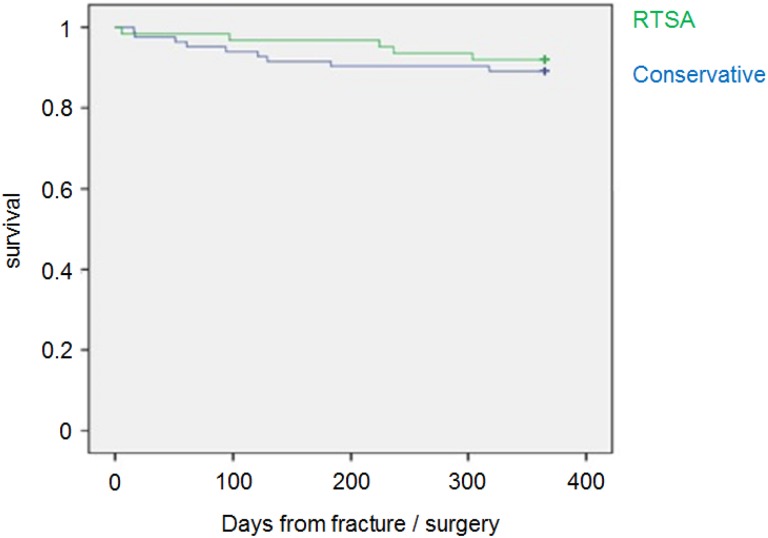
Results: One-year mortality was 8.1% (male 7.1%; female 8.3%) in the surgical treatment group and 10.8% (male 18.8%; female 9.0%) in the conservative treatment group. The reduction in mortality in the surgical treatment group was not significant (entire cohort P = .56; males P = .35; females P = .59).
Discussion: Recent studies failed to show better functional results after surgical treatment with RTSA when compared to conservative treatment. This study suggests that a benefit of surgical treatment with RTSA that was not examined until now might exist-a reduction in the increased mortality risk associated with PHFs.
Conclusions: There was no significant difference in 1-year mortality between the groups, although there was a trend showing lower mortality with RTSA, mostly in men. Further studies with larger populations and longer follow-up times are needed to determine whether this trend is of clinical significance.
Keywords: 1-year mortality; conservative treatment; elderly patients; fragility fractures; proximal humerus fracture; reverse total shoulder arthroplasty.
Conflict of interest statement
Declaration of Conflicting Interests: The author(s) declared no potential conflicts of interest with respect to the research, authorship, and/or publication of this article.
Figures
References
-
- Court-Brown CM, Caesar B. Epidemiology of adult fractures: a review. Injury. 2006;37(8):691–697. - PubMed
-
- Chu SP, Kelsey JL, Keegan TH, et al. Risk factors for proximal humerus fracture. Am J Epidemiol. 2004;160(4):360–367. - PubMed
-
- Court-Brown CM, Garg A, McQueen MM. The epidemiology of proximal humeral fractures. Acta Orthop Scand. 2001;72(4):365–371. - PubMed
-
- Palvanen M, Kannus P, Niemi S, Parkkari J. Update in the epidemiology of proximal humeral fractures. Clin Orthop Relat Res. 2006;442:87–92. - PubMed
-
- Morin S, Lix LM, Azimaee M, Metge C, Caetano P, Leslie WD. Mortality rates after incident non-traumatic fractures in older men and women. Osteoporos Int. 2011;22(9):2439–2448. - PubMed
LinkOut - more resources
Full Text Sources
Other Literature Sources
