


Long-Term Antipsychotic Effectiveness in First Episode of Psychosis: A 3-Year Follow-Up Randomized Clinical Trial Comparing Aripiprazole, Quetiapine, and Ziprasidone
- PMID: 30215723
- PMCID: PMC6276055
- DOI: 10.1093/ijnp/pyy082
Long-Term Antipsychotic Effectiveness in First Episode of Psychosis: A 3-Year Follow-Up Randomized Clinical Trial Comparing Aripiprazole, Quetiapine, and Ziprasidone
Abstract
Background: Different effectiveness profiles among second-generation antipsychotics may be a key point to optimize treatment in patients suffering a first episode of psychosis to affect long-term outcome. The aim of this study was to compare the clinical effectiveness of aripiprazole, ziprasidone, and quetiapine in the treatment of first episode of psychosis at 3-year follow-up.
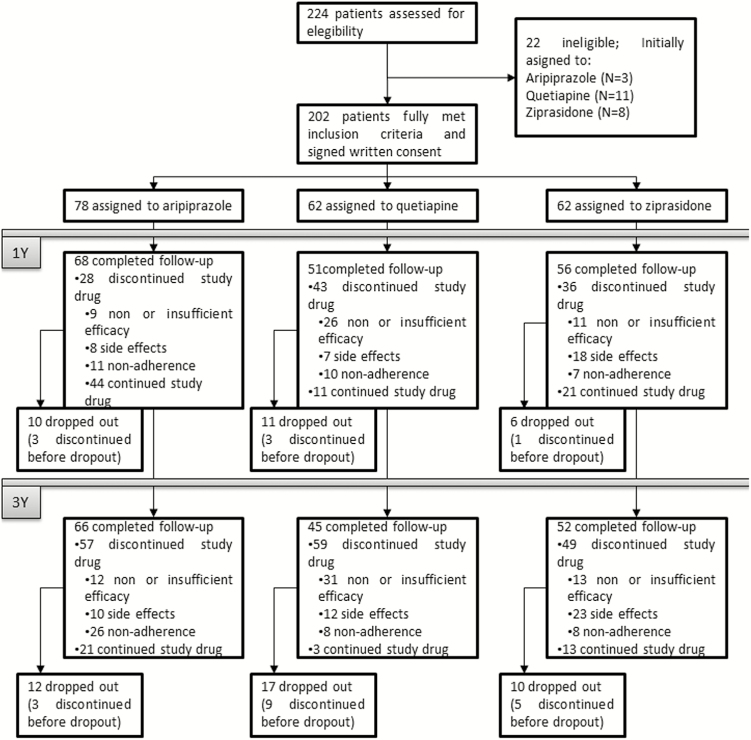
Method: From October 2005 to January 2011, a prospective, randomized, open-label study was undertaken. Two hundred-two first-episode, drug-naïve patients were randomly assigned to aripiprazole (n=78), ziprasidone (n =62), or quetiapine (n=62) and followed-up for 3 years. The primary effectiveness measure was all cause of treatment discontinuation. In addition, an analysis based on the intention-to-treat principle was conducted in the analysis for clinical efficacy.
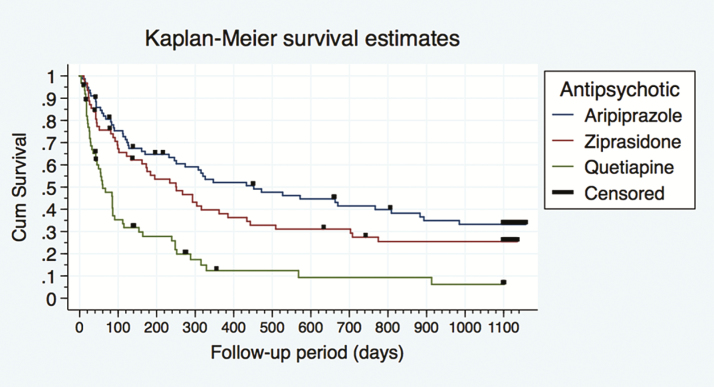
Results: The overall dropout rate at 3 years reached 19.3%. Treatment discontinuation rates were significantly different among treatment groups (aripiprazole=73.08%, ziprasidone=79.03%, and quetiapine=95.16%) (χ2=11.680; P=.001). Statistically significant differences in terms of nonefficacy, nonadherence, and side effects were observed among treatment groups along the 3-year follow-up determining significant differences in time to all-cause discontinuation (log-rank=32.260; P=.001). Significant differences between treatments were found in the categories of sleepiness/sedation (χ2=9.617; P=.008) and increased sleep duration (χ2=6.192; P=.004). No significant differences were found in the profile of extrapyramidal symptoms. Patients on aripiprazole were more likely to be prescribed benzodiazepines.
Conclusions: First-episode psychosis patients on quetiapine were more likely to discontinue treatment due to nonefficacy. Identifying different discontinuation patterns may contribute to optimize treatment selection after first episode of psychosis.
Trial registration: ClinicalTrials.gov NCT02526030.
Figures
References
-
- Addington D, Addington J, Maticka-Tyndale E(1993)Assessing depression in schizophrenia: the Calgary depression scale. Br J Psychiatry 22:39–44. - PubMed
-
- Alvarez-Jimenez M, Priede A, Hetrick SE, Bendall S, Killackey E, Parker AG, McGorry PD, Gleeson JF(2012)Risk factors for relapse following treatment for first episode psychosis: a systematic review and meta-analysis of longitudinal studies. Schizophr Res 139:116–128 - PubMed
-
- Andreasen N.(1984)The Scale for the Assessment of Positive Symptoms (SAPS). Iowa City: University of Iowa.
-
- Andreasen NC.(1989)Scale for the Assessment of Negative Symptoms (SANS). Br J Psychiatry 155:53–58. - PubMed
Publication types
MeSH terms
Substances
Associated data
LinkOut - more resources
Full Text Sources
Other Literature Sources
Medical
