


Safety of on-scene medical care by EMS nurses in non-transported patients: a prospective, observational study
- PMID: 30217231
- PMCID: PMC6137918
- DOI: 10.1186/s13049-018-0540-z
Safety of on-scene medical care by EMS nurses in non-transported patients: a prospective, observational study
Abstract
Background: After on-scene examination and /or treatment, emergency medical services (EMS) nurses must decide whether the patient requires further assessment or treatment, most frequently in a hospital. The primary objective of this study was to assess the reliability of the current EMS protocol by determining whether the decision not to transport the patient to a care provider was correct or not.
Methods: Adults receiving on-scene medical care by an EMS rapid responder or full team without transport to the hospital were included in this prospective observational study. The primary outcome measure was secondary consultation within 24 h after an on-scene EMS evaluation without transport for the same or a closely related complaint. The secondary outcome measures were patient satisfaction, type of secondarily consulted health care provider, provisional and definitive diagnosis, and correctness of the EMS members' decision to provide on-scene medical care without transport.
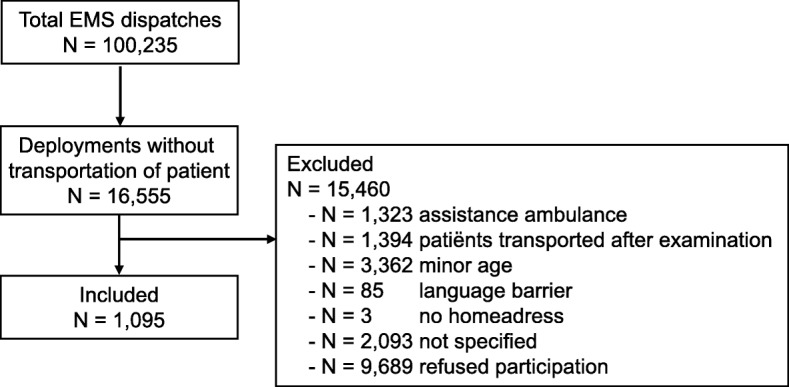
Results: Of the 1095 participating patients, 271 (24.7%) patients requested secondary medical attention for the same complaint. This percentage was significantly larger in incidents attended by an ambulance team than by a rapid responder (N = 248 (26.5%) vs. N = 23 (14.4%); p < 0.05). In eleven (1.0%) cases an urgent medical diagnosis requiring admission was missed. A total of 873 (79.7%) patients were satisfied with the decision not to be transported. In 44 (4.0%) cases the EMS nurse's decision was rated incorrect since the patient needed help contradictory to the EMS nurse's recommendation.
Conclusions: The data show that EMS nurses can effectively examine patients, but a low threshold of referral for consultation should be considered because one in four patients requested secondary medical attention for the same complaint(s) again. However, due to a low response rate (11.3%) more research is needed to further determine the safety of the current EMS protocol.
Trial registration: Not applicable.
Keywords: Ambulance; Care on the scene; EMS; Non-conveyance; Non-transport; On-scene; Paramedics.
Conflict of interest statement
Ethics approval and consent to participate
This study was exempted by the local Medical Research Ethics Committee (Reference No MEC-2014-145). All patients provided written informed consent to participate.
Consent for publication
Not applicable.
Competing interests
The authors declare that there is that they have no competing interests.
Publisher’s Note
Springer Nature remains neutral with regard to jurisdictional claims in published maps and institutional affiliations.
References
-
- Bakker EJ, Verhage V, Tuinstra J, Bouma J. Ambulanceritten zonder vervoer van de patiënt. Tijdschrift voor Gezondheidswetenschappen. 2014;3:119–124.
-
- Frankhuijzen NP. Kwaliteit van zorg bij “Eerste Hulp ter Plaatse ritten”. 2010.
-
- Gooselink B. Wel 112 gebeld, maar niet vervoerd. Een epidemioloisch onderzoek. De Ambulance, vakblad ambulancehulpverlening. 2006:27–32.
-
- Francissen O. Is eerstelijns hulpverlening ook een zorg voor de ambulancedienst? Nijmegen university of applied science. 2012;
Publication types
MeSH terms
LinkOut - more resources
Full Text Sources
Other Literature Sources
Medical
