


Impact of Vasoactive Medications on ICU-Acquired Weakness in Mechanically Ventilated Patients
- PMID: 30217640
- PMCID: PMC6689081
- DOI: 10.1016/j.chest.2018.07.016
Impact of Vasoactive Medications on ICU-Acquired Weakness in Mechanically Ventilated Patients
Abstract
Background: Vasoactive medications are commonly used in the treatment of critically ill patients, but their impact on the development of ICU-acquired weakness is not well described. The objective of this study is to evaluate the relationship between vasoactive medication use and the outcome of ICU-acquired weakness.
Methods: This is a secondary analysis of mechanically ventilated patients (N = 172) enrolled in a randomized clinical trial of early occupational and physical therapy vs conventional therapy, which evaluated the end point of ICU-acquired weakness on hospital discharge. Patients underwent bedside muscle strength testing by a therapist blinded to study allocation to evaluate for ICU-acquired weakness. The effects of vasoactive medication use on the incidence of ICU-acquired weakness in this population were assessed.
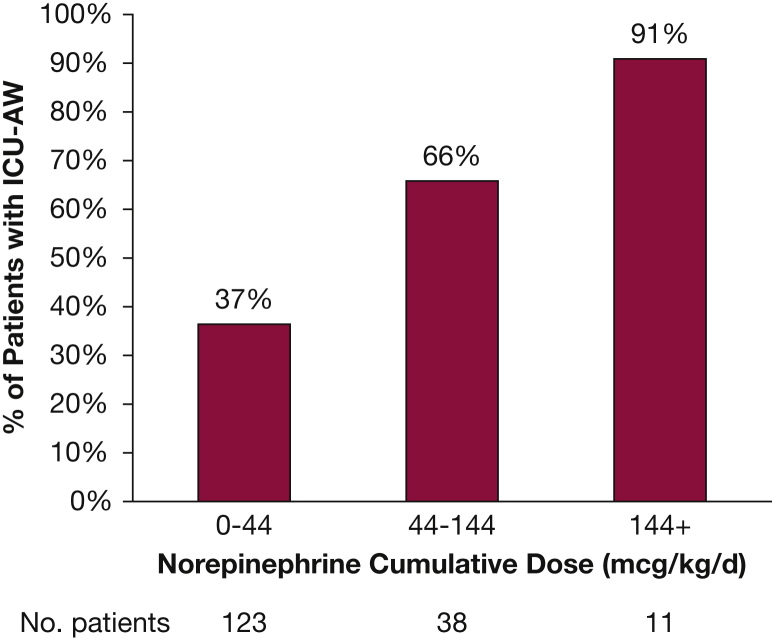
Results: On logistic regression analysis, the use of vasoactive medications increased the odds of developing ICU-acquired weakness (odds ratio [OR], 3.2; P = .01) independent of all other established risk factors for weakness. Duration of vasoactive medication use (in days) (OR, 1.35; P = .004) and cumulative norepinephrine dose (μg/kg/d) (OR, 1.01; P = .02) (but not vasopressin or phenylephrine) were also independently associated with the outcome of ICU-acquired weakness.
Conclusions: In mechanically ventilated patients enrolled in a randomized clinical trial of early mobilization, the use of vasoactive medications was independently associated with the development of ICU-acquired weakness. Prospective trials to further evaluate this relationship are merited.
Trial registry: ClinicalTrials.gov; No.: NCT01777035; URL: www.clinicaltrials.gov.
Keywords: ICUs; critical care outcomes; critical illness; humans; muscle weakness; vasoconstrictor agents.
Copyright © 2018 American College of Chest Physicians. Published by Elsevier Inc. All rights reserved.
Figures
References
-
- De Jonghe B., Sharshar T., Lefaucheur J.P. Paresis acquired in the intensive care unit: a prospective multicenter study. JAMA. 2002;288(22):2859–2867. - PubMed
-
- Fan E., Cheek F., Chlan L. An official American Thoracic Society Clinical Practice guideline: the diagnosis of intensive care unit-acquired weakness in adults. Am J Respir Crit Care Med. 2014;190(12):1437–1446. - PubMed
-
- Hermans G., Van Mechelen H., Clerckx B. Acute outcomes and 1-year mortality of intensive care unit-acquired weakness: a cohort study and propensity-matched analysis. Am J Respir Crit Care Med. 2014;190(4):410–420. - PubMed
-
- Brunello A.G., Haenggi M., Wigger O., Porta F., Takala J., Jakob S.M. Usefulness of a clinical diagnosis of ICU-acquired paresis to predict outcome in patients with SIRS and acute respiratory failure. Intensive Care Med. 2010;36(1):66–74. - PubMed
Publication types
MeSH terms
Substances
Associated data
Grants and funding
LinkOut - more resources
Full Text Sources
Other Literature Sources
Medical
