Comment
doi: 10.1085/jgp.201812172.
Epub 2018 Sep 14.
The exquisitely cooperative nature of Orai1 channel activation
Affiliations
- PMID: 30217863
- PMCID: PMC6168242
- DOI: 10.1085/jgp.201812172
Item in Clipboard
Comment
The exquisitely cooperative nature of Orai1 channel activation
J Gen Physiol.
.
Abstract
Yeung and Prakriya highlight new research showing that STIM1 must bind to all six Orai1 subunits to effectively activate the channel.
Figures
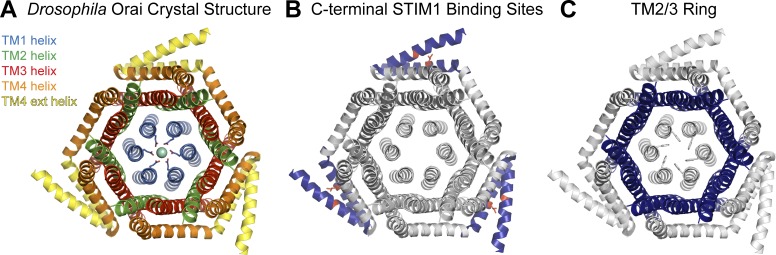
Structural features of the Orai channel. (A) Top down view of the crystal structure of Drosophila Orai (PDB ID: 4HKR), showing a hexameric channel with concentric layers of transmembrane domains (TMs) surrounding the pore-lining TM1 helices (Hou et al., 2012). TMs 1–4 and the C-terminal extensions are shown in blue, green, red, orange, and yellow, respectively. (B) The peripheral STIM1 binding sites formed by pairs of neighboring C-terminal extensions are highlighted in blue, with residue I316 (human Orai1 L273) shown in red sticks. (C) TMs 2 and 3, colored in blue, form an interlocked ring situated in between TM1 and TM4. This cage of helices may play a key role in enforcing cooperativity in transmitting the STIM1 binding signal from the C termini of different Orai1 subunits to the pore. Residue F171 (human Orai1 F99), which forms the dynamically regulated part of the hydrophobic gate in the pore, is depicted in gray sticks.
Comment on
-
Physiological CRAC channel activation and pore properties require STIM1 binding to all six Orai1 subunits.J Gen Physiol. 2018 Oct 1;150(10):1373-1385. doi: 10.1085/jgp.201711985. Epub 2018 Aug 17. J Gen Physiol. 2018. PMID: 30120197 Free PMC article.
References
-
- Frischauf I., Muik M., Derler I., Bergsmann J., Fahrner M., Schindl R., Groschner K., and Romanin C.. 2009. Molecular determinants of the coupling between STIM1 and Orai channels: differential activation of Orai1-3 channels by a STIM1 coiled-coil mutant. J. Biol. Chem. 284:21696–21706. 10.1074/jbc.M109.018408 - DOI - PMC - PubMed
Publication types
MeSH terms
Substances
Associated data
- Actions
Grants and funding
LinkOut - more resources
Full Text Sources
Other Literature Sources