


Do all HEART Scores beat the same: evaluating the interoperator reliability of the HEART Score
- PMID: 30217951
- PMCID: PMC6287564
- DOI: 10.1136/emermed-2018-207540
Do all HEART Scores beat the same: evaluating the interoperator reliability of the HEART Score
Abstract
Background: Patients presenting with chest pain represent a significant proportion of attendances to the ED. The History, ECG, Age, Risk Factors and Troponin (HEART) Score is validated for the risk stratification of suspected ischaemic chest pain within the ED. The goal of this research was to establish the interoperator reliability of the HEART Score as performed in the ED by different grades of doctor and nurse.
Methodology: Patients with suspected ischaemic chest pain presenting to the ED of an inner city, London Hospital, were recruited prospectively between January and May 2016. Patients that had been enrolled in the study were interviewed by clinicians from four different categories: senior doctor, junior doctor, senior nurse and junior nurse. Clinicians, blinded to other raters' results, calculated the HEART Scores for each patient with the assistance of a pocket-sized HEART Score card. The intraclass correlation coefficient (ICC) was calculated as the primary measure of reliability. 120 patients were required to achieve a desired power of 80%.
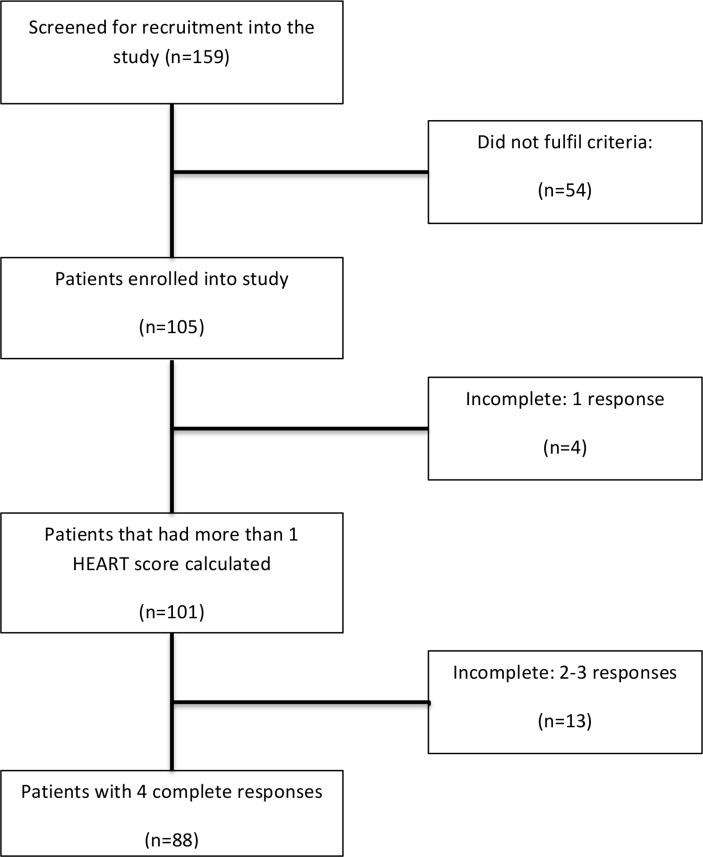
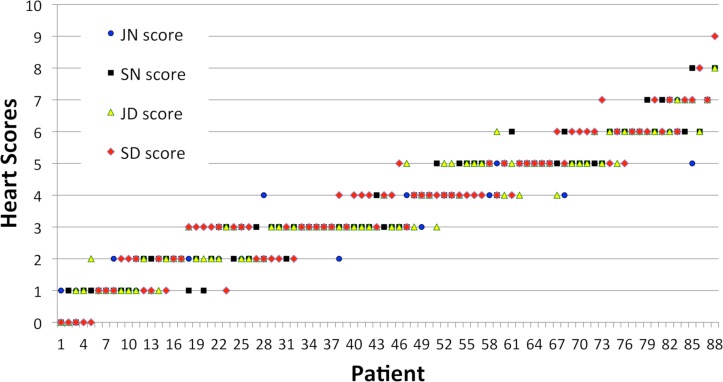
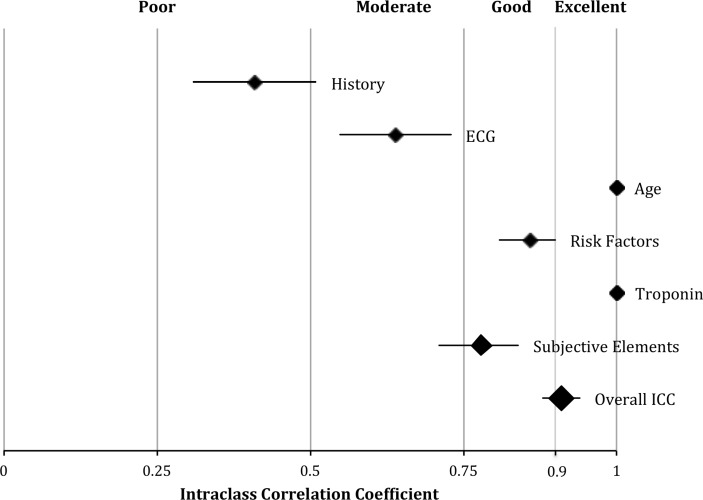
Results: 88 complete comparisons were obtained. There were no significant differences between the distributions of HEART Scores for each clinician group (p=0.95). The ICC for the overall HEART Score was 0.91 (95% CI 0.87 to 0.93). The ICC for troponin and age were '1', for 'history' 0.41 (95% CI 0.30 to 0.52), 'ECG' 0.64 (95% CI 0.54 to0.73) and 'risk factors' 0.84 (95% CI 0.79 to 0.89).
Conclusion: This study demonstrates very strong overall interoperator reliability between the four groups of clinicians studied. This suggests that the HEART Score is reproducible when used by different professional groups and grade of clinician.
Keywords: cardiac care, diagnosis; chest - non trauma; emergency care systems, emergency departments; management, risk management; nursing, emergency departments.
© Author(s) (or their employer(s)) 2018. Re-use permitted under CC BY-NC. No commercial re-use. See rights and permissions. Published by BMJ.
Conflict of interest statement
Competing interests: Dr Niven reports grants from Royal College of Emergency Medicine, during the conduct of the study; and I have collaborated with Dr Barbra Backus, one of the original developers of the HEART Score, in creating a teaching video for the HEART Score.
Figures
References
MeSH terms
Substances
LinkOut - more resources
Full Text Sources
Other Literature Sources
